Products


rConfig launches Version 8 of its network configuration platform
Irish software developer rConfig has announced the release of Version 8 of its network configuration and compliance management platform. The update introduces a new distributed architecture, enhanced security features, and broader vendor support. It has been designed to support large-scale environments, with capacity for more than 20,000 devices and faster search and compliance processes. Key Features in Version 8 • Vector architecture — Distributed collection and multi-tenant scalability for managed service providers and large enterprises • Security and compliance — Expanded policy frameworks, encrypted configuration storage, and reporting designed to meet regulatory requirements • Performance — Proven capability to manage 20,000+ devices with faster compliance execution • Vendor support — Broad compatibility without restrictions Positioning in the Market The company says the platform combines its open-source heritage with enterprise-level capability. Its distributed design, focus on compliance automation, and multi-vendor support aim to make it suitable for sectors including telecommunications, manufacturing, energy, and government. rConfig is also developing AI-driven features, including automated compliance baselines, anomaly detection, and predictive analytics to support proactive network management. Industry Collaboration The company will be a Platinum Partner at Zabbix Summit 2025 in Riga this October, where it will demonstrate how Version 8 integrates with Zabbix for real-time configuration monitoring and compliance. “With V8, we’ve set a new standard for the industry,” claims Stephen Stack, CTO of rConfig. “Our customers demanded speed, compliance, and distributed scale – we delivered. And with AI-driven innovation and our deepening partnership with Zabbix, we’re excited to lead the next chapter of network automation.”

GoodWe introduces liquid-cooled energy storage system
GoodWe, an inverter manufacturer and smart energy system provider, has launched the ESA Series, an all-in-one, liquid-cooled energy storage system designed for commercial and industrial (C&I) applications. The unit provides 125kW nominal output power and 261kWh storage capacity, as well as integrating the power conversion system, battery cells, energy management system, and battery management system into a single cabinet. The system can be scaled by connecting up to 15 units in parallel, supporting a maximum total capacity of 3.91MWh in grid-connected scenarios. GoodWe says the design allows for simplified installation, operation, and maintenance whilst offering flexible expansion. Performance and safety features The ESA cabinet has a footprint of 1.47m² and an energy density of 177.6kWh per square metre, aimed at sites with limited space. It incorporates 314Ah lithium iron phosphate (LFP) cells and liquid cooling technology to regulate temperatures across the system. The storage supports 6,000 cycles and operates in temperatures from -25°C to 55°C. The ESA 125kW/261kWh was tested under UL 9540A methodology and includes multiple safety measures, such as smoke detection, thermal sensors, combustible gas monitoring, and humidity control with automatic dehumidification. Fire protection uses both active and passive approaches, including integrated aerosol suppression modules. TÜV Rheinland has certified the system for environmental adaptability across climatic, mechanical, chemical, electromagnetic, and specialised scenarios. Deployment examples GoodWe reports that early projects in China have demonstrated reductions in energy costs and improved operational efficiency. At its Guangde manufacturing site, nine ESA cabinets were installed in parallel to provide large-scale storage. Another installation in De’an combined seven cabinets with wind and solar power to support an energy storage project for heavy-duty truck charging. The system supports operating modes including peak shaving, demand management, energy trading participation, and off-grid backup power. In on-grid deployments, ESA units can be combined with GoodWe GT Series inverters and managed by the SEC3000C Smart Energy Controller to support up to 40 string inverters.

Danfoss expands UQDB coupling range
Danfoss Power Solutions, a Danish manufacturer of mobile hydraulic systems and components, has completed its Universal Quick Disconnect Blind-Mate (UQDB) coupling portfolio with the launch of the -08 size Hansen connector. The couplings are designed for direct connection between servers and manifolds in data centre liquid cooling systems and are fully compliant with Open Compute Project (OCP) standards. Higher flow capacity The new -08 size joins the existing -02, -04, and -06 sizes, covering body sizes from 1/8-inch to 1/2-inch. The company says it delivers a 29% higher flow rate than OCP requirements, supporting greater cooling efficiency for high-density racks. Danfoss UQDB couplings feature a flat-face dry break design to prevent spillage and a push-to-connect system with self-alignment to simplify installation in tight spaces. The plug half can move radially to align with the socket half, allowing compensation of up to +/-1 millimetre for easier in-rack connections. Developed in collaboration with the OCP community, the couplings meet existing standards and are designed to comply with the forthcoming OCP V2 specification for liquid cooling, expected in October. All UQDB units undergo helium-leak testing for reliability and include QR codes on both plug and socket halves for easier identification and tracking. https://www.youtube.com/watch?v=yjt9_O0Wb1o Chinmay Kulkarni, Data Centre Product Manager at Danfoss Power Solutions, says, “Our now-complete UQDB range expands our robust portfolio of thermal management products for data centres, enabling us to provide comprehensive systems and delivering on our 'one partner, every solution' promise. "When paired with our flexible, kink-free hoses, we deliver a complete direct-to-chip cooling solution that sets the standard for efficiency and reliability.” The couplings are manufactured from 303 stainless steel for corrosion resistance, with EPDM seals for fluid compatibility. They feature ORB terminal ends for secure, leak-free connections, an operating temperature range of 10°C to 65°C, and a minimum working pressure of 10 bar. For more from Danfoss, click here.

Trane adds CRAH units to DC cooling portfolio
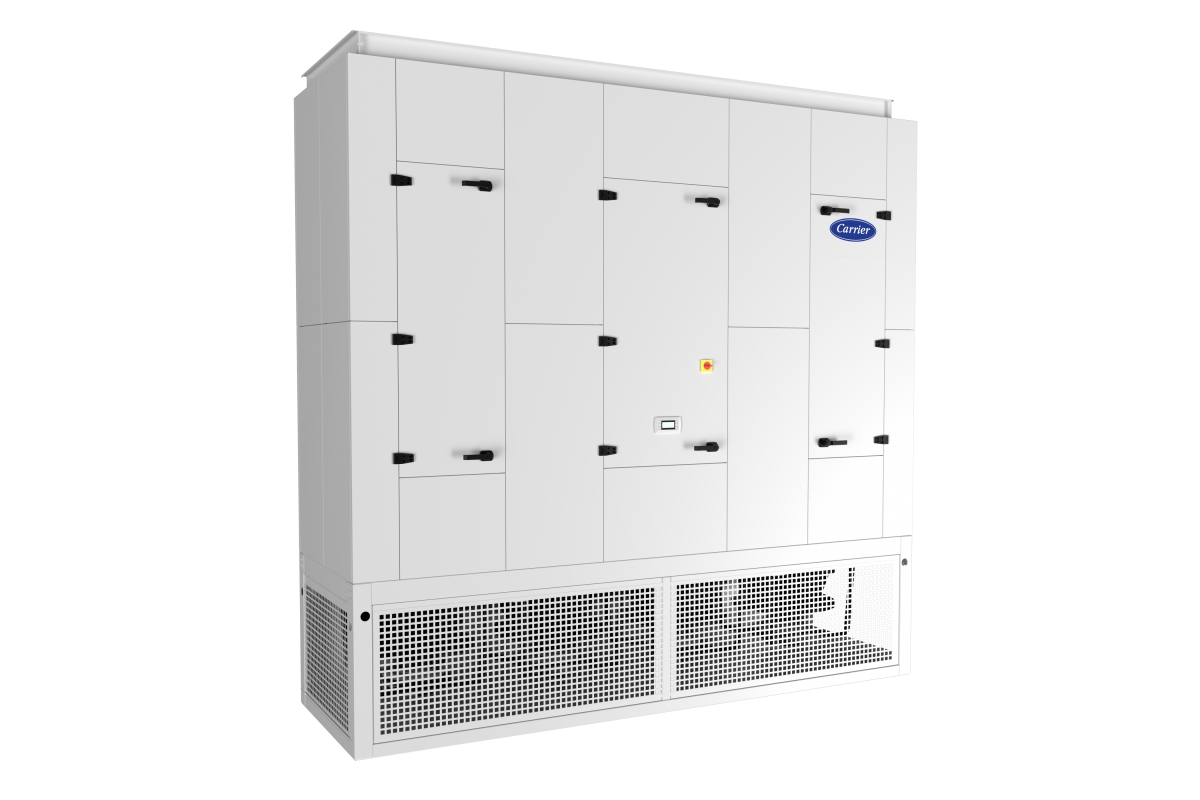
Trane, an American manufacturer of heating, ventilation, and air conditioning (HVAC) systems, has expanded its data centre thermal management range with the addition of a Computer Room Air Handler (CRAH) system. The unit is designed to maintain airflow and temperature conditions for servers and other electronic equipment, aiming to support operational uptime while reducing energy use. The CRAH system is equipped with Trane’s Symbio controller, which provides a broad capacity range and customisable configurations. The controller enables leader designation and dynamic reassignment for up to 32 units, allowing continuous operation and access to digital tools for lifecycle management. According to Trane, the new airside system is intended for both colocation and hyperscale data centre operators seeking flexible integration into existing or new-build facilities. Steve Obstein, Vice President and General Manager, Data Centres, Trane Technologies, says, “Expansion of our airside offer gives our colo and hyperscale customers greater flexibility for configuring custom systems and addresses the growing trend toward a single-source solutions provider.” Integration and lifecycle support The CRAH addition is part of Trane’s wider approach to unifying and integrating thermal management systems through smart controls. The company offers local service teams across North America and remote monitoring capabilities for predictive maintenance and operational oversight. Recent updates to Trane’s thermal management portfolio include: • Scalable liquid cooling platforms• A fan coil wall platform• Larger capacity and higher ambient temperature air-cooled chillers The CRAH system has been developed to operate alongside these technologies as part of a consolidated data centre cooling strategy, with the aim of improving efficiency, reliability, and sustainability. For more from Trane, click here.

Cloudera is bringing Private AI to data centres
Cloudera, a hybrid platform for data, analytics, and AI, today announced the latest release of Cloudera Data Services, bringing Private AI on premises and aiming to give enterprises secure, GPU-accelerated generative AI capabilities behind their firewall. With built-in governance and hybrid portability, Cloudera says organisations can now build and scale their own sovereign data cloud in their own data centre, "eliminating security concerns." The company claims it is the only vendor that delivers the full data lifecycle with the same cloud-native services on premises and in the public cloud. Concerns about keeping sensitive data and intellectual property secure is a key factor in what holds back AI adoption for enterprises across industries. According to Accenture, 77% of organisations lack the foundational data and AI security practices needed to safeguard critical models, data pipelines, and cloud infrastructure. Cloudera argues that it directly addresses the biggest security and intellectual property risks of enterprise AI, allowing customers to "accelerate their journey from prototype to production from months to weeks." Through this release, the company claims users could reduce infrastructure costs and streamline data lifecycles, boosting data team productivity, as well as accelerating workload deployment, enhancing security by automating complex tasks, and achieving faster time-to-value for AI deployment. As part of this release, both Cloudera AI Inference Service and AI Studios are now available in data centres. Both of these tools are designed to tackle the barriers to enterprise AI adoption and have previously been available in cloud only. Details of the products • Cloudera AI Inference services, accelerated by NVIDIA: The company says this is one of the industry’s first AI inference services to provide embedded NVIDIA NIM microservice capabilities and it is streamlining the deployment and management of large-scale AI models to data centres. It continues to suggest the engine helps deploy and manage the AI production lifecycle, right in the data centre, where data already securely resides. • Cloudera AI Studios: The company claims this offering democratises the entire AI application lifecycle, offering "low-code templates that empower teams to build and deploy GenAI applications and agents." Data and comments According to an independent Total Economic Impact (TEI) study - conducted by Forrester Consulting and commissioned by Cloudera - a composite organisation representative of interviewed customers who adopted Cloudera Data Services on premises saw: • An 80% faster time-to-value for workload deployment• A 20% increase in productivity for data practitioners and platform teams• Overall savings of 35% from the modern cloud-native architecture The study also highlighted operational efficiency gains, with some organisations improving hardware utilisation from 30% to 70% and reporting they needed between 25% to 50% less capacity after modernising. “Historically, enterprises have been forced to cobble together complex, fragile DIY solutions to run their AI on premises,” comments Sanjeev Mohan, an industry analyst. “Today, the urgency to adopt AI is undeniable, but so are the concerns around data security. What enterprises need are solutions that streamline AI adoption, boost productivity, and do so without compromising on security.” Leo Brunnick, Cloudera’s Chief Product Officer, claims, “Cloudera Data Services On-Premises delivers a true cloud-native experience, providing agility and efficiency without sacrificing security or control. “This release is a significant step forward in data modernisation, moving from monolithic clusters to a suite of agile, containerised applications.” Toto Prasetio, Chief Information Officer of BNI, states, "BNI is proud to be an early adopter of Cloudera’s AI Inference service. "This technology provides the essential infrastructure to securely and efficiently expand our generative AI initiatives, all while adhering to Indonesia's dynamic regulatory environment. "It marks a significant advancement in our mission to offer smarter, quicker, and more dependable digital banking solutions to the people of Indonesia." This product is being demonstrated at Cloudera’s annual series of data and AI conferences, EVOLVE25, starting this week in Singapore.

Comnet releases 720W industrial PoE switch
Comnet, a manufacturer of mission-critical industrial networking systems, has just announced the release of an "ultra-resilient," high-power PoE switch. As the first in Comnet’s new line of IEEE802.3bt-compliant ethernet switches, the CNGE10FX2TX8MSBT switch has been designed to power next-generation devices in extreme environments. With 8 RJ45 ports delivering 90W simultaneously and a total PoE budget of 720W, plus 2 SFP ports supporting up to 2.5 Gbps, the new system has been engineered for high-capacity, high-performance applications like advanced IP cameras, edge sensors, digital signage, and intelligence-driven systems. The switch’s power architecture allows users to install a smaller power supply today and scale up later, aiming to eliminate the need for costly hardware replacements as demands grow. Built for resilience and bandwidth intensive applications, the switch maintains full power output across a -40°C to +70°C temperature range, while ruggedised housing and redundant power inputs intend to ensure maximum uptime. It is designed for mission-critical sectors, including transportation, security, energy, and manufacturing, and features Comnet’s Port Guardian technology, which automatically locks down ports in case of tampering to guard against unauthorised access. “We are proud to introduce our latest product innovation, designed and built in the United States, for harsh environments with high bandwidth and high-power requirements,” says Sergio Resendiz, President, Comnet. “We built this new switch to deliver full 90W power on every port, even in harsh conditions. "Whether you need that level of power today or are planning for tomorrow, the new switch provides the flexibility to scale without compromising reliability or security. It’s built to keep your network connected, no matter the circumstances.” Designed, manufactured, and supported in the United States, the switch meets BABA, NDAA, and TAA compliance standards.

Microchip launches Adaptec SmartRAID 4300 accelerators
Semiconductor manufacturer Microchip Technology has introduced the Adaptec SmartRAID 4300 series, a new family of NVMe RAID storage accelerators designed for use in server OEM platforms, storage systems, data centres, and enterprise environments. The series aims to support scalable, software-defined storage (SDS) solutions, particularly for high-performance workloads in AI-focused data centres. The SmartRAID 4300 series uses a disaggregated architecture, separating software and hardware elements to improve efficiency. The accelerators integrate with Microchip’s PCIe-based storage controllers to offload key RAID processes from the host CPU, while the main storage software stack runs directly on the host system. This approach allows data to flow at native PCIe speeds, while offloading parity-based functions such as XOR to dedicated accelerator hardware. According to internal testing by Microchip, the new architecture has delivered input/output (I/O) performance gains of up to seven times compared with the company’s previous generation products. Architecture and capabilities The SmartRAID 4300 accelerators are designed to work with Gen 4 and Gen 5 PCIe host CPUs and can support up to 32 CPU-attached x4 NVMe devices and 64 logical drives or RAID arrays. This is intended to help address data bottlenecks common in conventional in-line storage solutions by taking advantage of expanded host PCIe infrastructure. By removing the reliance on a single PCIe slot for all data traffic, Microchip aims to deliver greater performance and system scalability. Storage operations such as writes now occur directly between the host CPU and the NVMe endpoints, while the accelerator handles redundancy tasks. Brian McCarson, Corporate Vice President of Microchip’s Data Centre Solutions Business Unit, says, “Our innovative solution with separate software and hardware addresses the limitations of traditional architectures that rely on a PCIe host interface slot for all data flows. "The SmartRAID 4300 series allows us to enhance performance, efficiency, and adaptability to better support modern enterprise infrastructure systems.” Power efficiency and security Power optimisation features include automatic idling of processor cores and autonomous power reduction mechanisms. To help maintain data integrity and system security, the SmartRAID 4300 series incorporates features such as secure boot and update, hardware root of trust, attestation, and Self-Encrypting Drive (SED) support. Management tools and compatibility The series is supported by Microchip’s Adaptec maxView management software, which includes an HTML5-based web interface, the ARCCONF command line tool, and plug-ins for both local and remote management. The tools are accessible through standard desktop and mobile browsers and are designed to remain compatible with existing Adaptec SmartRAID utilities. For out-of-band management via Baseboard Management Controllers (BMCs), the series supports Distributed Management Task Force (DMTF) standards, including Platform-Level Data Model (PLDM) and Redfish Device Enablement (RDE), using MCTP protocol. For more from Microchip, click here.

Riverbed launches new network observability tools
Riverbed, a US-based provider of network performance monitoring, application management, and WAN optimisation software and hardware, has launched a new range of AI-powered network observability tools, aimed at helping enterprise IT teams manage increasingly complex environments. The latest updates include new hardware, enhanced software, and a more flexible licensing model, designed to support high-performance, AI-ready infrastructure. The new release features the Riverbed xx90 appliance family, reportedly delivering up to three times the performance of previous systems for AppResponse, NetProfiler, and Flow Gateway. The appliances are built for high-throughput packet and flow capture across distributed networks, supporting monitoring at over 50Gbps and offering scalable storage beyond 2.4PB. AppResponse 11.21 now enables real-time analysis of encrypted IPSec ESP tunnel traffic and cipher hygiene, while the new version of NetProfiler (10.29), according to the company, brings faster reporting, dynamic flow balancing, and support for Versa SD-WAN. The release also introduces the Riverbed Intelligent Network Observability Essentials bundle, combining key tools for hybrid environments: • Riverbed IQ – AI-powered diagnostics for issue detection and resolution • Workspaces – Role-based dashboards integrating packet, flow, and endpoint data • Grafana plug-in – Allows Riverbed data to be displayed in existing Grafana dashboards • Topology Viewer – Map-based visualisation of networks, applications, and user experience These features are available through the company's Riverbed Flex Subscription. The model, they claim, is intended to improve licensing flexibility, reduce total cost of ownership, and simplify long-term planning. “With today’s launch, we’re introducing next-generation observability systems that align with what our customers need: streamlined toolsets, automation, and cost-efficient performance,” says Dave Donatelli, CEO of Riverbed. “We’re delivering these capabilities with faster appliances, smarter software, and greater flexibility.” Riverbed reports 92% year-on-year growth in observability bookings for the first half of 2025. “As organisations prepare their infrastructure for AI and data-heavy applications, they need monitoring systems that are intelligent and built to scale,” adds Shamus McGillicuddy, Research Vice President at EMA.

Scolmore introduces IEC Lock C21 Locking Connector
Scolmore, a UK-based manufacturer of electrical wiring accessories, circuit protection products, and lighting equipment, has expanded its IEC Lock range with the addition of a new C21 locking connector, compatible with both C20 and C22 inlets.Featuring a side button release, the IEC Lock C21’s design aims to offer extra protection against accidental disconnection, making it an appropriate choice for applications where reliability is essential.Designed to handle the heat, the company says the C21 is a durable, lockable connector built to protect appliances that are sensitive to vibration against power loss. The product is particularly suited to data centres, servers, and other industrial equipment where maintaining the proper device temperature is critical to operational success.

Chatsworth launches new eConnect PDUs
Chatsworth Products (CPI), a US-based manufacturer of IT infrastructure equipment, has launched a new addition to its eConnect Power Distribution Unit (PDU) portfolio, introducing a QuadLock outlet design that the company says provides improved outlet compatibility and power reliability for high-density, high-performance data centres. The new eConnect PDUs with QuadLock outlets aim to support a range of infrastructure requirements, including AI- and GPU-based computing environments, as well as liquid-cooled systems. The units are designed to enhance adaptability, reduce operational risk, and streamline deployment by integrating four outlet types - C13, C15, C19, and C21 - within a single chassis. CPI’s new offering supports all four outlet types with built-in locking mechanisms, without the need for proprietary power cords. “With data centres facing rapid technological advancements, including the proliferation of GPU and AI workloads, infrastructure flexibility and power reliability are more critical than ever,” argues Ashish Moondra, Senior Director of Electronics and Software at CPI. “eConnect PDUs with QuadLock Outlets empower our customers to quickly adapt to changing equipment requirements without sacrificing performance or uptime.” Key features of the eConnect PDU with QuadLock Outlets include: • Four-outlet compatibility — One unit supports C13, C15, C19, and C21 outlet types, increasing equipment compatibility and reducing the need for multiple PDU models. • Secure locking mechanism — Each outlet includes integrated locking to prevent accidental disconnections, including in high-vibration or high-traffic environments. • High-power support — Systems can deliver up to 57.5kW per cabinet with 100A input capacity, supporting intensive workloads. • Colour-coded outlets — Aids in load balancing and troubleshooting by making outlet identification easier. • Flexible integration — Compatible with all six CPI eConnect PDU models - Basic, Metered, Monitored, Monitored Pro, Switched, and Switched Pro - and can be pre-installed into CPI cabinets for quicker deployment. The modular design is intended to reduce PDU redundancy, simplify inventory management, and support a scalable approach to data centre infrastructure. CPI also highlights the product’s contribution to sustainability goals by reducing waste through long-term compatibility and reusability. The new PDUs will be available from 7 July 2025 through CPI’s global network of distribution partners.


Translate »