News


LINX achieves 25 x 400GE port count milestone
The London Internet Exchange (LINX), an internet exchange point (IXP) operator, has successfully deployed their 25th 400GE port across their global network, a major milestone within the wider industry's growth. The first 400GE port was provisioned in 2021, with demand for ultra-high bandwidth connectivity surging since then, driven by the exponential growth in cloud services, video streaming, gaming, and AI workloads. A single 400GE connection delivers four times the capacity of a standard 1000GE port, enabling networks to consolidate traffic, reduce operational complexity, and build in resilience, future-proofing their infrastructure. Investing in the future LINX has invested heavily in Nokia’s next-generation hardware and optical technologies to enable 400GE delivery across its interconnection ecosystems in London and Manchester. This investment aims to ensure members can scale quickly and efficiently while maintaining the resilience and reliability that underpin the global internet. Jennifer Holmes, CEO of LINX, comments, “Reaching 25 active 400GE ports is a testament to the evolving needs of our members and the strength of our technical infrastructure. "We’ve seen a clear shift towards high-capacity services, with our larger delivery networks upgrading first to 400GE. "In the last 12 months UK ISPs are now seeing the demand for the service and are upgrading in London and Manchester, a positive sign of effective network traffic management or regional peering. "This evolution demonstrates how network operators of all sizes are adapting to keep pace with the demands of modern digital services.” As digital transformation accelerates globally, LINX says it continues to extend its reach beyond the UK, also supporting interconnection platforms in the US and Africa. For more from LINX, click here.

365 Data Centers appoints new CEO and President
365 Data Centers (365), a provider of network-centric colocation, network, cloud, and other managed services, has announced the appointment of Derek Gillespie as Chief Executive Officer (CEO) and Steve Amelio as President. This leadership transition follows the planned retirement of co-founder and CEO Bob DeSantis, who will continue to serve as a Board Member and strategic advisor to the company. Who's who Derek Gillespie brings over two decades of experience across the data centre and telecommunications industries. The company says that since joining 365 as CRO in 2024, Derek has played a role in expanding the company’s market reach, strengthening customer relationships, and executing strategic acquisitions. He will continue to act as CRO in addition to taking on the new role of CEO. Steve Amelio, who has been with 365 since 2019, has reportedly helped build the company’s operational and financial foundation. As well as becoming President, he will continue to serve as CFO, overseeing finance and administration while leading day-to-day operations to ensure continued customer satisfaction and scalable growth. Bob DeSantis, co-founder and Board Member of 365 Data Centers, comments, “Derek and Steve have been central to 365’s success and are ideally suited to lead the company into its next phase of growth. “Their leadership, deep industry expertise, and shared vision will ensure continuity while propelling the company forward as a trusted infrastructure-as-a-service and managed services provider.” During Bob’s tenure, 365 has transformed from a collection of eight standalone data centres into a US-wide, interconnected platform with 20 facilities, 80MW of capacity, 1,200 customers, and a network spanning key edge markets. “We are honoured to carry forward the incredible momentum that Bob and the team have built,” says Derek Gillespie, CEO at 365 Data Centers. “Our focus remains on delivering reliable, high-performance infrastructure solutions that empower our customers to grow and innovate.” “This is an exciting time for 365,” adds Steve Amelio, President of 365 Data Centers. “We look forward to building upon our strong operational backbone and customer-first culture as we continue to scale and strengthen our network-centric platform.” For more from 365 Data Centers, click here.

Object First launches 'ransomware-proof' storage
Object First, a US provider of storage appliances, has introduced Ootbi Mini, a compact immutable storage appliance designed for remote and branch offices, edge environments, and small businesses using Veeam for backup. The device is intended to protect local backup data against ransomware attacks without requiring a traditional data centre setup. Available in 8, 16, and 24 terabyte capacities, Ootbi Mini brings the company’s existing enterprise-level security to a smaller form factor. Built on 'zero trust' principles, it provides what the company describes as “absolute immutability”, meaning that no one - including administrators - can alter its firmware, operating system, storage layer, or backup data. The device offers the same data protection, user interface, and Veeam integration as Object First’s existing Ootbi systems, with minimal setup required. Ootbi Mini will be available for purchase or through a subscription model, with deliveries due to begin in January 2026. New additional features Alongside Ootbi Mini, Object First has announced several additional updates: The first, Ootbi Honeypot, introduces early warning protection against cyberthreats targeting Veeam Backup and Replication (VBR). The feature, available in version 1.7 at no additional cost to current customers, deploys a decoy VBR environment to detect suspicious activity. If a threat is detected, Honeypot immediately sends an alert via the customer’s chosen communication channel. The company has also launched a beta programme for Ootbi Fleet Manager, a cloud-based platform that allows customers to monitor and manage their entire Ootbi fleet from a single dashboard. The system provides granular monitoring, reporting, and hardware health insights, enabling customers to maintain visibility across distributed environments. Phil Goodwin, Research Vice President at IDC, comments, “Organisations running Veeam can benefit from storage technologies that combine immutability, simplicity, and resilience. "With Ootbi Mini, Honeypot, and Fleet Manager, Object First is expanding its ransomware-proof portfolio to meet the needs of businesses of all sizes.” David Bennett, CEO at Object First, adds, “Our mission is to make ransomware-proof backups simple, powerful, and accessible for every Veeam user. With Ootbi Mini, any organisation can achieve enterprise-grade immutability within a small footprint. "Honeypot strengthens cyber resilience by providing early threat detection, while Fleet Manager simplifies how customers monitor their deployments. Together, these innovations reinforce our commitment to secure, straightforward, and reliable backup for Veeam users.” For more from Object First, click here.

Duos Edge AI expands edge DC network in Texas
Duos Technologies Group, through its subsidiary Duos Edge AI, a provider of edge data centre (EDC) systems, has deployed a new EDC in Waco, Texas, at the Education Service Centre (ESC) Region 12. The facility marks the company’s sixth site in the state and aims to strengthen digital infrastructure to support local education and community development. The project aims to expand access to reliable, low-latency computing for schools and community partners, providing the resources needed to deliver modern digital learning tools and services. Supporting distributed computing and digital learning The partnership with Region 12 highlights the increasing demand for distributed computing infrastructure to enable K–12 education, workforce development, and regional digital transformation across Texas. The new edge data centre seeks to enhance bandwidth, secure data processing, and local AI capabilities, improving connectivity and efficiency throughout the region. Doug Recker, President of Duos and Duos Edge AI, comments, “This deployment is a significant advancement in our statewide initiative to bring modern computing capabilities closer to where data is created and used. "Our collaboration with Region 12 strengthens the foundation for next-generation learning tools, administrative efficiency, and community connectivity - all powered locally at the edge.” Kenny Berry, Executive Director of ESC Region 12, adds, “Access to real-time, reliable data processing directly supports our educators and students. "This edge data centre brings long-term value to our schools by enabling advanced learning technologies, improving efficiency, and reducing latency across our network.” The deployment forms part of Duos Edge AI’s 2025 strategy to establish 15 operational edge data centres. Each facility features a modular design for rapid deployment, offering scalable compute power and high-speed connectivity in as little as 90 days. These sites, the company says, are helping meet the evolving digital needs of the education, healthcare, and government sectors. For more from Duos Edge AI, click here.

Saudi Arabia’s first integrated data science and AI diploma
DataVolt, a Saudi Arabian developer and operator of sustainable data centres, has partnered with the Energy & Water Academy (EWA) and Innovatics to launch the Kingdom of Saudi Arabia’s first fully industry-integrated Diploma in Data Science and Artificial Intelligence (AI). The new programme is designed to blend academic learning with practical, real-world experience, helping to prepare Saudi talent for the digital economy. Announced at the LEARN event in Riyadh, the Diploma is approved by the Technical and Vocational Training Corporation (TVTC) and College of Excellence (CoE), and endorsed by the Ministry of Communications and Information Technology (MCIT). It is also supported by the Human Resources Development Fund (HRDF). Unlike traditional academic pathways, the programme combines classroom study with applied projects. Students will work with sponsoring companies, including DataVolt, on live industry challenges, developing proof-of-concept AI applications and gaining hands-on experience that directly aligns with workforce needs. As part of its commitment, DataVolt will sponsor five students from the first cohort and guarantee them employment after graduation. They will join the company’s operations supporting high-power-density workloads at its data centres, including its planned AI campus in Oxagon, NEOM. DataVolt is inviting other organisations to co-sponsor the inaugural class of 100 students, with a target of 50% female participation. The first intake is scheduled to begin in November 2025. Industry-led learning for the digital future Rajit Nanda, CEO at DataVolt, says, “DataVolt is not only building the Kingdom’s next-generation data centres, but also the local Saudi talent to power them, ensuring the country is prepared to lead the global AI economy in the long term. "Our investment in this first-of-its-kind Diploma demonstrates our commitment to Vision 2030 and we encourage our partners across the industry to join us in sponsoring the programme and future-proofing the local workforce.” With AI expected to contribute around US$320 billion (£239.1 billion) to the Middle East economy by 2030, and Saudi Arabia set to see the greatest share of that value, the initiative supports the country’s Vision 2030 and the National Strategy for Data and AI (NSDAI). The programme aims to help bridge the national skills gap and contribute to the target of training 20,000 AI professionals over the next five years. Salwa Smaoui, CEO of Innovatics, comments, “This Diploma is not just education; it is a strategic workforce initiative. Our mission is to ensure every graduate is ready to contribute from day one to the Kingdom’s most ambitious AI projects.” Tariq Alshamrani, CEO of EWA, adds, “EWA is proud to partner with DataVolt and Innovatics to deliver this programme. Together, we are developing the next generation of data scientists and AI professionals who will power the Kingdom’s digital future.” DataVolt continues to expand its data centre footprint across Saudi Arabia. Earlier this year, the company signed an agreement with NEOM to design and develop the region’s first sustainable, net-zero AI campus in Oxagon. The first phase of the 1.5 GW development, backed by an initial investment of US$5 billion (£3.7 billion), is expected to begin operations in 2028. For more from DataVolt, click here.

Honeywell, LS Electric deal to boost data centre power
Honeywell, a US multinational specialising in building automation, has announced a global partnership with LS Electric, a South Korean manufacturer of electrical equipment and automation systems, to develop and market integrated hardware and software systems for power management and distribution in data centres and commercial buildings. The collaboration aims to simplify the integration of electrical and automation systems, improving operational efficiency, resilience, and energy management for operators of data-intensive and energy-critical facilities. Integrated approach to power and automation The partnership combines LS Electric’s experience in power infrastructure with Honeywell’s expertise in building automation and control systems. Together, the companies plan to offer systems that unify power distribution and building management, ensuring load and capacity are balanced to maintain resilience and uptime. The first joint products will include integrated switchgear and power management systems that help data centre operators control and distribute power more effectively. Future development will focus on new electrical monitoring systems using the Honeywell Forge platform, enhanced with AI and analytics, and LS Electric’s software capabilities. These systems will be designed to regulate energy distribution, improve efficiency, and provide predictive maintenance to reduce downtime and power quality issues. Energy storage and grid resilience Honeywell and LS Electric also plan to develop a grid- and building-aware battery energy storage system (BESS) for commercial and industrial buildings. The modular BESS will integrate LS Electric’s energy storage technology with Honeywell’s dynamic energy control software, allowing users to forecast and optimise energy sourcing and costs based on grid data, weather conditions, and other variables. The companies said the technology will help manage growing energy demand from sectors such as data centres, which currently account for between 1-2% of global electricity consumption. Billal Hammoud, President and CEO of Honeywell Building Automation, comments, “Our collaboration with LS Electric supports our continued focus on delivering smarter, scalable solutions for the world’s most critical industries. "As the global demand for data and energy accelerates, this partnership combines our complementary strengths to deliver intelligent infrastructure that’s both resilient and efficient.” JongWoo Kim, President of LS Electric Power Electric, adds, “Building on our expertise in power infrastructure and energy storage systems, we are expanding globally into the data centre and industrial building markets. "Through our collaboration with Honeywell, we will provide solutions that help large-scale operators achieve both energy efficiency and reliability.” For more from Honeywell, click here.

CleanArc adds 300 MW to planned Virginia campus
CleanArc Data Centers, a US developer of renewable-energy-powered hyperscale data centre campuses, has acquired an additional 35.4 hectares of land to expand its flagship hyperscale data centre campus in Virginia. The expansion increases the site’s planned capacity from 600 MW to nearly 1 GW, supporting growing demand for scalable and energy-efficient digital infrastructure. The new development will deliver an extra 300 MW of critical power capacity, enhancing redundancy and long-term resilience for hyperscale clients. Expansion timeline and capacity growth The first 300 MW phase of the Virginia campus is scheduled to come online in the first quarter of 2027, followed by a second phase in 2030. The latest land acquisition enables a third 300 MW phase, currently planned for between 2033 and 2035. James Trout, founder and CEO of CleanArc Data Centers, comments, “Securing this additional land and substantially increasing our planned capacity positions CleanArc to meet the needs of the most demanding hyperscalers. "We’re ensuring our customers have the infrastructure they need to grow, innovate, and operate without limits today and well into the future. "Working closely with Caroline County, this expansion will support our customers’ growth while reinforcing our dedication to sustainability and making a positive, lasting impact on the local community.” Groundbreaking for the VA1 project is scheduled for the fourth quarter of 2025. For more from CleanArc Data Centers, click here.

CommScope expands SYSTIMAX Constellation platform
CommScope, a US manufacturer of network infrastructure products, has announced the global availability of its evolved SYSTIMAX Constellation platform, an edge-based system for power and data connectivity designed for large-scale enterprise networks. Now compliant with international power and data transmission standards, the Constellation platform combines fault-managed power with hybrid power and data fibre cabling in a simplified star topology. The design enables hundreds or thousands of connected devices to be powered and linked efficiently across buildings or campuses. Simplified architecture for modern infrastructure The platform’s modular, technology-agnostic design supports both AC and DC power applications and multiple IT and operational technology (OT) standards. The company says unlike traditional structured cabling, Constellation removes the need for a telecoms room or wiring closet on every floor, allowing centralised uninterruptible power supply (UPS) management. Constellation Points (CPs) can be installed in ceilings, walls, or equipment racks, reducing space requirements and component use. The system delivers higher power and faster data speeds over longer distances, supporting 10G and above bandwidth and up to 1kW of fault-managed power. According to CommScope, the platform can reduce installation labour by more than 50% compared with conventional cabling, while also lowering material use and the network’s overall carbon footprint through reductions in copper and plastic. Luc Adriaenssens, Vice President of Building and Campus, CommScope Connectivity Solutions, comments, “The Constellation platform enables our customers to support denser urban environments and the growing number of connected devices in their buildings. "By offering a modular, technology-agnostic solution, we’re providing greater flexibility for network design - allowing scalability, sustainability, and cost efficiency.” Technical and sustainability features Part of CommScope’s SYSTIMAX cabling and connectivity range, the Constellation system includes Propel fibre panels, power transmitters, and transition panels connected to CPs via hybrid fibre trunks. End devices are linked through pre-terminated Cat 6A patch cords and cable assemblies. Key performance and sustainability metrics include: • Up to 1,800W of power delivered at distances of 250m• Up to 1,000W at 500m• Up to 700W at 1,000m• Support for 10G and higher data rates• Up to 50 connected devices per CP• 57% reduction in skilled installation labour hours• 59% less copper and 65% less plastic compared with traditional LAN systems• Up to 40% lower embodied network carbon footprint The Constellation platform is now available worldwide. For more from CommScope, click here.

Building AI-ready networks: Smart cabling for the edge era
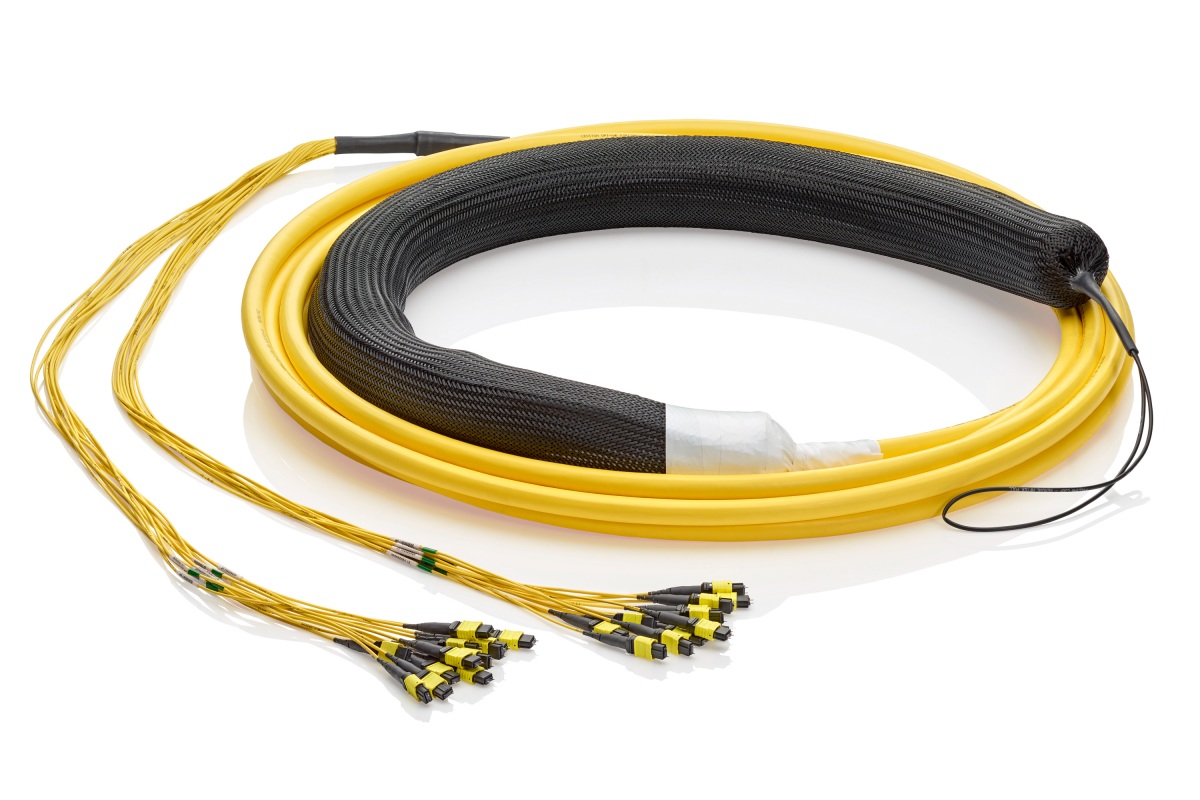
In this exclusive article for DCNN, Rachid Ait Ben Ali, Product & Solutions Manager, Smart Building & Data Center at Aginode, explores how next-generation fibre and automated management systems are redefining infrastructure for AI and edge computing: Cabling for the future As artificial intelligence and edge computing rapidly reshape data centre architectures, network infrastructure has to evolve to keep up. Critical applications such as autonomous systems, real-time analytics, and GPU-to-GPU communication for AI model training are highly sensitive to latency, signal degradation, and disruptions caused by excessive hops or amplification points. To meet fast-moving, rigorous requirements, cutting-edge cabling solutions - including ultra-dense fibre panels and the latest generation of Automated Infrastructure Management (AIM) systems - are essential. A closer look at the requirements AI-driven infrastructure is unforgiving of downtime and demands built-in redundancy. Workloads are often unpredictable and heavily overloaded, which means they need optical cabling that can absorb traffic spikes without performance degradation. Architectures supporting AI are non-linear and bandwidth-intensive, requiring designs with optimised physical pathways. Fibre networks in these settings must be capable of supporting transmission rates of 400G, 800G, and beyond. At the same time, edge computing introduces a new level of complexity. Its highly distributed nature requires fibre connectivity that is not only robust and high-performing, but also low maintenance and compact enough to function within physical and power-constrained environments. As AI workloads - from training to inference - generate immense volumes of east-west traffic across dense GPU clusters, managing connectivity and thermal performance becomes critical. These clusters produce extreme heat, making thermally optimised cabling and carefully considered airflow vital. Addressing challenges from a technical perspective Everything starts with the right cabling. Pre-terminated fibre links support rapid and reliable deployment at hyperscale and edge sites. High CPR-rated solutions help ensure compliance with stringent fire safety standards. As organisations plan for upgrades to 800G or even 1.6 Tbps networks, deploying a future-ready cabling plant is essential. Smart labelling systems simplify identification, reduce downtime, and help teams operate more efficiently. Ultra-polished UPC and APC connectors minimise reflection and insertion loss - crucial for extremely latency-sensitive AI applications. High-density fibre-optic cabling, such as MPO/MTP for parallel optics, enables scalable bandwidth in compact footprints. OM5 multimode fibre is well-suited for dense AI clusters and edge deployments. Supporting multiple wavelengths over short distances and offering tighter loss budgets, OM5 delivers high bandwidth without dramatically increasing cable volume. Modern cable designs enhance performance through quality shielding, precise construction, shorter channel lengths, and cleaner signal paths that reduce hops and signal loss. The network architecture itself also plays a key role. Ethernet backbones operating at 400G and 800G, combined with direct-connect models like leaf-spine or fully meshed fabrics, reduce latency and support AI’s massive east-west traffic patterns. Minimising patching and interconnection points cuts down on signal attenuation and interference, further improving efficiency. Innovations such as ultra-dense fibre panels and MPO connectors help scale operations without overloading valuable rack space and enable rapid deployment while avoiding costly rewiring. AIM systems are becoming indispensable, offering real-time visibility into port status, topology, and usage, and integrating with Data Centre Infrastructure Management (DCIM) and orchestration tools. By leveraging AI-powered tracking and analytics, AIM systems enable real-time monitoring and automate management tasks. This reduces mean time to repair (MTTR), minimises human error, and supports large-scale, AI-driven operations. In environments where model training may take months, cabling with embedded diagnostics ensures uninterrupted operation and transparency. Different types of fibre can be tracked, diagnosed, and reconfigured with minimal manual intervention. That’s essential for mission-critical systems. Further considerations Smooth integration of high-performance fibre into AI and edge-ready environments demands careful attention to detail. As GPU-dense racks fill with fibre, insertion and connection loss must be minimised, which increases the importance of ultra-low-loss multimode solutions. Thermal and spatial constraints in AI deployments necessitate slim, compact cabling designs that do not compromise on performance. Adhering to industry standards such as ISO/IEC OM5 and MPO ensures compatibility across hardware ecosystems and simplifies deployment at geographically distributed edge sites. Looking ahead, future-proofing and sustainability are equally important. Investing in OM5 fibre today helps avoid the cost and disruption of replacement as bandwidth demands continue to grow. Automated cabling systems reduce operational expenditures but also enable agile provisioning, even in edge locations where power is constrained. Low-loss fibre reduces the need for signal amplification, conserving energy, while structured, durable panels minimise long-term maintenance waste. To accommodate the demanding requirements of AI and edge computing, data centre design must transition from legacy copper and basic point-to-point fibre models to high-density, automated multimode fibre ecosystems. Smart cabling, ultra-dense panels, and intelligent management solutions form the backbone of this transformation. These technologies empower both hyperscale and edge operations with high bandwidth, low latency, and operational agility. Meeting the needs of AI-ready infrastructure doesn’t just require speed; it demands ultra-high bandwidth, minimal latency, granular insights, simplified manageability, and flexible (re)configuration. With the right infrastructure, it’s possible to build networks that are powerful enough for AI at scale and flexible enough enough for edge deployment.

DE-CIX Malaysia extends reach with NTT DATA partnership
Internet exchange (IX) operator DE-CIX Malaysia has announced the launch of its full suite of interconnection services at NTT DATA’s CBJ1 data centre in Cyberjaya, marking a further expansion of Malaysia’s digital infrastructure and the country’s role as a regional connectivity hub. The partnership represents the first local collaboration between DE-CIX Malaysia and NTT Global Data Centres, following successful projects in other international markets. It aims to enhance interconnection options for enterprises, internet service providers (ISPs), cloud providers, and content delivery networks (CDNs) across Southeast Asia. Expanding interconnection capacity in Cyberjaya The collaboration enables customers at NTT DATA’s Cyberjaya facility to access DE-CIX’s peering, cloud exchange, and virtual private network interconnection (VPNI) services. These include premium peering through GlobePEER, direct cloud connectivity via DirectCLOUD, and Blackholing for DDoS mitigation. Weng-Yew Wong, Member of the Board of Management at DE-CIX Malaysia, comments, “This partnership is a strategic move to bring DE-CIX’s interconnection services closer to Malaysia’s enterprises. "By enabling our platform at NTT Global Data Centres’ Cyberjaya site, we are expanding the region’s digital ecosystem and offering greater reach, security, and reliability.” The collaboration will also allow NTT Global Data Centres to attract additional network-focused tenants, including enterprise and hyperscale operators. Yasuo Suzuki, Managing Director, APAC, NTT Global Data Centres, says, “This collaboration reflects our ongoing efforts to bring strategic partners such as DE-CIX into our facilities to enhance connectivity and performance for our clients. "The presence of DE-CIX in our Cyberjaya campus offers improved access to cloud platforms and digital services with minimal latency.” Strengthening Malaysia’s digital ecosystem Cyberjaya has become one of Malaysia’s leading technology hubs, offering high-capacity power, fibre connectivity, and a growing community of network-based enterprises. DE-CIX’s presence at NTT DATA’s CBJ1 data centre provides immediate access to its global interconnection platform via secure ethernet cross-connects and VLAN tagging, supporting low-latency connectivity to international networks. The companies say the collaboration will contribute to the development of resilient, scalable digital infrastructure across Malaysia and strengthen interconnection routes between Asia, Europe, and the United States. For more from DE-CIX, click here.


Translate »