tde expands tML breakout module for 800GbE ethernet
Author: Joe Peck
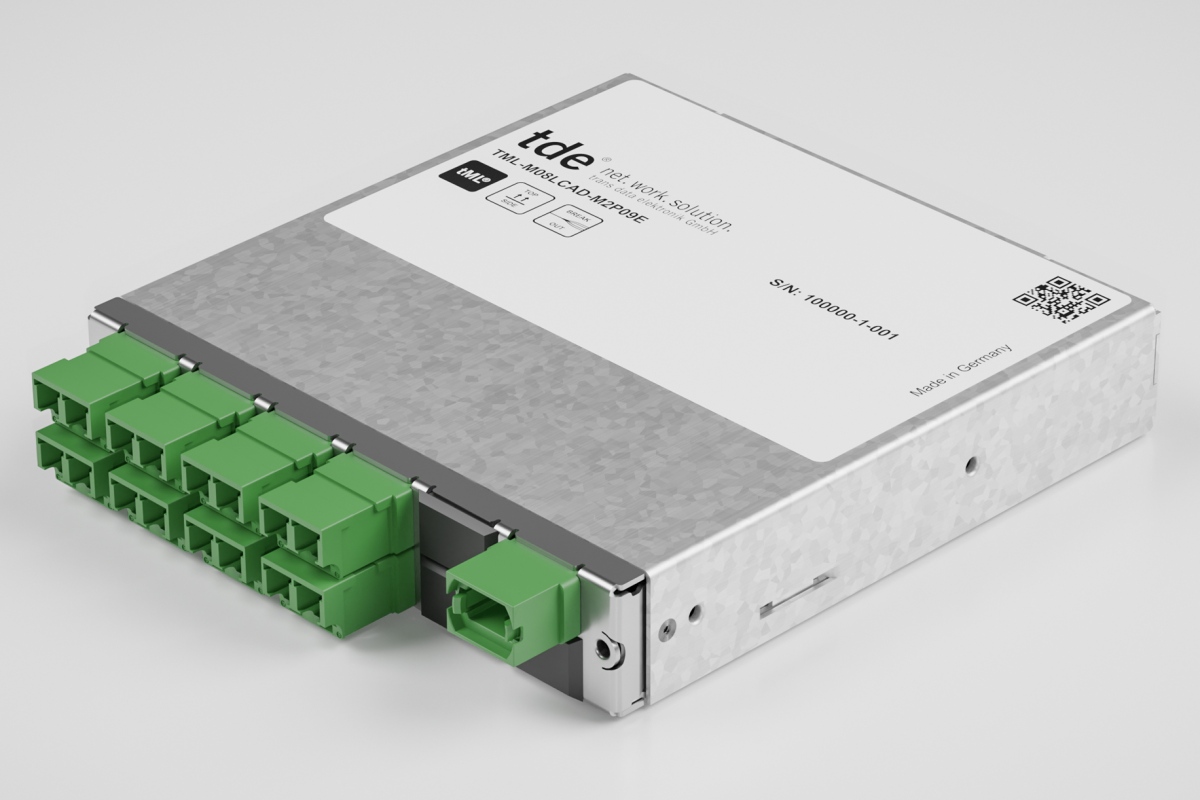
trans data elektronik (tde), a German manufacturer of fibre optic and copper cabling systems for data centres, has further developed its tML system and made it fit for increased network requirements, with the new breakout modules now supporting transceivers up to 800GbE.
QSFP, QSFP-DD, and OSFP transceivers can now be used more efficiently and split into ports with lower data rates (4 x 100GbE or 8 x 100GbE). This allows data centre and network operators to increase the port density of their switch and router chassis and make better use of existing hardware.
The company says the new breakout module is particularly suitable for use in high-speed data centres and modern telecommunications infrastructures.
“Breakout applications have become firmly established in the high-speed sector,” explains André Engel, Managing Director of tde. “With our tML breakout modules, customers can now use transceivers up to 800GbE and still split them into smaller, clearly structured port speeds.
“This allows them to combine maximum port density with very clear, structured cabling.”
Efficient use of MPO-based high-speed transceivers
The current high-speed transceivers in the QSFP, QSFP-DD, and OSFP form factors have MPO connectors with 12, 16, or 24 fibres – in multimode (MM) or single-mode (SM).
Typical applications such as SR4, DR4, and FR4 use eight fibres of the 12-fibre MPO, while SR8, DR8, and FR8 use sixteen fibres of a 16- or 24-fibre MPO.
This is where tde says it comes in with its tML breakout modules. Depending on the application, the modules split the incoming transmission rate into, for example, four 100GbE or eight 100GbE channels with LC duplex connections.
This allows multiple dedicated links with lower data rates to be provided from a single high-speed port – for switches, routers, or storage systems, for example.
Alternatively, special versions with other connector faces such as MDC, SN, SC, or E2000 are available.
Front MPO connectors and maximum packing density
tde also relies on front-integrated MPO connectors for the latest generation of tML breakout modules. The MPO connections are plugged in directly from the front via patch cables.
Compared to conventional solutions with rear MPO connectors, this aims to simplify structured patching, ensure clarity in the rack, and facilitate moves, adds, and changes during operation.
A high port density can be achieved without the need for separate fanout cables. Eight tML breakout modules can be installed in the tML module carrier with one height unit.
Future-proofing and investment protection
tde says it has designed the tML breakout module for maximum ease of use. It can only be patched in the front patch panel level, seeking to support structured and clear cabling.
Since the tML module carrier can be mixed and matched depending on the desired application and requirements, the breakout module should offer high packing density. Fibre-optic and copper modules can also be combined.
André concludes, “With the addition of the tML breakout module, our tML system platform is well equipped for the future and will remain competitive in the long term.”