Data centre cooling options
Author: Joe Peck
Modern data centres require advanced cooling methods to maintain performance as power densities rise and workloads intensify. In light of this, BAC (Baltimore Aircoil Company), a provider of data centre cooling equipment, has shared some tips and tricks from its experts.
This comes as the sector continues to expand rapidly, with some analysts estimating an 8.5% annual growth rate over the next five years, pushing the market beyond $600 billion (£445 billion) by 2029.
AI and machine learning are accelerating this trajectory. Goldman Sachs Research forecasts a near 200TWh increase in annual power demand from 2024 to 2030, with AI projected to represent almost a fifth of global data centre load by 2028.
This growth places exceptional pressure on cooling infrastructure. Higher rack densities and more compact layouts generate significant heat, making reliable heat rejection essential to prevent equipment damage, downtime, and performance degradation. The choice of cooling system directly influences efficiency and Total-power Usage Effectiveness (TUE).
Cooling technologies inside the facility
Two primary approaches dominate internal cooling: air-based systems and liquid-based systems.
Air-cooled racks have long been the standard, especially in traditional enterprise environments or facilities with lower compute loads. However, rising heat output, hotspots, and increased energy consumption are testing the limits of air-only designs, contributing to higher TUE and emissions.
Liquid cooling offers substantially greater heat-removal capacity. Different approaches to this include:
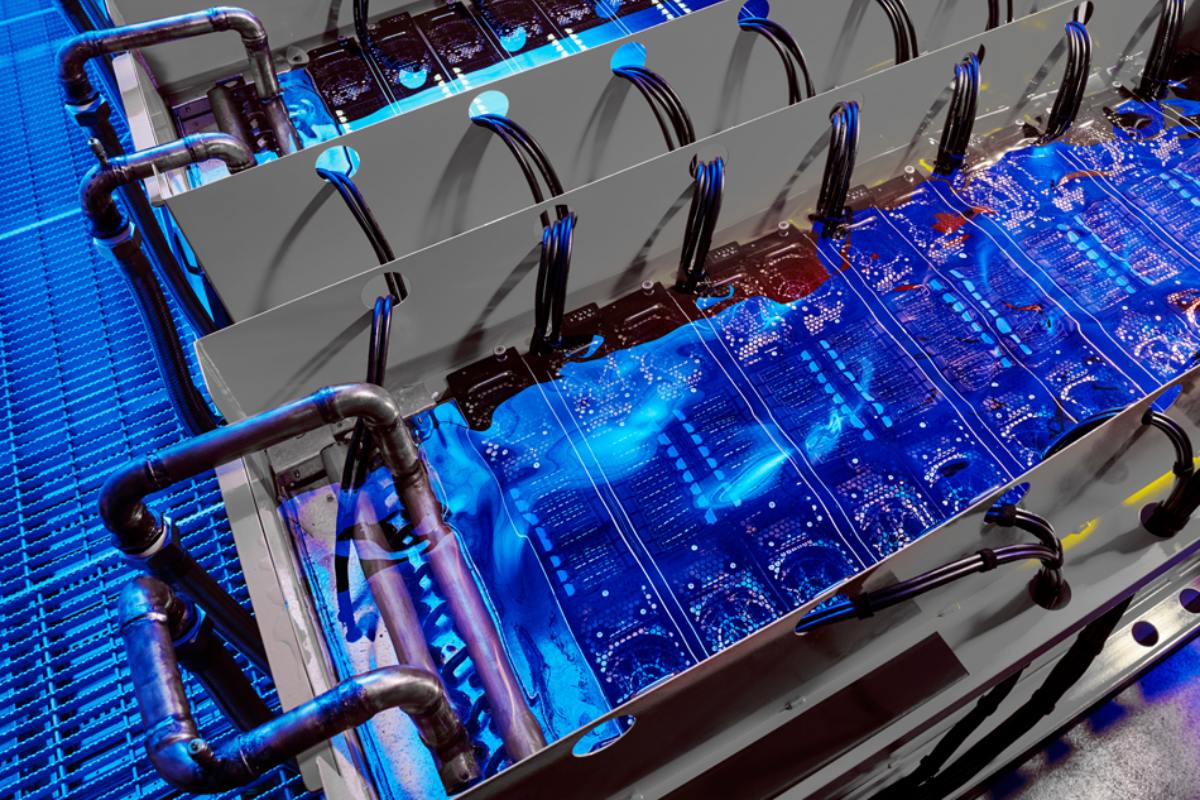
• Immersion cooling, which submerges IT hardware in non-conductive dielectric fluid, enabling efficient heat rejection without reliance on ambient airflow. Immersion tanks are commonly paired with evaporative or dry coolers outdoors, maximising output while reducing energy use. The method also enables denser layouts by limiting thermal constraints.
• Direct-to-chip cooling, which channels coolant through cold plates on high-load components such as CPUs and GPUs. While effective, it is less efficient than immersion and can introduce additional complexity. Rear door heat exchangers offer a hybrid path for legacy sites, removing heat at rack level without overhauling the entire cooling architecture.
Heat rejection outside the white space
Once captured inside the building, heat must be expelled efficiently. A spectrum of outdoor systems support differing site priorities, including energy, water, and climate considerations. Approaches include:
• Dry coolers — These are increasingly used in water-sensitive regions. By using ambient air, they eliminate evaporative loss and offer strong Water Usage Effectiveness (WUE), though typically with higher power draw than evaporative systems. In cooler climates, they benefit from free cooling, reducing operational energy.
• Hybrid and adiabatic systems — These offer variable modes, balancing energy and water use. They switch between dry operation and wet operation as conditions change, helping operators reduce water consumption while still tapping evaporative efficiencies during peaks.
• Evaporative cooling — Through cooling towers or closed-circuit fluid coolers, this remains one of the most energy-efficient options where water is available. Towers evaporate water to remove heat, while fluid coolers maintain cleaner internal circuits, protecting equipment from contaminants.
With data centre deployment expanding across diverse climates, operators increasingly weigh water scarcity, power constraints, and sustainability targets. Selecting the appropriate external cooling approach requires evaluating both consumption profiles and regulatory pressures.
For more from BAC, click here.