News


LiquidStack expands GigaModular CDU capacity
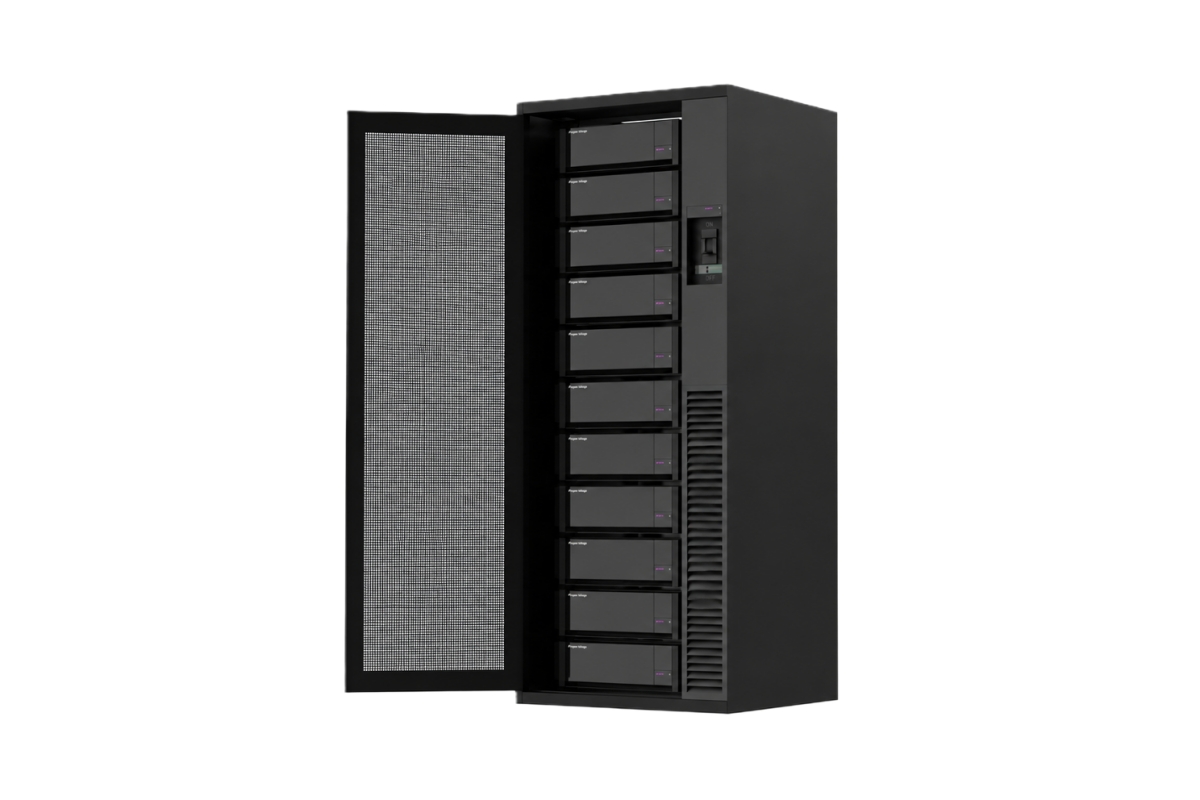
LiquidStack, a US-based provider of liquid cooling technology for data centres, has expanded the scaling capabilities of its GigaModular CDU platform, with the system now validated for deployments of up to 14MW. The modular liquid cooling platform is designed for AI and high-density data centre environments, including infrastructure aligned with NVIDIA Vera Rubin specifications. LiquidStack says the architecture is intended to allow operators to expand cooling capacity incrementally without large-scale infrastructure redesigns. First introduced in June 2025, the GigaModular platform has now completed multi-module system integration and full-load testing. The company says the system has achieved ETL certification and has been released to manufacturing. The announcement comes amid continued growth in AI infrastructure demand and increasing pressure on data centre capacity. According to CBRE, the global weighted average data centre vacancy rate reached 6.6% during the first quarter of 2025. Modular cooling aimed at AI infrastructure growth LiquidStack says the platform has been designed to support phased AI infrastructure expansion through modular deployment and centralised controls. Key features of the GigaModular CDU platform include: • Centralised system controls intended to simplify operations and reduce infrastructure redundancy• Modular scaling designed to support phased AI deployment growth• Flexible cooling distribution architecture for changing rack densities and facility layouts• Support for high-density GPU environments and large-scale AI deployments• Global service support through Trane Technologies, LiquidStack's parent company Joe Capes, Vice President at Trane Technologies and General Manager of LiquidStack, says, “The challenge for AI infrastructure today is the ability to scale quickly and efficiently enough to keep pace with demand. "GigaModular was designed to remove the infrastructure constraints limiting AI growth through a centrally controlled, modular architecture built for system-level scalability, flexible deployment, and hyperscale AI expansion.” LiquidStack has also announced it will demonstrate the GigaModular platform at Datacloud Global Congress 2026, taking place from 2–4 June in Cannes, France. For more from LiquidStack, click here.

Huawei launches AI data centre infrastructure platform
Chinese multinational technology company Huawei has introduced a new full-stack data infrastructure platform designed for AI data centres and large-scale enterprise AI deployments. The announcement was made during the Huawei Innovative Data Infrastructure (IDI) Forum 2026 on 21 May in Paris, France, where Yuan Yuan, Vice President of Huawei and President of the company’s Data Storage Product Line, outlined the growing role of AI infrastructure in enterprise operations. According to Huawei, increasing adoption of AI agents and AI applications is driving significant growth in enterprise data processing and token consumption, requiring organisations to redesign traditional IT infrastructure around AI workloads. With this in mind, the company says its platform has been developed to support AI data lakes, inference systems, model deployment, agent frameworks, and data resilience. Platform targets large-scale AI workloads Huawei says the infrastructure platform combines storage, data management, model deployment, and AI orchestration technologies intended for enterprise and hyperscale AI environments. The company introduced updates across several areas of its AI infrastructure portfolio, including: • OceanStor Pacific Scale-Out Storage for high-density data storage• DME Omni-Dataverse unified data management platform• Context Memory Storage for AI inference environments• ModelEngine deployment and resource scheduling platform• Nexent AI agent framework• AI-focused data resilience and protection technologies Firstly, Huawei says its OceanStor Pacific storage platform can deliver 11PB of capacity within a 2U chassis, enabling massive data storage at "optimal total cost of ownership" (TCO), while DME Omni-Dataverse is designed to support multimodal and cross-site data management. The company also introduced its Context Memory Storage system, which it says is designed for large-scale inference clusters and can reportedly reduce time to first token by 90%. AI infrastructure evolves beyond compute alone Huawei states that AI infrastructure planning increasingly requires integration between storage, compute, models, and data management systems, rather than focusing solely on GPU capacity. The company says its ModelEngine platform supports model deployment and compute resource scheduling, including partitioning resources across multiple workloads. Huawei also introduced the Nexent agent platform, which is designed to allow AI agents to be generated through natural language interactions. “AI is unlocking new opportunities for the IT industry," says Yuan. "The next chapter of AI is data. "Committed to technological innovation in data storage, Huawei will accumulate the experience of industrial AI adoption and work closely with the entire industry to help customers accelerate their journey into the intelligent era." The company says the platform also includes technologies designed to address AI-related security risks including ransomware, data tampering, and data poisoning attacks. For more from Huawei, click here.

Why the inbox is becoming the weakest link in DC security
As AI accelerates demand for digital infrastructure, data centre operators are investing heavily in power, cooling, and resilience. Yet, while the industry focuses on physical infrastructure challenges, one of the most common and effective cyberattack methods remains far more familiar: email. In this exclusive article for DCNN, Billy McDiarmid, VP Customer Engineering at Red Sift, argues that phishing, impersonation, and supply-chain email attacks are becoming an increasingly serious risk for operators managing high-value AI workloads and complex partner ecosystems: Email security The data centre industry is in the middle of an unprecedented expansion that is unleashing economic growth across the United Kingdom, creating more than 43,000 jobs, according to Datum. Still, with AI workloads driving historic demand for power, cooling, and high-density computing, operators are racing to accommodate new capacity. As a result, the UK Government is fast tracking planning approvals, with entire regions repositioning themselves as AI infrastructure hubs through the UK’s AI Growth Zones. Yet, amid this rapid growth, the industry is overlooking a threat that is far more mundane than liquid cooling, grid constraints, or even expansion protests. For all the advancements of modern data centre design, the most common entry point for attackers going after network security is still the inbox. Today, email remains the primary vector for things like phishing, impersonation, and invoice fraud. As AI accelerates both the value of data centre workloads and the sophistication of cyberattacks, the gap between physical resilience and basic things like email security is becoming a critical vulnerability. Modern data centres are complex ecosystems of operators, contractors, equipment vendors, and service partners. Every one of these relationships is mediated through email, and when attackers impersonate a supplier, mimic an executive, or compromise a contractor’s mailbox, they gain a direct path into the operational heart of a facility. A single fraudulent email can trigger misconfigurations, grant unauthorised access, or divert critical payments. These are not hypothetical scenarios; they are the most common form of cyberattack across infrastructure-reliant industries, according to the NCSC. And the threat now extends beyond the inbox. Just last year, attackers created a domain impersonating a logistics platform used by UK freight brokers, causing significant operational disruption and financial losses, with estimates ranging from £40,000 to £160,000 per incident. AI is increasing the sophistication of attacks Now, with the cost of entry for bad actors at near zero, AI is only exacerbating the problem. Attackers can now generate highly convincing phishing messages tailored to specific individuals, roles, or organisations. They can scrape public data to mimic writing styles, automate reconnaissance, and craft messages that bypass traditional filters. Deepfake audio and video add another layer of credibility to fraudulent requests. The result is an environment where even experienced professionals struggle to distinguish legitimate communication from malicious intent. At the same time, the value of what sits inside data centres has never been higher. AI models, training datasets, and proprietary algorithms represent some of the most valuable intellectual property in the world. A breach that once disrupted a handful of virtual machines can now compromise entire AI pipelines. This makes data centre operators and their supply chains irresistible targets. And because email is the easiest and cheapest attack vector to exploit, it is where attackers focus their efforts. Email security must become baseline infrastructure protection The industry has invested heavily in physical security, redundancy, and environmental resilience. Ironically, email security has not kept pace. For the UK, this is not just a corporate hygiene issue; it is about network security and ensuring trust behind the country’s most iconic industries. Enforcing modern email authentication standards, such as email security across data centre operators and their supply chains, must be treated as a baseline security requirement, not an optional control left to individual organisations. Unfortunately, according to a recent analysis at Red Sift, over 39% of the top organisations in the UK are not enforcing DMARC. With foreign threats on the rise, the status quo that viewed email security as 'nice to have' is no longer tenable. It is a real world infrastructure risk, just like locking the front door to the building. If an attacker can impersonate a trusted partner, they can influence operational decisions. If they can compromise a contractor’s account, they can gain access to sensitive systems. And because data centre operations depend on a vast network of suppliers, these standards must extend across the entire ecosystem, not just within the operator’s perimeter. Regulation is pushing security higher up the agenda Recent regulations are starting to move in this direction. The UK Government, as well as those around Europe, are tightening requirements around identity verification, communication security, and supply-chain resilience. It is also pushing forward on the Cyber Security and Resilience bill, an important step in this direction. As AI becomes more central to national infrastructure, these expectations will only grow. Operators who invest early in robust email security will be better positioned to meet emerging compliance demands and to reassure customers that their most sensitive workloads are protected. Enterprises choosing where to host their AI workloads want to know that partners are resilient not only in physical infrastructure but in digital channels as well. The future of data centre resilience depends on recognising that the inbox is not a theoretical risk; it is the front line, just as the security guard out front is. As the AI era accelerates, the industry must build not only bigger and more efficient facilities, but safer and more trustworthy communication systems. Email may be one of the oldest technologies in the digital world, but securing it is one of the most urgent challenges facing the data centre sector today.

EDGE Modular launches containerised data centres
EDGE Modular has launched globally, expanding its containerised data centre offering for edge computing, telecoms, and remote infrastructure deployments. The New Zealand-based company, a division of Edge Defence, designs and manufactures modular data centre systems intended for rapid deployment in locations where traditional construction may be impractical or time-consuming. According to EDGE Modular, the systems are aimed at organisations requiring scalable infrastructure for edge computing and localised data processing. The company says its modular approach allows systems to be manufactured, tested, and deployed more quickly than conventional brick-and-mortar facilities, while also supporting future expansion through scalable designs. John Gell, General Manager at EDGE Modular, explains, “Our mission is to provide innovative, containerised data centre solutions tailored to the unique needs of each client. "We ensure efficiency, quality, and flexibility for future growth in every project we undertake.” Modular infrastructure for edge computing EDGE Modular’s portfolio includes containerised data centres in 10ft, 20ft, and 40ft formats, alongside telecom exchange units, command and control rooms, battery storage systems, and specialist workshop environments. The company states that its infrastructure is designed for deployment in remote and challenging environments, with systems transportable via road, rail, or sea using standard shipping container logistics. EDGE Modular also says its systems are designed for concurrent maintainability, allowing maintenance work to be carried out without interrupting critical operations. In addition to manufacturing, the company provides infrastructure consultancy, system design services, and maintenance support for deployed installations.

Vultr launches Milan cloud data centre region
Vultr, a privately held cloud infrastructure company, has launched a new cloud data centre region in Milan, expanding its European footprint to nine locations. The Milan site becomes Vultr’s 33rd global cloud data centre region and was announced during AI Week 2026 at Fiera Milano Rho. The company is also participating in the event as a platinum sponsor and co-host of the AI Agent Olympics Hackathon. Vultr says the Milan region will provide access to its AI and cloud infrastructure portfolio, including its VX1 cloud compute platform, bare metal services, and GPU infrastructure based on technologies from NVIDIA and AMD. The company states that the new region is intended to support workloads including AI, SaaS platforms, databases, analytics, ERP applications, microservices, and APIs. Milan joins Vultr’s existing European regions in London, Amsterdam, Frankfurt, Manchester, Madrid, Paris, Stockholm, and Warsaw. Milan expansion targets AI and enterprise demand According to Vultr, the Milan region is designed to provide low-latency connectivity for European users while supporting increasing demand for AI and cloud infrastructure services. The company says its global network is positioned to reach 90% of the world’s population within 2–40 milliseconds. J.J. Kardwell, CEO of Vultr, comments, “Italy is one of Europe's fastest-growing cloud infrastructure markets, and Milan is at the heart of it. Vultr is here because the enterprises and developers driving that growth need high-performance cloud infrastructure without the cost and complexity of the traditional hyperscalers. "This is a long-term investment in Italy and in European AI innovation." Vultr has also connected its Autonomous System Number (ASN) to the Milan Internet Exchange (MIX) to support local traffic routing, lower latency, and increased regional bandwidth capacity. The company says its cloud compute platform supports configurations ranging from two to 192 vCPUs. For more from Vultr, click here.

Zayo Europe expands network into Genoa
Network infrastructure provider Zayo Europe has expanded its Southern European network with a new point of presence (PoP) in Genoa, Italy, strengthening connectivity between Mediterranean subsea cable systems and its terrestrial fibre network. The new point of presence is located within Quadrivium Digital’s QGEN01 facility and extends Zayo Europe’s existing Italian footprint alongside sites in Milan and Rome. According to the company, Genoa is becoming an increasingly important landing point for subsea cable systems connecting Europe with Asia (including the Middle East) and Africa. Zayo Europe says the expansion is intended to support growing traffic flows across the Mediterranean region while providing alternative connectivity routes into major European hubs including Frankfurt and Paris, as well as interconnection points in Barcelona and Lisbon. Subsea connectivity expanding network diversity The company states that the new route options are designed to provide additional network diversity and reduce reliance on traditional connectivity routes through Marseille. Quadrivium Digital says the deployment also gives customers within the QGEN01 facility direct access to Zayo Europe’s wider network and more than 600 connected data centres across Europe. Aditya Ayyagari, CEO of Quadrivium Digital, comments, “This partnership positions QGEN01 as a key interconnection hub in the Mediterranean ecosystem. “By combining direct access to new subsea systems with Zayo Europe’s diverse terrestrial routes, we are enabling customers to efficiently reach key traffic hubs like Barcelona and Lisbon, as well as the US, while achieving greater route diversity and lower latency across global networks.” Colman Deegan, CEO of Zayo Europe, adds, “The digital map of Europe is evolving and our expansion into Genoa is a direct response to our customers’ need for greater resilience and choice. “By connecting this important Mediterranean landing point to our 400G-enabled backbone, we are creating a seamless bridge between subsea systems and our terrestrial infrastructure. "Ultimately, this ensures our customers have access to the scalable, high-capacity connectivity required to support the next wave of cloud and AI-driven growth.” For more from Zayo Europe, click here.

NEC completes Pacific submarine cable system
Japanese multinational technology company NEC Corporation has completed construction of the East Micronesia Cable System (EMCS), a submarine cable network linking the Federated States of Micronesia, Kiribati, and Nauru. The approximately 2,250km cable system connects Tarawa in Kiribati to Nauru, before extending to Kosrae and Pohnpei in the Federated States of Micronesia. The infrastructure has now been handed over to FSM Telecommunications Cable Corporation, Bwebweriki Net Limited, and Cenpac Corporation. According to NEC, the project provides the first optical submarine cable connection for Kosrae, Tarawa, and Nauru, which had previously relied primarily on satellite communications. The company says the new cable system is designed to improve internet connectivity, reliability, and latency across the region, supporting applications including video communications and digital payment services. Submarine cable boosts regional connectivity The EMCS project was supported by the governments of Australia, Japan, and the United States through grant funding initiatives focused on Pacific infrastructure development. Gordon Segal, Chief Executive Officer of FSM Telecommunications Cable Corporation and Chairman of the EMCS Management Committee, comments, “Kosrae was the only state in the FSM without a submarine cable connection. "We are truly delighted that the construction of the EMCS has now provided digital connectivity to all four states of the FSM. “This infrastructure development not only advances the digitalisation of the regional economy, but also dramatically improves residents' access to information and services. "NEC's strong execution capabilities and high reliability have been essential to the project’s success, and we hold them in high regard.” Bwanouia Aberaam, Officer in Charge of Bwebweriki Net, adds, “We are pleased to see the completion of resilient communications infrastructure in Kiribati and the Micronesia region. "With this vital foundation supporting the digitalisation of the regional economy now in place, access to diverse information and essential services will significantly improve going forward.” Zikki Eoe, Chairlady of Cenpac Corporation, notes, “This project is Nauru's first undersea cable, enabling the provision of high-speed, reliable internet services to residents. We have high expectations that this will significantly accelerate Nauru's economic development and digitalisation going forwards.” Tomonori Uematsu, Managing Director of NEC’s Submarine Network Division, concludes, “We are truly delighted to have completed this new telecommunications infrastructure in the Pacific Island region. "We consider it a highly significant achievement that NEC's long-established optical submarine cable technology has helped strengthen the region's communications environment, contributing to the realisation of safe and prosperous lives.” NEC states that it has installed more than 400,000km of submarine cable infrastructure globally during its 60 years in the sector.

Zumtobel upgrades lighting at London data centre
Zumtobel, an Austrian company specialising in professional indoor and outdoor lighting, has completed a lighting upgrade at Global Switch’s London East data centre campus in Docklands, supporting the site’s ongoing refurbishment programme for AI and high-performance computing (HPC) workloads. The project covered multiple floors across the facility, including data halls, plant areas, offices, and a liquid cooling demonstration suite. The refurbishment programme is focused on improving flexibility, operational resilience, and energy efficiency as demand for AI-ready infrastructure continues to grow. Zumtobel worked alongside consultants including Hilson Moran, Burns & McDonnell, and AFK Studios, while Datalec Precision Installations carried out installation works. Lighting designed for AI-ready infrastructure The lighting installation was designed to improve visibility within the high-density data halls while supporting energy efficiency and long-term operational requirements. Zumtobel deployed its TECTON continuous-row lighting system across the halls, using split-lens optics to improve vertical illuminance at rack level for maintenance and operational tasks. Emergency lighting was integrated with the eBOX monitoring platform, providing automated testing and reporting functions designed for mission-critical environments. Plant areas, offices, and shared spaces were fitted with AMPHIBIA luminaires, selected for durability in technical environments, while the LITECOM lighting management platform enables centralised monitoring and control. Future refurbishment phases on levels eight and nine are expected to include TECTON II lighting, which supports faster installation through a modular 'plug-and-play' design. Ken Knight, Head of Data Centres - UK & Ireland at Zumtobel Group, comments, “Data centre environments place very specific demands on lighting, from vertical illuminance at rack level to reliability and energy efficiency. "Our role was to translate those requirements into a scalable solution that could be implemented across multiple floors while supporting Global Switch’s ongoing expansion and innovation strategy.” Matt Perrier Flint, Director - UK & Ireland at DPI, adds, “Delivering a project of this scale required close coordination between all parties. The modular design of the Zumtobel lighting system simplified installation and helped maintain programme certainty, while the collaborative approach ensured that technical requirements were clearly understood at every stage.” Lighting a liquid cooling demonstration suite Level 10 of the facility includes a liquid cooling demonstration suite designed by AFK Studios, showcasing technologies intended to support higher-density AI and HPC deployments. The lighting scheme was developed to support visibility, operational safety, and flexibility within the technical demonstration environment. According to Global Switch, the upgraded lighting infrastructure supports safer rack maintenance, lower energy consumption through LED technology and intelligent controls, simplified future upgrades, and improved emergency lighting monitoring. Derek Allen, Group Operations Director at Global Switch, notes, “Across our global portfolio, operational resilience and flexibility are fundamental. The lighting strategy implemented at our London data centre supports safe, efficient operations while giving us the adaptability required to meet evolving customer demands. "It forms part of the wider infrastructure platform that enables us to support increasingly complex AI and high-performance computing deployments.” Emily Clark, Global Switch, explains, “As our London data centre continues to evolve to support the demands of the most powerful AI and high-performance workloads, it was important that the supporting infrastructure could match that pace of innovation. "The lighting solution delivered by Zumtobel provides the performance, flexibility, and reliability we require across both operational data halls and demonstration spaces.” For more from Zumtobel, click here.

'DC construction enters a new era of delivery pressure'
In this exclusive article for DCNN, Dave Wagner, VP of Product Marketing at Newforma, examines how AI-driven demand, compressed timelines, and constantly evolving designs are forcing construction teams to rethink how data centre projects are coordinated and delivered: Why construction teams are rewriting the playbook The data centre boom has pushed construction into unfamiliar territory. Demand keeps climbing, driven by cloud computing, AI workloads, and real-time digital services. Analysts expect the global data centre market to pass $500 billion (£369 billion) within the decade. That growth sounds like opportunity; on the ground, it feels like pressure. Project teams face a new reality: Designs shift mid-build, stakeholders span continents, precision requirements leave no room for error, timelines shrink, and the old workflows do not hold up under these conditions. The solution isn’t just to work harder; it’s to work differently. The golden thread is under strain The “golden thread” promises a clear, traceable record of decisions from design through to delivery. In data centre projects, that thread gets pulled in every direction. Designs evolve while construction is already underway and a change in server density drives new cooling requirements. That then triggers updates across mechanical and electrical systems, while documentation must reflect those changes in real time or the thread breaks. Carl Veillette, Chief Product Officer at Newforma, sees this first hand, stating, “On data centre projects, the golden thread is not a static record; it is a live system. If it falls out of sync with reality, the risk compounds fast.” When information lags, teams build off outdated assumptions. That leads to rework, delays, and finger-pointing. Maintaining continuity of information is no longer a compliance exercise, but a delivery requirement. Design does not sit still Traditional construction relies on a stable design phase. Data centres ignore that sequence as technology advances too quickly. A facility planned around one generation of hardware often needs to support the next before completion. GPU-heavy AI workloads increase power density while liquid cooling replaces air in certain zones and redundancy strategies evolve. Each shift forces coordination across disciplines:• Electrical systems must handle higher loads.• Cooling infrastructure must adapt to new methods.• Structural layouts must support revised equipment footprints. These are not minor tweaks; they affect core systems. Carl puts it plainly, “You are designing for a future state that keeps changing. The teams that succeed are the ones that accept that volatility and build processes around it.” That means parallel workflows. Design, coordination, and construction happen at the same time, whilst decisions move faster, often with incomplete data. Teams need immediate visibility into the latest information to stay aligned. Precision, security, and uptime raise the stakes Data centres operate under strict conditions. Downtime is not tolerated and systems must perform on day one. This drives extreme precision: • Redundant power systems must function without failure.• Cooling must maintain exact environmental conditions.• Security measures must meet strict standards.• System integration must be flawless. At the same time, security concerns limit information access. Teams must share data widely enough to stay aligned while also restricting sensitive details. The margin for error disappears. According to Uptime Institute, over 60% of data centre outages cost more than $100,000 (£74,000), with a growing share exceeding $1 million (£739,000). That risk shapes every decision. Teams cannot afford mistakes caused by poor coordination or outdated information. Speed to market is the new benchmark The race to bring capacity online has compressed schedules across the industry. Hyperscale operators push for faster delivery to meet demand, and delays translate into lost revenue and competitive disadvantage. This pressure reshapes project timelines: • Design cycles shorten.• Construction phases overlap.• Procurement accelerates.• Commissioning windows tighten. There is no buffer for inefficiency. Rework becomes expensive and miscommunication becomes costly. Carl highlights the impact, noting, “Speed to market is not a goal anymore; it is the baseline. The only way to hit it is to remove friction from how teams share and act on information.” A shift towards structured collaboration The common thread across these challenges is information flow. Projects succeed when the right data reaches the right people at the right time. That requires a shift in how teams manage project information: • Centralised access to current documents and models• Clear tracking of RFIs, submittals, and decisions• Real-time updates across all stakeholders• A complete audit trail for accountability and risk management This is where platforms like Newforma play a role. They support the golden thread by keeping project information connected, traceable, and accessible. The impact shows up in reduced risk and faster delivery. Teams spend less time searching for information and more time acting on it. Coordination improves and errors drop, whilst projects move forward with fewer disruptions. The new standard Data centre construction has set a new standard for the industry. It demands speed without sacrificing precision. It requires flexibility without losing control. It depends on collaboration at a scale most projects never reach. These conditions will not ease, as demand will keep rising and technology will keep evolving. The teams that adapt their workflows to this reality will keep pace. Those that do not will fall behind. The playbook has already changed. The only question is who is still using the old one.

Lightpath announces new long-haul US fibre route
Lightpath, a New York-based fibre network and connectivity provider, has announced plans to build a new long-haul fibre route in the US, connecting Columbus, Ohio, and Chicago, Illinois. The approximately 392-mile (630-kilometre) route will include 327 miles (526 kilometres) of newly constructed underground multi-conduit fibre infrastructure spanning three US states. According to Lightpath, the project will be delivered in phases, with full end-to-end completion targeted for the end of 2028. The company says the route will connect two rapidly growing North American data centre markets and will incorporate eight LightCube Data Centers facilities, including seven new sites. Lightpath states that the infrastructure will support services including conduit access, dark fibre, colocation, high-capacity wavelengths, and connectivity services for hyperscale, carrier, and enterprise customers. New long-haul route for AI infrastructure growth Chris Morley, CEO of Lightpath, comments, “The Columbus-to-Chicago corridor reflects sustained hyperscale demand for high-capacity, long-haul fibre built to production-grade standards. “Connecting two of the world’s fastest-growing data centre markets on our own, purpose-built infrastructure positions Lightpath to support the next generation of AI and cloud workloads at scale.” According to the company, the new route builds on existing fibre infrastructure in Columbus and follows its acquisition of a 323-mile (520-kilometre) fibre system between New York and Ashburn in late 2024. The southern section of the route, connecting Columbus and South Bend, is expected to be the first phase brought online. Tim Haverkate, Chief Commercial Officer at Lightpath, suggests, “Building this corridor from the ground up - on a timeline driven by a real anchor award - demonstrates what our team is capable of delivering.” Lightpath says it is also assessing additional in-line amplifier locations along the route to support future capacity expansion. For more from Lightpath, click here.


Translate »