EUDCA publishes its new 2026 report
Author: Joe Peck
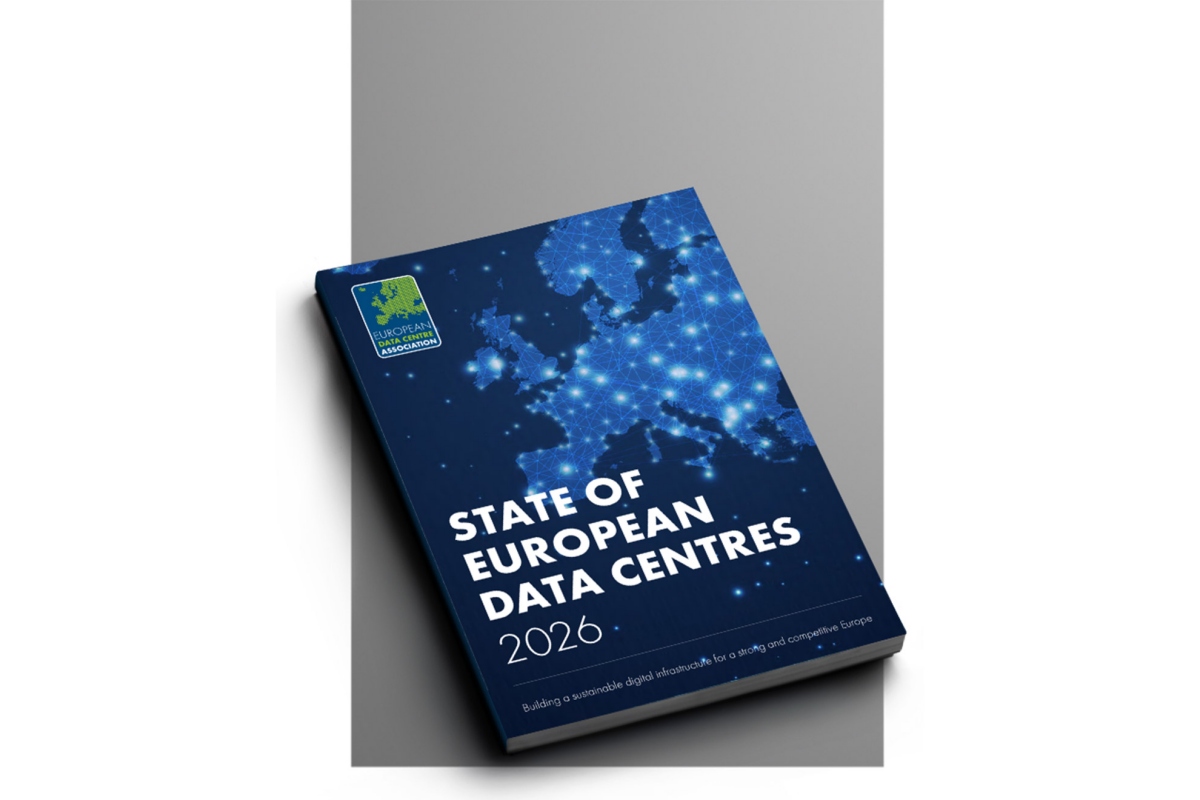
The European Data Centre Association (EUDCA), the representative body of the European data centre community, has announced the publication of its 2026 State of European Data Centres report.
Building upon regional benchmarks established in last year’s report, the new data reveals a European market that has moved beyond the era of hub-centric development and is evolving into a distributed, energy-integrated, and AI-driven digital ecosystem.
Europe’s data centre sector is shown to be entering a period of exceptional expansion, structural diversification, and rapid technological transformation, driven by AI hyper-expansion. However, its ability to fully exploit potential growth is threatened by energy availability and access.
The new EUDCA report finds European market growth not only within traditional centres – such as the Frankfurt, London, Amsterdam, Paris, and Dublin (FLAP-D) – but also rapidly decentralising across Southern Europe, the Nordics, Central and Eastern Europe (CEE), and selected Tier2 metros.
Moving from cloud-led growth to AI demand, data centres are now recognised as critical infrastructure underpinning Europe’s competitiveness and security.
Growth and investment in Europe’s data centres
Europe’s IT power capacity grew from 10,539 MW (2023) to 14,784 MW (2025), exceeding forecasts. Furthermore, €176 billion (£151.6 billion) in cumulative investment is expected from 2026–2031.
Within this growth and investment, scale colocation campuses and AI-optimised facilities dominate new builds. A CAGR exceeding 25% through to 2031 is expected for scale colocation, reflecting rising demand for high-density cloud and AI clusters.
Traditional retail and wholesale sites continue to expand, but their relative share of new capacity is declining as customers increasingly require multi-building, AI-ready environments with long-term scalability.
Hyperscale data centre expansion is accelerating into regions with improving access to renewable energy and favourable operating conditions, as training workloads tend to favour regions with abundant power availability such as the Nordics and parts of Southern Europe.
A notable driver of growth is the rise of neocloud, namely providers of ultra-high-density compute with rapid deployment capability and large power tranches aligned with the needs of AI developers, global model providers, and emerging cloud-adjacent platforms.
Constraints and socioeconomic impact
A significant factor affecting the industry is energy availability and access. Power availability is reported as the top challenge for more than two thirds (67%) of operators. Grid congestion and long connection timelines in many geographies are slowing deployment.
Within these developments, AI clusters are pushing extreme rack densities beyond 100kW, calling for changes in data centre design, deployment, and operation, as well as driving a rapid shift towards liquid and hybrid cooling architectures.
The European data centre industry continues to make a significant contribution to the economy and society.
The report finds a €53 billion (£45.6 billion) GDP contribution in 2025, rising to an expected €137.5 billion (£118.4 billion) by 2031, with more than 300,000 direct, high-skilled jobs supported across the ecosystem.
The facilities and campuses also bring local benefits, such as supporting district heating, providing energy grid flexibility services, renewable power purchase agreements (PPA) that support renewable energy development, and community infrastructure.
Sustainability progress and regulatory alignment
The industry’s rapid growth is firmly aligned with climate and regulatory expectations.
The continued application of the Energy Efficiency Directive (EED) marks a new era of harmonised reporting and transparency for the industry. The vast majority (90%) of energy consumed by European data centres is now generated from renewable energy sources.
At the same time, there has been strong progress on water usage effectiveness (WUE), renewable procurement, and heat reuse integration, addressing many of the concerns of the citizenry with regard to data centre facilities.
There are outstanding examples of biodiversity, heat reuse, and community benefit projects across Europe.
Global leadership and the next phase
EUDCA Secretary General Michael Winterson comments, “The exceptional growth of Europe’s data centre market is welcome news at a time when international volatility has focused many geographies on digital sovereignty and security.
“Once the issues of power availability and access are addressed, Europe has the opportunity to lead globally in AI-ready infrastructure, while maintaining the highest standards of sustainability and responsible stewardship.”
The 2026 State of European Data Centres report clearly demonstrates the need for industry, policymakers, and partners to come together on bold steps to accelerate grid investment and permitting reform. This will require deeper and improved cross-border coordination to achieve greater collaboration on energy system integration.
The report states that if these challenges are met, Europe will be positioned not only to accommodate growth in cloud and AI infrastructure, but to lead in the development of a secure, sustainable, and strategically independent digital economy.
For more from the EUDCA, click here.