DCNN reports from Johnson Controls’ ‘Innovation Studio’
Author: Joe Peck
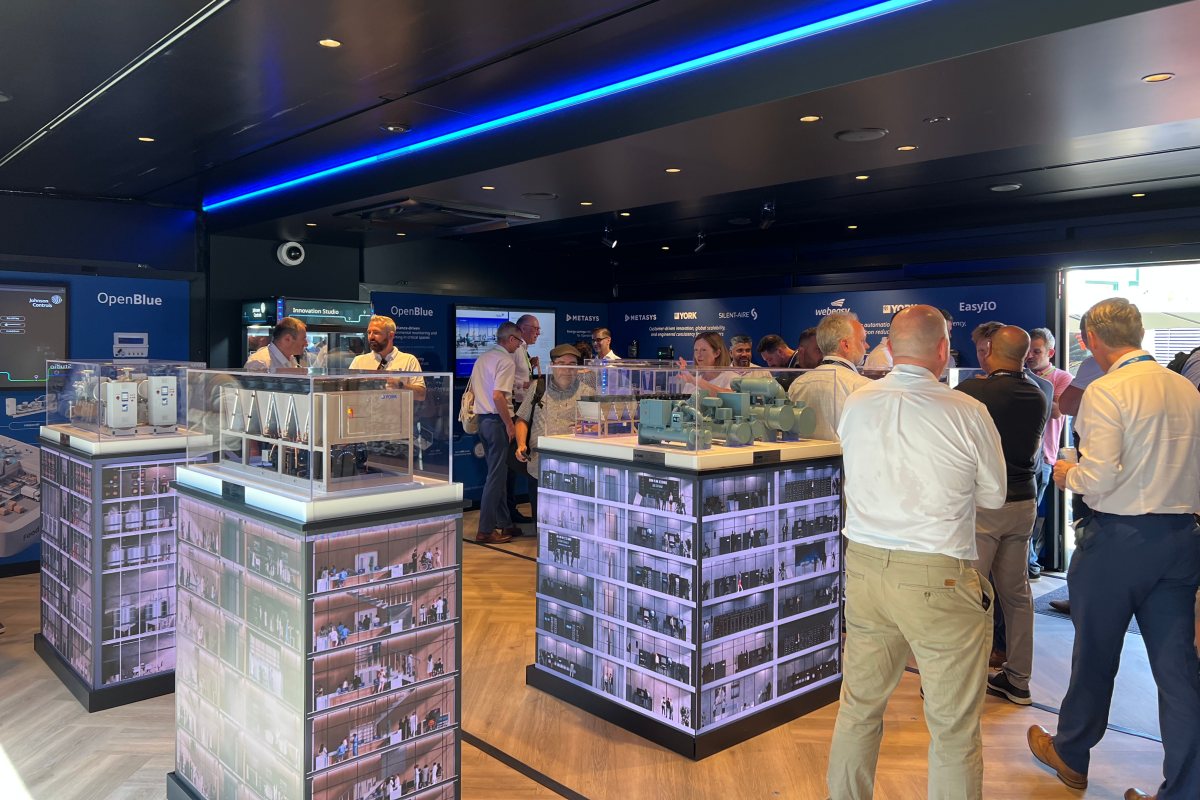
Johnson Controls, a global provider of smart building technologies, brought its travelling Innovation Studio to London between 23 and 26 June, one stop on a 44-city tour taking the company’s building technologies portfolio directly to customers, partners, and media across Europe.
DCNN was invited along to step inside the mobile showcase and sit down with John Foley, General Manager, North West Europe at Johnson Controls, whose day job involves leading the company’s HVAC team, but whose knowledge stretches across every industry the business serves.
The Innovation Studio itself is the physical expression of an idea Johnson Controls has been mulling for some time: how do you take the collective expertise scattered across the business’s European operations and put it in front of every market at once?
John told us, “All of this information, intellectual property, and, more importantly, the experts that come with it are so diffused all around Europe.”
The tour, he explains, grew out of conversations between the company’s EMEA marketing leadership about how to concentrate that firepower and take it on the road. It is, by his own admission, a fairly bold departure for a company of Johnson Controls’ size, but the early results have surprised even the team behind it.
“The engagement with our customers so far has been unbelievable,” he continued, adding that appetite has varied (sometimes counterintuitively) from city to city, but has been strong across the board.
Three pillars, one thermal chain
To understand why a HVAC and controls business is investing so heavily in this kind of outreach now, John points to a set of strategic priorities set out by Johnson Controls’ chief executive in November 2025: decarbonising the existing built environment, winning in critical environments such as pharmaceutical and biologics production, and enabling what he calls “the future AI economy”. It is that third pillar that explains the data centre focus of the London leg.
Johnson Controls has served data centres in one form or another for decades, spanning fire and security, heating and cooling, and building automation. What has changed, John says, is the scale of capital and engineering attention now being directed at the sector as a result of AI-driven growth. The company’s pitch to the market has also shifted.
“Our right to win in a data centre, it’s not just about cooling; it’s actually about our ability to own and also command the entire thermal management chain,” he suggested. That means everything from extracting heat at the chip via liquid cooling plates, through rejection and plant-level cooling, all orchestrated through building automation systems.
Heat that does not go to waste
One strand of the conversation that stood out was waste heat reuse, an area in which John argues Johnson Controls’ combined HVACR capability (he is careful to stress the “R” for refrigeration) gives it an edge over cooling specialists.
The company’s heat pumps, manufactured at its Sabroe facility in Aarhus, Denmark, are already being used across parts of Europe to funnel heat recovered from data centres into district heating networks serving tens of thousands of homes, a practice some Scandinavian countries now effectively mandate for new data centre developments.
John, who lived in Norway for four years, is candid that the UK lags behind on this front. “It’s quite frustrating… it’s embarrassing,” he remarked, though adding that he also sees plenty of opportunity ahead as the conversation matures.
What was on show
That thermal chain philosophy was reflected in the technology on display inside the studio. On the digital side, OpenBlue, Johnson Controls’ AI-powered smart building platform, was positioned as the connective layer tying data, insight, and outcomes together across a building’s systems, built on the Metasys building automation and controls backbone, alongside the EasyIO Neo controller range and the Webeasy front end.
On the mechanical side, the YORK YVAM air-cooled magnetic bearing chiller was a centrepiece, aimed squarely at hyperscale and colocation cooling loads and built to run efficiently across a wide ambient range without relying on free-cooling coils, alongside the YCPB heat pump range for lower-carbon heating and cooling.
Representing the industrial refrigeration side of the business, the Sabroe DualPAC combines the company’s ChillPAC and HeatPAC units into a single modular heat pump, aimed at applications needing both cooling and high-temperature heat output efficiently.
Bringing it to the UK
Wrapping up, John returned to the purpose of the tour itself: getting Johnson Controls’ engineers and technology in front of customers who might otherwise only encounter the brand through a single product line.
Given the scale of change facing UK data centre operators, from AI-driven density increases to mounting pressure on energy and water use, it is a conversation that feels timely, and one that DCNN expects to keep returning to as the Innovation Studio continues its European run.
For more from Johnson Controls, click here.