Janitza launches UMG 801 power analyser
Author: Joe Peck
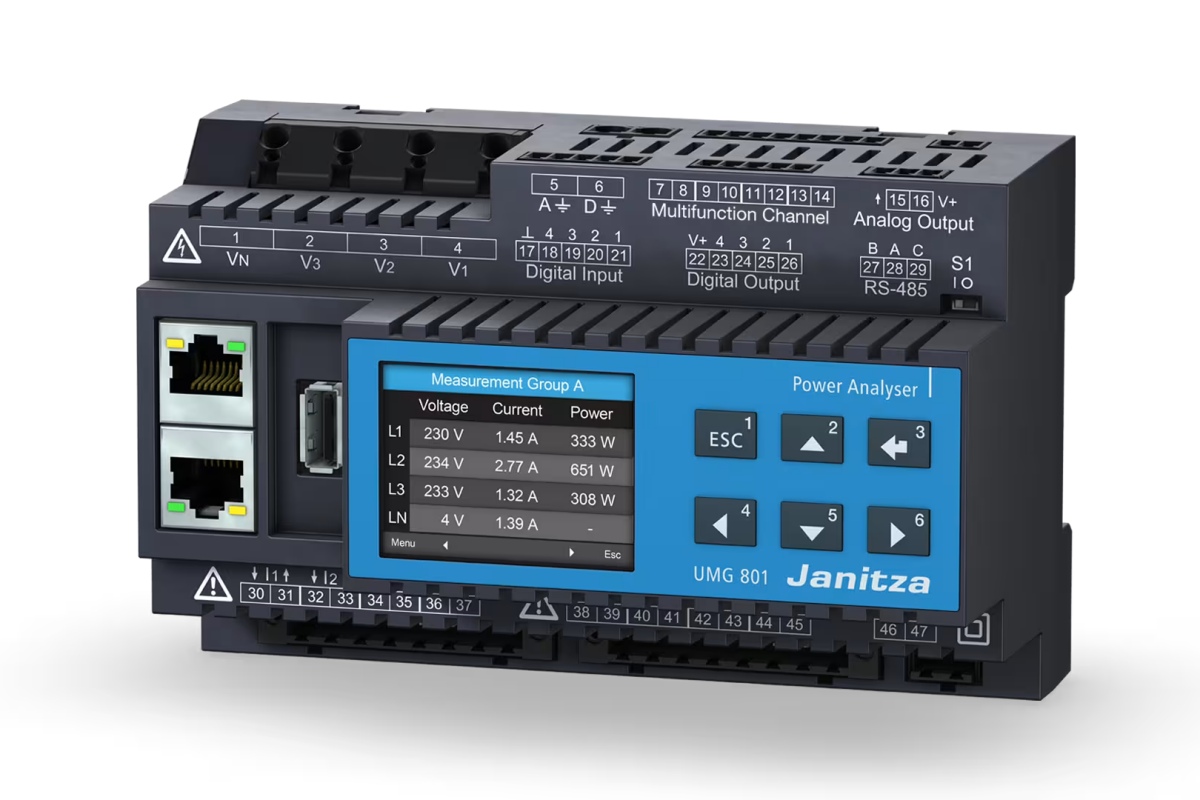
Modern data centres often face a choice between designing electrical monitoring systems far beyond immediate needs or replacing equipment as sites expand.
Janitza, a German manufacturer of energy measurement and power quality monitoring equipment, says its UMG 801 power analyser is designed to avoid this issue by allowing users to increase capacity from eight to 92 current measuring channels without taking systems offline.
The analyser is suited to compact switchboards, with a fully expanded installation occupying less DIN rail space than traditional designs that rely on transformer disconnect terminals.
Each add-on module introduces eight additional measuring channels within a single sub-unit, reducing physical footprint within crowded cabinets.
Expandable monitoring with fewer installation constraints
The core UMG 801 unit supports ten virtual module slots that can be populated in any mix. These include conventional transformer modules, low-power modules, and digital input modules.
Bridge modules allow measurement points to be located up to 100 metres away without consuming module capacity, reducing wiring impact and installation complexity.
Sampling voltage at 51.2 kHz, the analyser provides Class 0.2 accuracy across voltage, current, and energy readings. This level of precision is used in applications such as calculating power usage effectiveness (PUE) to two decimal places, as well as assessing harmonic distortion that may affect uninterruptible power supplies (UPS).
Voltage harmonic analysis extends to the 127th order, and transient events down to 18 microseconds can be recorded. Onboard memory of 4 GB also ensures data continuity during network disruptions.
The system is compatible with ISO 50001 energy management frameworks and includes two ethernet interfaces that can operate simultaneously to provide redundant communication paths.
Native OPC UA and Modbus TCP/IP support enable direct communication with energy management platforms and legacy supervisory control systems, while whitelisting functions restrict access to approved devices. RS-485 additionally provides further support for older infrastructure.
Configuration is carried out through an integrated web server rather than proprietary software, and an optional remote display allows monitoring without opening energised cabinets.
Installations typically start with a single base unit at the primary distribution level, with additional modules added gradually as demand grows, reducing the need for upfront expenditure and avoiding replacement activity that risks downtime.
Janitza’s remote display connects via USB and mirrors the analyser’s interface, providing visibility of all measurement channels from the switchboard front panel. Physical push controls enable parameter navigation, helping users access configuration and measurement information without opening the enclosure.
The company notes that carrying out upgrades without interrupting operations may support facilities that cannot accommodate downtime windows.
For more from Janitza, cick here.