News


Vertiv launches new MegaMod HDX configurations
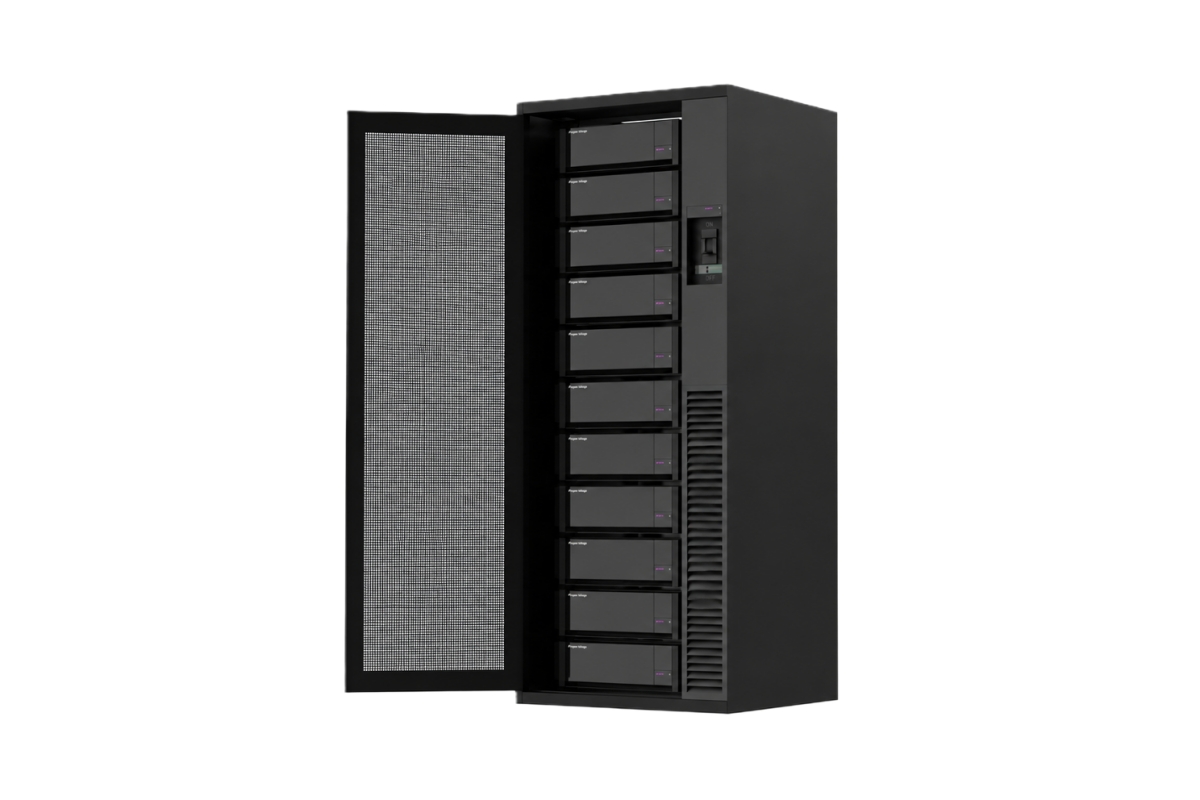
Vertiv, a global provider of critical digital infrastructure, has introduced new configurations of its MegaMod HDX prefabricated power and liquid cooling system for high-density computing deployments in North America and EMEA. The units are designed for environments using artificial intelligence and high-performance computing and allow operators to increase power and cooling capacity as requirements rise. Vertiv states the configurations give organisations a way to manage greater thermal loads while maintaining deployment speed and reducing space requirements. The MegaMod HDX integrates direct-to-chip liquid cooling with air-cooled systems to meet the demands of pod-based AI and GPU clusters. The compact configuration supports up to 13 racks with a maximum capacity of 1.25 MW, while the larger combo design supports up to 144 racks and power capacities up to 10 MW. Both are intended for rack densities from 50 kW to above 100 kW. Prefabricated scaling for high-density sites The hybrid architecture combines direct-to-chip cooling with air cooling as part of a prefabricated pod. According to Vertiv, a distributed redundant power design allows the system to continue operating if a module goes offline, and a buffer-tank thermal backup feature helps stabilise GPU clusters during maintenance or changes in load. The company positions the factory-assembled approach as a method of standardising deployment and planning and supporting incremental build-outs as data centre requirements evolve. The MegaMod HDX configurations draw on Vertiv’s existing power, cooling, and management portfolio, including the Liebert APM2 UPS (uninterruptible power supply), CoolChip CDU (cooling distribution unit), PowerBar busway system, and Unify infrastructure monitoring. Vertiv also offers compatible racks and OCP-compliant racks, CoolLoop RDHx rear door heat exchangers, CoolChip in-rack CDUs, rack power distribution units, PowerDirect in-rack DC power systems, and CoolChip Fluid Network Rack Manifolds. Viktor Petik, Senior Vice President, Infrastructure Solutions at Vertiv, says, “Today’s AI workloads demand cooling solutions that go beyond traditional approaches. "With the Vertiv MegaMod HDX available in both compact and combo solution configurations, organisations can match their facility requirements while supporting high-density, liquid-cooled environments at scale." For more from Vertiv, click here.

DCNN to host webinar with CRH
Resilient data centre infrastructure isn’t built at commissioning; it’s built at conception. DCNN and CRH, a US data centre construction specialist, are coming together for a powerful panel discussion exploring how early collaboration with building material providers and site engineers can shape smarter, stronger, and more sustainable data centres. The webinar, 'From the ground up: How future‑proofing data centres starts at the beginning of the project', is a must‑attend session for anyone involved in planning, designing, or delivering next‑generation facilities. Date: 19 February 2026Time: 3pm BST (10am EST)Location: Online (Zoom) Why join this webinar? • Understand how early‑stage decisions influence long‑term resilience • Hear directly from CRH’s global leaders in sustainability, innovation, and infrastructure delivery • Gain insights across the full project lifecycle - from planning to execution • Connect with experts shaping the future of data centre construction Meet the panel Moderator: Joe Peck, Assistant Editor, DCNN Frans Vreeswijk, VP Customer Solutions Strategy, CRH Americas Jenessa Miglietta, VP Sustainability & Innovation, CRH Americas Thomas Donoghue, VP Industry Innovation, CRH Group Click here to register now and be part of the conversation that starts at the foundation.

DE-CIX, Nomad Futurist partner to tackle skills gap
The Interconnection Academy, founded by internet exchange (IX) operator DE-CIX and the Universitat Pompeu Fabra in Barcelona, has formed a partnership with the Nomad Futurist Foundation, a nonprofit organisation advancing education in digital infrastructure, to widen access to free training covering networking, data centres, and interconnection. The collaboration aims to support skills development as digital infrastructure roles expand and organisations report difficulty filling technical posts. Industry research points to growing demand for skills in areas including networks, security, AI, and data, alongside an expected fall in available talent as experienced network engineers retire over the coming years. Through the agreement, both organisations will share selected online learning content and training modules, with new Interconnection Academy courses on networking and interconnection scheduled to launch in January and April 2026 and additional material planned later in the year. Shared content and new training pathways The Interconnection Academy is an online education initiative created to improve understanding of digital infrastructure and interconnection. It works with industry specialists and partner organisations to produce accessible technical and market-related material, aimed at supporting people entering the workforce as well as existing staff needing to update their knowledge. The Nomad Futurist Foundation is a non-profit organisation focused on raising awareness of the digital infrastructure sector through education and engagement. Its associated academy provides introductory and specialist learning covering data centre development, interconnection, and related areas. As part of the agreement, selected modules - beginning with content explaining data centre infrastructure - will be made available through the Interconnection Academy platform. The partnership announcement coincides with meetings between the organisations in Hawaii on 16 and 17 January, where Interconnection Academy founder and DE-CIX Chief Executive Ivo Ivanov will take part in the annual PTC Beyond Masterclass educational programme. Ivo notes, “With the advent of AI, we are facing the newest industrial revolution, in which we will need to further up-skill and re-skill workers for tomorrow’s industries.” Yolandi Cloete, Manager of the Global Interconnection Academy, comments, “Working with the Nomad Futurist Foundation enables us to expand access to high-quality educational offerings and co-create and share industry-relevant learning modules with a trusted partner. "The two organisations are united by a shared passion for education and innovation in the digital infrastructure space.” Nabeel Mahmood, co-founder and CEO of the Nomad Futurist Foundation, adds, “Digital infrastructure touches every part of modern life, yet very few people truly understand how it works or the opportunities it creates. "By partnering with the Interconnection Academy, we’re bridging that gap, making complex concepts approachable, and helping people see a future for themselves in this industry. Education is the on-ramp to inclusion, innovation, and long-term impact.” For more from DE-CIX, click here.

Janitza launches UMG 801 power analyser
Modern data centres often face a choice between designing electrical monitoring systems far beyond immediate needs or replacing equipment as sites expand. Janitza, a German manufacturer of energy measurement and power quality monitoring equipment, says its UMG 801 power analyser is designed to avoid this issue by allowing users to increase capacity from eight to 92 current measuring channels without taking systems offline. The analyser is suited to compact switchboards, with a fully expanded installation occupying less DIN rail space than traditional designs that rely on transformer disconnect terminals. Each add-on module introduces eight additional measuring channels within a single sub-unit, reducing physical footprint within crowded cabinets. Expandable monitoring with fewer installation constraints The core UMG 801 unit supports ten virtual module slots that can be populated in any mix. These include conventional transformer modules, low-power modules, and digital input modules. Bridge modules allow measurement points to be located up to 100 metres away without consuming module capacity, reducing wiring impact and installation complexity. Sampling voltage at 51.2 kHz, the analyser provides Class 0.2 accuracy across voltage, current, and energy readings. This level of precision is used in applications such as calculating power usage effectiveness (PUE) to two decimal places, as well as assessing harmonic distortion that may affect uninterruptible power supplies (UPS). Voltage harmonic analysis extends to the 127th order, and transient events down to 18 microseconds can be recorded. Onboard memory of 4 GB also ensures data continuity during network disruptions. The system is compatible with ISO 50001 energy management frameworks and includes two ethernet interfaces that can operate simultaneously to provide redundant communication paths. Native OPC UA and Modbus TCP/IP support enable direct communication with energy management platforms and legacy supervisory control systems, while whitelisting functions restrict access to approved devices. RS-485 additionally provides further support for older infrastructure. Configuration is carried out through an integrated web server rather than proprietary software, and an optional remote display allows monitoring without opening energised cabinets. Installations typically start with a single base unit at the primary distribution level, with additional modules added gradually as demand grows, reducing the need for upfront expenditure and avoiding replacement activity that risks downtime. Janitza’s remote display connects via USB and mirrors the analyser’s interface, providing visibility of all measurement channels from the switchboard front panel. Physical push controls enable parameter navigation, helping users access configuration and measurement information without opening the enclosure. The company notes that carrying out upgrades without interrupting operations may support facilities that cannot accommodate downtime windows. For more from Janitza, cick here.

Southco develops blind-mate mechanism for liquid cooling
Southco, a US manufacturer of engineered access hardware including latches, hinges, and fasteners, has developed a high-tolerance blind-mate floating mechanism designed for next-generation liquid-cooled data centres. The company says the design is intended to address mechanical tolerance challenges that affect cooling system efficiency and operational stability. It notes that demand for liquid cooling is increasing as traditional air-cooling methods struggle to manage higher power densities associated with AI workloads and high-performance computing. Adoption is accelerating further as operators pursue sustainability and targeted PUE reductions. Liquid cooling, however, requires reliable physical connections, with Southco highlighting that even small alignment deviations at manifold and cold-plate interfaces can disrupt coolant flow, increase pump energy consumption, and heighten the risk of leaks. Managing mechanical deviation in liquid cooling systems Citing guidance in the Open Compute Project’s rack-mounted manifold requirements, Southco notes that a 1mm deviation can raise flow resistance by 15%, leading to around a 7% increase in pump energy. In large facilities, these effects scale alongside thousands of connection points. The company identifies several contributors to misalignment in operational environments: • Accumulated tolerances between rack formats, including EIA-310-D and ORV3, which may reach ±3.2mm • Displacement caused by vibration during transport and operation • Thermal expansion of materials, including copper manifolds expanding more than 1mm over typical temperature ranges Rigid, low-tolerance couplings can leave systems vulnerable to leaks, rising operational costs, and downtime risk, and the newly introduced blind-mate floating mechanism is designed to absorb movement and compensate for these deviations. The product offers floating tolerance of ±4mm radially, axial displacement absorption up to 6mm, and automatic self-centring when disconnected. The design is intended to support long-term leak prevention and meet standards applicable to OCP and ORV3 liquid cooling deployments. Southco adds that the mechanism includes sealing rated to withstand high-pressure testing in line with ASME B31.3 requirements and is intended to support more than ten years of continuous operation. It uses universal quick-disconnect interfaces to enable “blind” maintenance without precise alignment or tooling. The company positions the technology as a step towards enabling rapid maintenance, reducing equipment handling time, and lowering the risk of service interruption. It also points to reduced energy used by pumps through lower flow resistance. Southco sees future development in integrating sensing for temperature, flow, and pressure; exploring lighter materials; and working towards greater standardisation across suppliers and data centre ecosystems.

ISE 2026 returns to Barcelona
Integrated Systems Europe (ISE) 2026 returns to Fira de Barcelona, Gran Via from 3–6 February, inviting attendees to ‘Push Beyond’ the boundaries of cyber security and intelligence. The organisers state that this event is "where visionaries, creators, and innovators unite to shape the future, foster collaboration, and spark new ideas." As AV systems become more integrated within enterprise, public sector, and venue settings, they are increasingly subject to the same security risks as conventional IT infrastructures. Whether deployed in control rooms, conferencing platforms, digital signage, smart buildings, or event venues, AV solutions have become prominent targets for threats such as ransomware, data breaches, social engineering, and denial-of-service attacks. ISE 2026 aims to push beyond to dive deeper into this defining megatrend, the importance of collaboration and innovation, and preparing AV professionals for safeguarding the future from emerging digital threats. CyberSecurity Summit On Thursday, 5 February, 09:00–12:00 in CC5.1, ISE 2026 will host the brand-new CyberSecurity Summit, a gathering for AV professionals and business leaders determined to strengthen their organisation’s defences. Recognising cyber security as a business-critical priority, the Summit will examine its pivotal role in securing public tenders, ensuring regulatory compliance, and maintaining client trust. Expert speakers will address urgent real-world challenges, guide delegates in pinpointing the most pressing risks, and outline practical, actionable strategies. During the summit, AV professionals will learn about safeguarding critical systems, navigate evolving regulations like NIS2 and ISO 27001, and transform cyber security from a vulnerability into a strategic advantage. Attendees should leave equipped with a clear, sector-relevant roadmap to enhance their organisations' digital resilience in an increasingly connected world. Summit Chair Pere Ferrer i Sastre, former Director General of the Catalan Police (Mossos d’Esquadra), has extensive experience in public security, digital transformation, regulatory frameworks, and critical infrastructure management. He will facilitate discussions addressing emerging digital threats to the AV and systems integration sectors from years of experience in the field. Cybersecurity megatrends This feeds into one of ISE’s defining megatrends for 2026: cyber security. These are environments where safeguarding critical infrastructure and public services against cyber threats has become paramount. At ISE 2026, you’ll discover how the cyber security ecosystem is pushing beyond boundaries to deliver intelligent, resilient, and secure systems that are equipped to protect public sector operations and ensure ongoing wellbeing amidst evolving digital threats. Other megatrends include: AI, robotics, smart spaces, sustainability, and tradescape. Strategies, innovation, and collaboration at ISE Hackathon Putting cyber security prevention into action, the ISE Hackathon brings together a dynamic community of highly skilled participants, representing top international universities. For 48 hours, the student participants will engage in rapid networking, collaboration, brainstorming, and innovation engineering to solve a business challenge, before pitching their ideas to the judging panel. This year, the event will once again offer three separate tracks: cyber security, sustainability, and innovation. The Hackathon is designed to serve as a catalyst for innovation, challenging participants to address critical security challenges through collaborative problem-solving. Connect, collaborate, and revolutionise Sol Rashidi, Chief AI Officer for enterprises, will headline ISE on Wednesday, 5 February 2026. Her keynote, ‘The AI Reality Check: What It Takes to Scale and the Future of Leadership’, will aim to expose the realities of AI beyond the hype, offering practical frameworks and highlighting the importance of AI governance and cyber security for successful scaling. The organisers say ISE 2026 is "more than just an exhibition; it’s a platform for networking, learning, and discovering new ways to drive value in your organisation." With opportunities to meet leading brands, share knowledge with peers, and explore emerging trends in cyber security and AI, those running the event hope every attendee will leave better equipped for the challenges ahead. Why attend ISE 2026? Whether you’re focused on enhancing communication within your organisation or delivering unforgettable live experiences, ISE 2026 is the event that brings it all together. Don’t miss your chance to be at the forefront of industry transformation. Click here to head to the website and register for free with the code ‘dcnnews’ to secure your place.

SPAL targets data centre cooling needs
SPAL Automotive, an Italian manufacturer of electric cooling fans and blowers, traditionally for automotive and industrial applications, is preparing to showcase its cooling technology at Data Centre World in London in March 2026, with a particular focus on brushless drive water pumps used in data centre thermal management. The pumps are designed for stationary applications where cooling demand is continuous and high. They feature software control compatibility - including CAN, PWM, and LIN - supporting precise regulation of coolant flow and temperature. The company says the pumps consume less power than mechanically driven units and use IP6K9K-rated brushless systems intended to mitigate issues such as overload, reverse polarity, and overvoltage. The role of cooling components in data centres Alongside its pumps, SPAL will display its wider cooling portfolio, which includes fans and blowers designed for controlled airflow and heat dissipation. The company plans to highlight the use of matched replacement components, particularly for systems that rely on coordinated assemblies of fans, pumps, and related controls. James Bowett, General Manager at SPAL UK, says, “In a world where costs are constantly under pressure, it’s false economy to opt for cheaper parts as this will not only affect the performance of the component itself, but the entire suite of parts within a system. "The only way to ensure effective, reliable, long-life operation is to replicate the set up installed at the point of manufacture. That means choosing the best calibre parts throughout.” SPAL states that its products are supplied with a four-year manufacturer’s warranty and are used to help maintain stable conditions for sensitive electronics. The company highlights that the growth of data centres linked to AI and cloud services is increasing demand for equipment designed specifically for energy efficiency, water use, and controlled cooling. SPAL will exhibit at Data Centre World on Stand F15, held at ExCeL London on 4–5 March 2026.

VIRTUS Data Centres names new CEO
VIRTUS Data Centres, a UK data centre owner-operator and part of ST Telemedia Global Data Centres (STT GDC), today announced the appointment of Adam Eaton as Chief Executive Officer, effective immediately. Under Adam’s leadership, VIRTUS says it will continue to "expand [its] portfolio of high-efficiency, sustainable data centres, building on a decade of rapid growth across the UK and Europe." The company adds that it "remains committed to [its] vision to deliver world-class, energy-efficient infrastructure that supports the growth of the digital economy." Bruno Lopez, President and Group CEO at STT GDC and Chairman at VIRTUS Data Centres, comments, “We are delighted to welcome Adam to VIRTUS at an exciting time. "His insight and proven ability to scale complex operations make him the ideal leader for the business as VIRTUS continues to grow its footprint and strengthen its position as one of Europe’s leading data centre operators. "We look forward to this new chapter of leveraging Adam’s knowledge, expertise, and stakeholder management skills for further growth across the business.” Adam says, “I first met the VIRTUS team over 15 years ago. Since then, I’ve watched the company evolve into one of Europe’s leading data centre operators. "Helping VIRTUS scale and support its next phase of growth is an exciting opportunity. I’m privileged to build on the foundations laid by the existing team, embracing one of the most exciting leadership roles in the industry today.” Decades of experience Adam brings a combination of commercial and operational expertise to VIRTUS. With over 20 years of experience spanning the data centre, cloud, and managed services sectors, he brings a track record of strategic leadership, business transformation, and operational performance. Most recently, Adam served as Executive Group Director for Europe at Global Switch, where he led the business across the FLAPM (Frankfurt, London, Amsterdam, Paris and Madrid) markets and drove transformation plans to strengthen the business’ performance and scale. Adam steps into the CEO role previously held by Thomas Ee, Group Chief Operating Officer of STT GDC, in an interim capacity for the past nine months. For more from VIRTUS, click here.

The blueprint for tomorrow’s sustainable data centres
In this exclusive article for DCNN, Francesco Fontana, Enterprise Marketing and Alliances Director at Aruba, explores how operators can embed sustainability, flexibility, and high-density engineering into data centre design to meet the accelerating demands of AI: Sustainable design is now central to AI-scale data centres The explosive growth of AI is straining data centre capacity, prompting operators to both upgrade existing sites and plan large-scale new-builds. Europe’s AI market, projected to grow at a 36.4% CAGR through 2033, is driving this wave of investment as operators scramble to match demand. Operators face mounting pressure to address the environmental costs of rapid growth, as expansion alone cannot meet the challenge. The path forward lies in designing facilities that are sustainable by default, while balancing resilience, efficiency, and adaptability to ensure data centres can support the accelerating demands of AI. The cost of progress Customer expectations for data centres have shifted dramatically in recent years. The rapid uptake of AI and cloud technologies is fuelling demand for colocation environments that are scalable, flexible, and capable of supporting constantly evolving workloads and managing surging volumes of data. But this evolution comes at a cost. AI and other compute-intensive applications demand vast amounts of processing power, which in turn place new strains on both energy and water resources. Global data centre electricity usage is projected to reach 1,050 terawatt-hours (TWh) by 2026, placing data centres among the world’s top five national consumers. This rising consumption has put data centres firmly under the spotlight. Regulators, customers, and the wider public are scrutinising how facilities are designed and operated, making it clear that sustainability can no longer be treated as optional. To survive amongst these new expectations, operators must balance performance with environmental responsibility, rethinking infrastructure from the ground up. Steps to a next-generation sustainable data centre 1. Embed sustainability from day one Facilities designed 'green by default' are better placed to meet both operational and environmental goals, and this why sustainability can’t be an afterthought. This requires renewable energy integration from the outset through on-site solar, hydroelectric systems, or long-term clean power purchase agreements. Operators across Europe are also committing to industry frameworks like the Climate Neutral Data Centre Pact and the European Green Digital Coalition, ensuring progress is independently verified. Embedding sustainability into the design and operation of data centres not only reduces carbon intensity but also creates long-term efficiency gains that help manage AI’s heavy energy demands. 2. Build for flexibility and scale Modern businesses need infrastructures that can grow with them. For operators, this means creating resilient IT environments with space and power capacity to support future demand. Offering adaptable options - such as private cages and cross-connects - gives customers the freedom to scale resources up or down, as well as tailor facilities to their unique needs. This flexibility underpins cloud expansion, digital transformation initiatives, and the integration of new applications - all while helping customers remain agile in a competitive market. 3. Engineering for the AI Workload AI and high-performance computing (HPC) workloads demand far more power and cooling capacity than traditional IT environments, and conventional designs are struggling to keep up. Facilities must be engineered specifically for high-density deployments. Advanced cooling technologies, such as liquid cooling, allow operators to safely and sustainably support power densities far above 20 kW per rack, essential for next-generation GPUs and other AI-driven infrastructure. Rethinking power distribution, airflow management, and rack layout ensures high-density computing can be delivered efficiently without compromising stability or sustainability. 4. Location matters Where a data centre is built plays a major role in its sustainability profile, as regional providers often offer greater flexibility and more personalised services to meet customer needs. Italy, for example, has become a key destination for new facilities. Its cloud computing market is estimated at €10.8 billion (£9.4 billion) in 2025 and is forecast to more than double to €27.4 billion (£23.9 billion) by 2030, growing at a CAGR of 20.6%. Significant investments from hyperscalers in recent years are accelerating growth, making the region a hotspot for operators looking to expand in Europe. 5. Stay compliant with regulations and certifications Strong regulatory and environmental compliance is fundamental. Frameworks such as the General Data Protection Regulation (GDPR) safeguard data, while certifications like LEED (Leadership in Energy and Environmental Design) demonstrate energy efficiency and environmental accountability. Adhering to these standards ensures legal compliance, but it also improves operational transparency and strengthens credibility with customers. Sustainability and performance as partners The data centres of tomorrow must scale sustainably to meet the demands of AI, cloud, and digital transformation. This requires embedding efficiency and adaptability into every stage of design and operation. Investment in renewable energy, such as hydro and solar, will be crucial to reducing emissions. Equally, innovations like liquid cooling will help manage the thermal loads of compute-heavy AI environments. Emerging technologies - including agentic AI systems that autonomously optimise energy use and breakthroughs in quantum computing - promise to take efficiency even further. In short, sustainability and performance are no longer competing objectives; together, they form the foundation of a resilient digital future where AI can thrive without compromising the planet. For more from Aruba, click here.

AirTrunk opens hyperscale data centre campus in Melbourne
AirTrunk, a hyperscale data centre specialist in the Asia Pacific & Middle East region, has announced the acquisition of a new site in Melbourne’s North West for its second Melbourne campus, to be known as MEL2. With over 354MW capacity, MEL2 will add more than AUD $5 billion (£2.48bn) in new direct investment and lift AirTrunk’s total deployable capacity in Melbourne to over 630 MW. Across MEL1 and MEL2, AirTrunk’s investment in the city’s digital infrastructure will exceed AUD $7 billion (£3.45bn), delivering one of the largest economic and productivity boosts to Victoria. MEL2 is expected to create over 4,000 jobs during the multi-phase construction and over 200 direct jobs, once operational. In addition, AirTrunk will boost the local supply chain creating in excess of 1,000 full-time jobs to support its data centres. The new site will complement AirTrunk’s existing Australian campuses, giving global AI and cloud customers greater geographical diversity across the Sydney and Melbourne markets. AirTrunk will operate five campuses nationally - SYD1 (121 MW+), SYD2 (158 MW+), SYD3 (330 MW+), MEL1 (276 MW+), and MEL2 (354 MW+) - delivering a combined capacity of more than 1.2 GW. Robin Khuda, Founder & CEO of AirTrunk, says, “Australia has set bold ambitions to become a global AI hub, and demand for AI ready infrastructure continues to grow. MEL2 is part of our response. Working closely with Invest Victoria, we’re expanding in Melbourne to support Australia’s AI future while creating new opportunities for local business and communities. “AI data centres require significant upfront investment, and AirTrunk’s strong balance sheet and proven regional track record helps give global AI customers confidence in reliable, on time deployment in Australia.” Victorian Premier, the Hon. Jacinta Allan, adds, “Victoria is leading Australia’s digital transformation, and investments like this will strengthen our state’s position as a hub for cloud and AI innovation, create thousands of jobs, and deliver sustainable infrastructure that supports our growing technology ecosystem." AirTrunk’s expansion in Melbourne follows last week’s announcement of a new hyperscale campus in Osaka, Japan, delivering up to 100MW of IT load in Japan and a AUD $3 billion-plus (£1.48bn) new direct investment in Japan. OSK2 and MEL2 - which will become AirTrunk’s fourteenth and fifteenth data centres respectively - expand the company’s hyperscale platform to deliver a total capacity in excess of 2.6 GW across six markets in Asia Pacific and Middle East: Australia, Singapore, Japan, Malaysia, Hong Kong and Saudi Arabia. AirTrunk’s Melbourne expansion comes as Australia advances its National AI Plan, released in late 2025, which outlines the country’s ambition to become a global hub for artificial intelligence. The plan is built around three pillars: capturing the opportunity through investment in infrastructure and skills, spreading the benefits across industries and communities, and keeping Australians safe through responsible AI governance. By delivering a new hyperscale data centre in Melbourne, AirTrunk says that it is directly supporting these national goals, enabling smarter government services, faster business innovation, and stronger human connection, while creating opportunities for local talent and suppliers. For more from AirTrunk, click here.


Translate »