Data Centre Regulations & UK Compliance Updates


How to ensure your infrastructure complies with DORA
In this exclusive article for DCNN, Chris Noon, Director of Solution Engineering, International at Alkira, outlines how financial institutions must embed security, resilience, and transparency into their network infrastructure to meet the demands of DORA: Rethinking network infrastructure The Digital Operational Resilience Act (DORA) marks a major change in how the European financial sector manages technology risk. Instead of focusing only on solvency, DORA emphasises keeping digital services running smoothly. For enterprise organisations, this means every part of the technology stack, especially the network infrastructure connecting cloud environments and data centres, must be reviewed with operational resilience and security in mind. With this new framework, financial institutions are ultimately responsible for their digital resilience, even as they rely more on a complex network of ICT third-party service providers. To manage this, IT and compliance teams need to shift from reactive security to building systems where resilience is built in from the start. The core pillars of DORA compliance DORA requires financial organisations to have a complete strategy for managing ICT risks. This strategy should address five main areas: ICT risk management, incident reporting, operational resilience testing, third-party risk management, and information sharing. From an infrastructure point of view, the regulation says organisations must treat their network and cloud providers as essential parts of service delivery. IT teams should make sure providers go beyond just offering a service-level agreement and also give clear information about how their systems are built, managed, and secured. Security by design in network infrastructure To build security by design, start by choosing infrastructure platforms that follow well-known industry standards. When reviewing a network provider, IT teams should look for signs of a "born-in-the-cloud" or "security-first" approach. This shows the platform was built to work in high-risk, tightly regulated settings. Key indicators of a security-by-design approach include: • Identity and access governance — Providers should have strong identity and access management (IAM) features, such as multi-factor authentication (MFA); detailed, role-based access control (RBAC); and Policy Based Access Control (PBAC). This helps make sure only authorised people can change important network settings. • Encrypted connectivity — Security by design means data must be protected both while moving and when stored. Network providers should make it easy to use encryption across multi-cloud and hybrid setups without making operations more complicated. • Independent validation — Security claims need to be supported by third-party audits. Certifications like SOC 2 Type II, which cover security, availability, and confidentiality, are important standards. These reports give the proof needed for the due diligence required by DORA. Building for operational resilience Operational resilience means a company can handle, respond to, and recover from technology problems. For DORA, this means the network should not have a single point of failure. A resilient setup is usually spread out so if one part fails, traffic is rerouted to keep services running. IT teams should choose providers that focus on high availability as a key part of their services. This means having constant monitoring and alerts to catch problems early. The provider should also have a clear and tested incident response plan. DORA requires financial institutions to report major ICT incidents to regulators quickly, so the network provider must be able to supply the needed data and logs for fast investigation and reporting. Managing third-party risk and oversight A major challenge with DORA is the extra oversight of third-party providers. Financial organisations now have to include clear contract terms about oversight and audit rights. This need for transparency can be hard for some traditional technology providers to handle. When choosing an infrastructure partner, organisations should pick providers with clear processes for handling compliance questions. This means they can share security policies, operational procedures, and proof of regular penetration testing under non-disclosure agreements. The provider should act as a partner, helping the customer meet regulatory requirements, not just supplying a technical service. The role of Infrastructure-as-a-Service (IaaS) As financial institutions update their networks, many are choosing Infrastructure-as-a-Service (IaaS) models to handle the complexity of multi-cloud environments. These platforms connect on-premises data centres with different cloud service providers, acting as the system’s central hub. To meet DORA requirements, an IaaS platform must show it does not create new risks. It should be built on a well-known cloud infrastructure that already meets strong security standards. Using a resilient IaaS model helps IT teams see their whole network clearly, making risk management and compliance easier. Practical steps for IT teams To get ready for DORA, IT and risk management teams should take these practical steps with their network providers: 1. Conduct comprehensive due diligence — Check current and potential providers to make sure they meet DORA’s rules for security controls, incident response, and resilience testing. 2. Audit contractual arrangements — Make sure contracts clearly state audit rights, service levels, and the provider’s duty to help during a regulatory inquiry. 3. Evaluate multi-cloud strategy — Check if your current network setup allows you to quickly move workloads between cloud providers if one goes down. 4. Establish clear reporting lines — Decide how the network provider will communicate during an incident and what information they will give to support your reporting needs. Looking forward DORA is an ongoing operational process, not a one-off project. As regulations change, the need for operational resilience will only grow. Financial institutions that focus on security by design and pick infrastructure partners who value transparency and reliability will be better prepared for these changes. In the end, resilience is something everyone shares. The financial organisation is still responsible to the regulator, but its compliance success depends on its technology providers. By choosing providers who see compliance as a key part of their design, organisations can build a digital foundation that meets DORA and supports the future of digital finance.


AECOM calls for sovereign UK data centre framework
AECOM, a US multinational infrastructure consulting firm, is advocating for the establishment of a sovereign data centre framework to protect critical digital infrastructure and ensure the UK benefits from the rapid growth of AI. As AI becomes embedded across public services and regulated sectors, questions of where sensitive data is hosted and who controls the infrastructure that underpins it are becoming more critical. In a new report, Data centres, energy and regional growth: a road map to success, AECOM cautions that while global investment in data centres is accelerating, the UK risks losing strategic control and economic value unless growth is guided by clearer national priorities, coordinated planning, and stronger alignment between energy, infrastructure, and regional development. The report makes the case that delivering secure, UK-based infrastructure for sensitive AI and public-sector workloads will require clearer long-term signals and greater coordination between government and industry, alongside continued private investment. “Data centres are now critical national infrastructure in every meaningful sense”, says Mary-Ann Clarke, UK and Europe Data Centre Lead at AECOM. “A clear sovereign framework would give developers and investors greater certainty, strengthen resilience, and help ensure the UK retains control over a critical layer of its digital economy.” The report’s key recommendations include: • Establishing a sovereign data centre infrastructure framework for sensitive public-sector and regulated workloads, supported by clear demand signals and long-term contracting models • Actively steering where digital demand is located, directing high-intensity computing towards locations that support the energy system, unlock powered land, and enable regional growth • Incentivising system-positive data centres that strengthen the energy system through flexible demand, waste heat reuse, and on-site generation • Positioning data centres as anchors for regional growth, aligning major developments with skills, energy, and regeneration strategies “The UK has made important progress in recognising the strategic role of data centres and AI-enabled infrastructure, particularly through recent planning and energy reforms,” notes Adrian Del Maestro, Vice President, Global Energy Advisory at AECOM. “The next step is to build on that momentum by providing clearer long-term signals on where critical digital infrastructure should be located, how it is powered, and how sensitive workloads are secured.” For more from AECOM, click here.

Data Centre Alliance, Clear Decisions launch Regulatory Radar
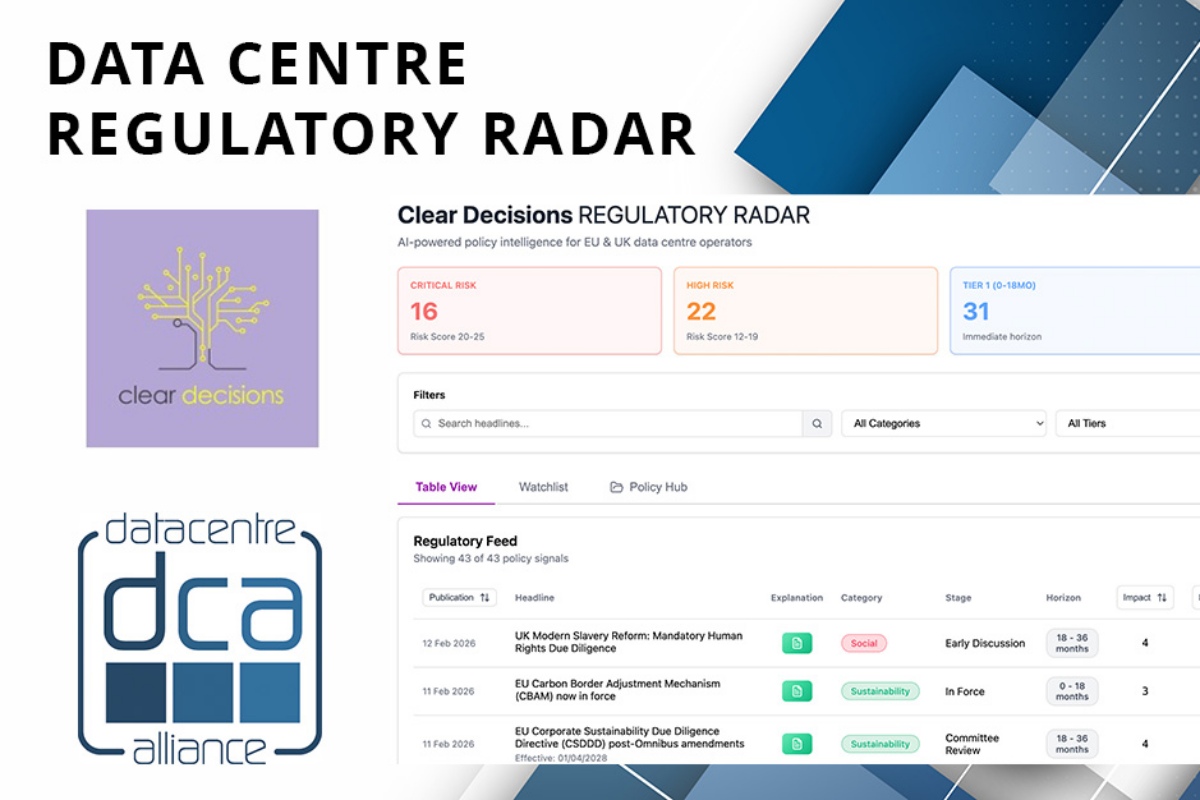
The Data Centre Alliance (DCA), a UK trade association for the data centre sector, and Clear Decisions, a regulatory compliance and sustainability reporting platform for data centre operators, have launched Regulatory Radar, a regulatory intelligence platform developed specifically for the data centre sector. The platform is designed to provide structured, real-time updates on policy and regulatory developments across the UK and EU, including energy reform, planning policy, sustainability regulation, and AI infrastructure strategy. Regulatory Radar combines AI-based analysis with expert review. The organisations state this approach is intended to ensure updates are interpreted in context and linked to potential operational and commercial impact. Tracking policy change across UK and EU The platform includes forward-looking analysis of planning, energy, and sustainability reform, alongside monitoring of digital and AI policy developments. It also identifies emerging compliance and reporting requirements. According to the DCA and Clear Decisions, the aim is to consolidate regulatory developments into a single source and provide greater visibility of potential risks and strategic considerations for data centre operators and investors. Steve Hone, Chief Executive of the Data Centre Alliance, says, “The regulatory landscape for digital infrastructure is evolving faster than ever. Our sector cannot afford to operate on partial information or delayed insight. "Regulatory Radar combines AI-driven intelligence with expert oversight to give operators and investors the foresight required to anticipate change, shape engagement, and protect long-term value. This collaboration sets a new benchmark for industry intelligence.” Regulatory Radar is available to DCA corporate members and Clear Decisions subscribers. For more from the DCA, click here.

'UK cannot delay action on power and infrastructure'
The UK must take urgent action to fix systemic issues in energy and infrastructure to sustain its ambition to lead the global digital economy and become an AI superpower, according to a new report published by trade association techUK. The report, Powering Digital Infrastructure, warns that while demand for data centres and compute infrastructure is accelerating rapidly - driven by AI, cloud, and edge computing - the UK’s energy system is struggling to keep pace. Without reform, rising electricity costs, grid connection delays, and fragmented policy could force investment overseas, undermining economic growth, innovation, and national resilience. The current problems Data centres are now critical national infrastructure (CNI), underpinning everything from financial services and healthcare to research, manufacturing, and public services, all while supporting the Clean Power 2030 Action Plan through Power Purchase Agreements (PPAs) and decarbonised heat. techUK's 2024 report highlights that the UK data centre sector already contributes billions to the economy and supports tens of thousands of jobs, with the potential to add an additional £44 billion in Gross Value Added between 2025 and 2035, if growth accelerates. The UK aims to triple compute capacity to around 6GW by 2030; however, this is colliding with structural constraints. Electricity prices for UK data centres are among the highest in the developed world - roughly four times those in the United States and about 46% above the median of 31 International Energy Agency (IEA) countries - while grid connection delays of up to eight years are becoming commonplace. As a result, techUK’s report identifies several interconnected risks for the UK if the situation remains unchanged, including loss of global competitiveness, grid bottlenecks and delays, and risks to the country's energy security and resilience, which could be compounded by growing geopolitical shocks and tensions. If left unaddressed, the report warns that the UK will struggle to meet its ambition of being an “AI maker”, weakening sovereignty and long-term economic control. The proposed solutions The report sets out a clear programme of solutions to minimise these risks: • Reform the grid connections process to prioritise committed, non-speculative projects; provide greater transparency over the queue; and offer phased connection agreements that reflect how data centres are actually built. • Reduce electricity costs for digital infrastructure through levy reform, targeted exemptions, and improved access to long-term power contracts, restoring international competitiveness. • Accelerate planning and delivery by enabling nationally significant data centre projects to move faster through the planning system and clarifying eligibility for prioritisation schemes. • Unlock private investment in networks by allowing the private sector to help build and finance grid infrastructure where it can reduce delays and costs. • Align digital growth with clean power by supporting renewable PPAs, co-location with generation, energy storage, and, where appropriate, nuclear and small modular reactors (SMRs). • Maximise local benefits by embedding data centres into regional growth strategies, supporting skills development, waste-heat reuse, and supply-chain expansion. Data centres can be part of the solution, acting as anchor customers for new renewable generation, supporting grid investment, and helping spread fixed system costs across a larger base of electricity demand. Matthew Evans, COO and Director of Markets for techUK, says, “Economic growth is directly linked to power and our country’s ability to digitise. If the UK is serious about unlocking economic growth, it needs to move decisively to fix energy costs, grid access, and regulatory fragmentation. "The results will unlock new cycles of investment and support the country’s decarbonisation efforts, as well as both national and regional growth. If we don’t, the UK risks falling behind at the very moment global competition is accelerating.”

UK parliamentarians launch Data Centres APPG
MPs and peers have launched a new All-Party Parliamentary Group (APPG) focused on data centres, examining the sector’s role in economic growth, digital infrastructure resilience, and net zero targets. The cross-party group is chaired by Chris Curtis MP, Labour MP for Milton Keynes North and Chair of the Labour Growth Group. Other officers include: • Lewis Cocking MP, Conservative MP for Broxbourne (as co-chair)• Alison Griffiths MP, Conservative MP for Bognor Regis and Littlehampton• Lord Philip Hunt of Kings Heath OBE, former Minister of State for Energy Security and Net Zero The APPG aims to improve parliamentary understanding of data centre development across the UK, review challenges and opportunities facing the sector, and produce evidence-based policy recommendations. The group will examine areas including infrastructure delivery, planning considerations, and energy demand linked to sector growth. The APPG has opened a formal call for evidence, inviting contributions from across the digital infrastructure ecosystem. Submissions will help shape the group’s Terms of Reference and define its areas of focus for 2026. Stakeholders invited to contribute include data centre operators and developers, energy suppliers, network operators, water providers, investors, consultancy organisations, local authorities, technology providers, trade associations, environmental groups, and academic institutions. Consultation launched to gather industry evidence Chris Curtis MP, Chair of the Data Centres APPG, notes, “Data centres are a vital part of the UK’s digital economy, and it is essential that we remain an attractive destination for the investment that drives growth and creates high-skilled jobs. "As Chair of the APPG, I want to ensure Parliament has the evidence and understanding it needs to shape a balanced approach: one that supports development, delivers real economic benefits, and works for local communities, while recognising wider considerations. "Getting this right will be critical to securing the UK’s long-term digital future.” Lewis Cocking MP, Co-Chair of the Data Centres APPG, adds, “Data centre development must work for the communities that host them. Google's £1 billion investment at Waltham Cross is a clear sign of Broxbourne's growing importance as a hub for technology and innovation, and we must ensure this growth delivers genuine benefits for local people. "This new APPG will focus on ensuring that local voices are heard in planning processes, that developments deliver tangible benefits (such as local jobs and waste heat utilisation), and that the highest environmental standards are met. "Local residents need to have a real say in projects like these. We'll work to ensure developments like Google's enhance Broxbourne and other local areas while meeting our environmental commitments.” Lord Hunt of Kings Heath OBE, Officer of the Data Centres APPG, says, “As a former Minister of State for Energy Security and Net Zero, I've seen firsthand how critical it is to align infrastructure growth with our climate commitments. "Data centres are major energy users, but they're also driving innovation in renewable energy procurement and efficiency. "This APPG will focus on ensuring their growth supports our net zero ambitions, exploring how these facilities can contribute to clean energy infrastructure, utilise waste heat, and support grid modernisation. "With the right policy framework, we can build the digital capacity our economy needs while advancing our environmental goals. Data centres shouldn't be seen as a challenge to net zero, but as part of the solution.”

FTTH Council Europe welcomes the DNA
The FTTH Council Europe, a European industry association promoting fibre-optic broadband deployment across Europe, has said it welcomes the Digital Networks Act, as put forward by the European Commission. The mission of the FTTH Council Europe is to see the widespread availability and use of FTTH (Fibre to the Home) in Europe as quickly as possible. It therefore maintains that it is important to ensure that the regulatory framework incentivises investment and fosters effective competition, adding that that these two objectives must remain at the core of any access policy. The FTTH Council Europe positively welcomes the proposal for the switch-off of copper networks. The process, it claims, strikes the right balance between the need to incentivise the take-up of future-proof networks, the necessity to consider national specificities, and avoiding unintended consequences for consumers. The association says it is convinced that copper switch-off is an important driver for investments and that it will positively contribute to the competitiveness of the EU, supporting the digital transition and the enhancement of the Single Market. Therefore, it invites the co-legislators to support the European Commission approach on this topic. The FTTH Council Europe further considers that the current regulatory framework has delivered positive outcomes. It believes maintaining the SMP process in the proposed DNA is central to preserving competition and demonstrates the Commission’s commitment to a stable and predictable regulatory environment, something critical to supporting investors and enabling the continued development of sustainable competition. The Council also notes the proposed harmonised access products but believes that any remedies should start by being tailored to the specific realities of national and market contexts, which can vary significantly between countries and market segments. National Regulatory Authorities (NRAs), it propounds, are best positioned to define, where necessary, appropriate SMP obligations that reflect the unique characteristics of their markets. The FTTH Council Europe also acknowledges the provisions on security and resilience in the DNA that recognise the critical importance of communications infrastructure. However, the body invites the co-legislators to make clear that any obligation that may arise should be adequately supported by national and European resources in the next MFF and not create excessive burdens for a sector that is investing heavily in the achievement of the Digital Decade targets. There are other aspects that need refinement, according to the FTTH Council Europe, and there are certain issues where it believes a different approach should be taken, not least regarding the availability of licence-free spectrum for RLAN. The FTTH Council Europe says it looks forward to working constructively with co-legislators to share its insights and experience in refining this proposal.

UK Chancellor urged to use AI for economic growth
UK Chancellor Rachel Reeves has been urged to use the opportunity afforded by AI to ‘Make Britain Great Again’. The news comes as the Government announced that thousands of new AI jobs and billions of pounds of investment will be poured into the next parliament to help stimulate economic growth. New AI Growth Zones Amongst the package of measures proposed for the budget today include a new AI Growth Zone in South Wales, which will create more than 5,000 new jobs for local communities over the next decade, and a further £137 million to support key scientists to drive breakthroughs and develop new drugs, cures, and treatments. Patrick Sullivan, CEO of think tank Parliament Street, argued that with limited options at the budget, only AI can ‘Make Britain Great Again’. He claims, “With limited options due to Labour’s absurd manifesto pledge to rule out income tax rises, the Chancellor is now forced to cobble together a quick fix solution to fill a black hole which is entirely of her own making. "However, the one saving grace is the advent of mass AI adoption, a technology that will bring mass savings at a time when the Government needs it most. “This is Labour’s chance to show that it gets private enterprise and recognises that by supporting tech talent, AI can truly Make Britain Great Again.” Tech expert Graeme Stewart, Head of Public Sector at Check Point Software, says, “The case for investing billions in AI to drive growth and reboot the economy is clear, yet little has been said about the cyber and regulatory risks associated with mass adoption. “Whether it’s attacks on the NHS, nurseries, or local councils, cyber criminals have already proven that nothing in the public sector is off limits. That’s why it’s vital the Chancellor’s AI rollout is backed up with a robust action plan for protecting critical national infrastructure and minimising cyber risk. "We also need to hear more about the Government’s plans to protect the public and private sector from the new wave of AI-enabled cyber-attacks, which require a cohesive national strategy.” Graeme continues, “Mastering AI to drive growth is the right thing to do, but this approach must always go hand-in-hand with the necessary cyber strategy, to ensure the government stays one step ahead of the increasingly lethal cyber threat.” Kenny MacAulay, CEO of Acting Office, a software platform for accounting practices, adds, “With businesses still reeling from the £25 billion National Insurance increase, the Chancellor has a tough task ahead to win the back trust from the private sector. "Proposals for a nationwide AI rollout and investment in infrastructure can help kickstart economic growth, but only alongside a clear action plan to get businesses hiring again. “The industry needs to embrace the opportunities that AI can bring, in terms of centralising technology investment and improving customer service.”

Industry reacts as EU Data Act comes into force
The EU Data Act officially comes into effect today, ushering in a new regulatory framework that aims to give users greater rights over their data while imposing fresh obligations on businesses around access, sharing, and cloud portability. The legislation seeks to improve transparency, promote fair competition, and create a more open data economy across Europe. However, industry reactions remain mixed, with some hailing the Act as a positive step forward and others warning of challenges with its implementation. A call for resilience and flexibility Tim Pfaelzer, Senior Vice President and General Manager EMEA at Veeam, says the Act arrives at a critical moment for organisations already navigating complex hybrid environments: “Many organisations have embraced hybrid models for their flexibility, but often at the expense of data portability. "The Act highlights why flexibility must be embedded into operations from the ground up. Proactive action now will not only support compliance, but also become a competitive advantage as data sovereignty and portability grow increasingly central to digital operations.” An opportunity for trust and openness Juliet Bramwell, Vice President EMEA at Glean, emphasises the Act’s potential to rebalance the data economy: “By giving users greater access to their own data and removing barriers to switching providers, the Act shifts power back to businesses and consumers. "Data sovereignty and interoperability are no longer optional; companies that embrace these principles will be better placed to innovate responsibly and build long-term trust in AI and cloud ecosystems.” Concerns around ambiguity and burden Adam Blake, CEO of ThreatSpike, welcomes the Act’s intent, but voices concern over its clarity and impact on smaller firms: “The language on forced data sharing is far too ambiguous and could end up weakening security. "Larger enterprises may have the resources to adapt, but for SMEs, redesigning products and meeting compliance demands could become a serious bottleneck. "Five years after GDPR, many businesses are still failing to comply [and] I fear this law could face the same fate.” Balancing ambition with practicality With the EU Data Act now in force, businesses across Europe will need to assess their compliance strategies, data management policies, and technical architectures to align with the new requirements. While many see it as an opportunity to improve trust and flexibility, others warn of potential risks and burdens. How effectively the Act is enforced - and how businesses adapt - will determine whether it becomes a cornerstone of Europe’s digital transformation, or another layer of complex regulation.

4 in 5 CISOs say DeepSeek must be regulated
According to cybersecurity company Absolute Security’s UK Resilience Risk Index Report, four in five (81%) UK CISOs (Chief Information Security Officers) believe DeepSeek - a China-based AI chatbot raising global security concerns - must be urgently regulated by the UK Government before it sparks a full-scale national cyber crisis. In response to these growing risks, over a third (34%) have implemented full bans on AI due to cyber security concerns, while 30% of CISOs say they’ve already pulled the plug on AI tools within their organisation. The findings come from a recent survey commissioned by Absolute Security, which polled 250 UK CISOs at enterprise organisations via independent research agency Censuswide, to assess how businesses are coping with accelerating cyber challenges in an increasingly AI-powered world. DeepSeek, the rapidly rising AI platform, has raised significant cybersecurity concerns due to its potential to expose sensitive data and be misused by cybercriminals. These issues have led organisations and governments to reconsider their cybersecurity strategies. Businesses are already struggling to cope with the increasing complexity of cyber threats, as shown by the recent Harrods breach among others. However, as CISOs grapple with this evolving landscape, the added layer of AI-powered threats is prompting a re-evaluation of cyber defences. Three out of five (60%) UK CISOs now predict a rise in cyber attacks as a direct result of DeepSeek, with another 60% saying this AI technology is already complicating privacy and governance frameworks, making their jobs more difficult. These concerns reflect a clear shift in mindset, with 42% of CISOs now seeing AI as a bigger threat than a help to cybersecurity. The readiness gap is just as concerning, with nearly half (46%) of security leaders admitting their teams are not prepared to handle AI-driven threats, such as those posed by tools like DeepSeek. The rapid development of DeepSeek is outpacing their defences, according to survey findings, creating a growing risk that many believe can only be managed through government regulation. Andy Ward, SVP International of Absolute Security, comments, “Our research highlights the significant risks posed by emerging AI tools like DeepSeek, which are rapidly reshaping the cyber threat landscape. "As concerns grow over their potential to accelerate attacks and compromise sensitive data, organisations must act now to strengthen their cyber resilience and adapt security frameworks to keep pace with these AI-driven threats. That’s why four in five UK CISOs are urgently calling for government regulation. They’ve witnessed how quickly this technology is advancing and how easily it can outpace existing cybersecurity defences. "These are not hypothetical risks. The fact that organisations are already banning AI tools outright and rethinking their security strategies in response to the risks posed by LLMs like DeepSeek demonstrates the urgency of the situation. "Without a national regulatory framework - one that sets clear guidelines for how these tools are deployed, governed, and monitored - we risk widespread disruption across every sector of the UK economy. The time for debate is over. We need immediate action, policy, and oversight to ensure AI remains a force for progress, not a catalyst for crisis.” Despite the risks, investment in AI talent is accelerating. 84% of organisations are prioritising the hiring of AI specialists in 2025, and 80% have committed to AI training at the C-suite level, hoping that upskilling AI talent can outweigh any increasing threats. Most companies don’t intend to retreat from AI; they want to face it head-on. To use AI safely, CISOs say they need clear rules, stronger government oversight, a skilled AI workforce, and a national plan to deal with the specific risks of DeepSeek and similar tools.

Schneider Electric announces new training programme
Schneider Electric has announced the launch of its Schneider Electric Training programme in the UK and Ireland (UK&I). Schneider Electric’s vision in the UK&I is to create a best-in-class approach to training, unifying specialist academies, courses, and digital campuses into a holistic offering named Schneider Electric Training. The move is in response to the chronic skills gap in engineering and the vital role that training plays in addressing the growing complexities associated with digital transformation. The extensive programme covers everything from AI, the automation of machinery and equipment, to innovations in power and energy management, and safety standards and regulations. Schneider Electric Training will provide customers, partners, and engineers with a single point of access to the vast array of training options and resources available, covering Schneider Electric solutions, industry focused courses, and professional accreditations. It will be delivered via several specialist academies for in-person courses and a digital campus offering on-demand courses for Continuing Professional Development (CPD) via the mySchneider portal. Two academies are already up and running, with three more due to be launched by the end of the year. The Safety Academy in Telford offers a range of Schneider Electric and professional training courses to ensure the safe operation of electrical equipment and site safety, including Competent Person certification and City & Guilds assured Authorised Person training. The Automation Academy in Coventry offers a comprehensive curriculum covering Schneider Electric’s automation portfolio. It is designed to take students from basic product understanding through to advanced programming of both legacy and current technology, including Programmable Logic Controllers (PLC), Variable Speed Drives (VSD), Human Machine Interfaces (HMI), Motion Control and Robotics. David Pownall, VP Services at Schneider Electric UK and Ireland, comments, “Organisations are becoming more dependent on their electrical backbone to support operations, digital transformation, automation, and manufacturing. Electrical engineers and their specialist expertise are critical to the installation, safety, and maintenance of this electrical infrastructure. “There is an urgent need to build skills to embrace new technologies, drive modernisation, improve performance, reduce downtime, and comply with changing safety regulations. Not only that, but training is critical to career enhancement and a key foundation of a positive employee experience, attracting and retaining people when we’re facing a significant skills gap crisis. “Smarter engineers, equipped with the skills needed today and a clear development path to build expertise for the future, make for smarter businesses.” For more from Schneider Electric, click here.


Translate »