Data Centre Business News and Industry Trends


Schneider Electric appoints new SVP in Europe
Global energy technology company Schneider Electric has appointed Damien Dhellemmes as Senior Vice President of its Secure Power and Data Center business in Europe. Damien has more than 30 years of experience at Schneider Electric, including senior operational and supply chain roles in Europe, Asia, and the Middle East. Most recently, he served as Senior Vice President of Schneider Electric’s Digital Energy business globally, where he worked on digital transformation through software, automation, and energy management. During his time in Digital Energy, the business saw reported growth and demand across areas including healthcare, public administration, real estate, and data centres. Having recently relocated to Paris, Damien will lead Schneider Electric’s Secure Power and Data Center business across Europe, working with customers, partners, and regional teams as demand for AI infrastructure continues to grow. His responsibilities will include Schneider Electric’s prefabricated power and three-phase UPS technologies, its EcoStruxure Data Center portfolio, Motivair by Schneider Electric liquid cooling systems, and EcoStruxure Software and Services. He will also work with the company’s existing AI ecosystem partnerships, including NVIDIA and AMD. New appointment for data centre growth Damien comments, "The data centre industry has entered one of the most exciting and demanding periods in its history and Europe has a unique opportunity to lead the next wave of AI leadership. "As the global energy technology partner for data centres and AI, Schneider Electric is perfectly positioned to help partners and customers capture demand. By combining our expertise across power, cooling, software, and services with our longstanding ecosystem partnerships, our customers can build infrastructure that is not only faster and more resilient from inception, but more efficient and sustainable.” Schneider Electric says Damien's operational and customer experience will support its work with customers deploying AI infrastructure, including efforts to reduce project risk and integrate power, cooling, software, and services. His tenure as Senior Vice President, Secure Power and Data Centers for Europe begins with immediate effect. For more from Schneider Electric, click here.

DataX Connect salary survey finds data centre pay gaps
UK data centre recruitment company DataX Connect has released the results of its 2026 Data Centre Salary Survey, drawing on responses from more than 1,700 data centre professionals across the UK, Europe, and the USA. The findings indicate a mobile talent market in which salary remains an important consideration, whilst career development, benefits, and progression are increasingly influencing decisions to stay with an employer or move elsewhere. The research also proposes a gender disparity, with more than 46% of women surveyed in Europe saying their gender had negatively affected their compensation or career progression. Almost four in 10 professionals in permanent roles in both Europe and the USA plan to change companies in the next 12 months, despite 65% of European and 71% of US respondents receiving a salary increase over the past year. In Europe, career development is the biggest reason for considering a move, while salary remains the leading factor in the USA, with career development close behind. Key findings include: • Pay rises do not guarantee retention: 38.8% of permanent professionals in Europe and 37.8% in the USA plan to change companies in the next 12 months. In Europe, career development is the biggest reason for considering a move, cited by 36.0% of respondents, while in the USA salary leads at 31.4%, followed by career development at 29.5%. • Gender continues to affect pay and progression: Nearly half of women surveyed say their gender has affected their pay or career progression, with 97% of those reporting a negative impact. The figure is 46.4% among women in Europe and 51.4% in the USA, compared with 1.7% of men in Europe and 2.2% in the USA. • Adjacent industries provide a potential talent pool: 41.7% of European respondents worked in energy or semiconductor/pharmaceutical roles before entering the data centre sector. In the USA, 36.9% came from energy or military backgrounds. • Benefit preferences vary by region: Shares, stocks, or equity are the most requested additional benefit in Europe, selected by 30.3% of respondents. In the USA, car or fuel allowance is the most requested (at 38.1%). Career development emerges as a key factor The findings of the 2026 Salary Survey point to opportunities for employers and professionals, whilst also highlighting changing expectations around benefits, career progression, and recruitment. Salary remains an important factor, but the survey indicates that employers may need to consider what employees value beyond pay, while also creating clearer routes for progression and looking beyond traditional data centre backgrounds when recruiting. Andy Davis, Director at DataX Connect and Data eXec, and host of the Inside Data Centre Podcast, comments, "The biggest takeaway from this year's Salary Survey is that there isn't one simple answer to the talent challenge. Pay is important, but so is career progression, the benefits people value, and, increasingly, where the skills we need actually exist. "The challenge now is turning that insight into better decisions around where we recruit, how we attract people, and how we retain them. Nearly half of women in our survey say their gender has affected their pay or career progression, and one of the clearest drivers is the lack of visible female role models in senior data centre roles. If people can't see a path for themselves, they're far less likely to stick around and carve one out. Closing that gap, and the gender pay gap alongside it, is vital to the future of this industry." The full 2026 Data Centre Salary Survey reports for Europe and the USA are available from the DataX Connect website. For more from DataX Connect, click here.

Kao Data appoints new CFO
Data centre developer and operator Kao Data has appointed Bruce Claassen as Chief Financial Officer (CFO), with the appointment taking effect on 1 October 2026. Bruce joins Kao Data as the company progresses developments in Stockport, Greater Manchester, and Park Royal, West London, alongside its AI-ready campus in Harlow, Essex. He brings more than 20 years of experience leading finance organisations across multinational and multi-sector businesses, with experience in capital investment, refinancing, and finance team development. Bruce joins from Global Switch, where he spent four years as Group Finance Director and most recently Acting CFO, leading the company's finance organisation across Europe and APAC, overseeing refinancing programmes, and supporting its international expansion. He comments, “The data centre industry is experiencing an unprecedented period of transformation, and I am excited to be joining one of the UK’s leading digital infrastructure businesses as it continues to support growing demand from the AI and hyperscale cloud sectors. “I look forward to working closely with the board, our investors, and the leadership team to deliver Kao Data's long-term growth strategy, building on the company’s strong foundations and reputation for developing and operating data centres engineered for AI and advanced computing workloads.” New CFO joins as Kao Data expands Spencer Lamb, CEO at Kao Data, says, “Bruce brings extensive experience of operating within fast-paced, high-growth, private equity-backed businesses, together with deep expertise in capital investment and refinancing. “We are delighted to welcome him to Kao Data as CFO. His combination of digital infrastructure expertise, financial leadership, and private equity experience makes him an excellent fit as we continue to accelerate our growth ambitions and meet increasing customer demand.” Bruce began his career in international listed companies before moving into senior finance roles at Towergate, Worldpay, RAC, and Global Switch. He qualified as a Chartered Accountant in London and is a Fellow of the Institute of Chartered Accountants in England and Wales. For more from Kao Data, click here.

Leviton invests $100m in network infrastructure
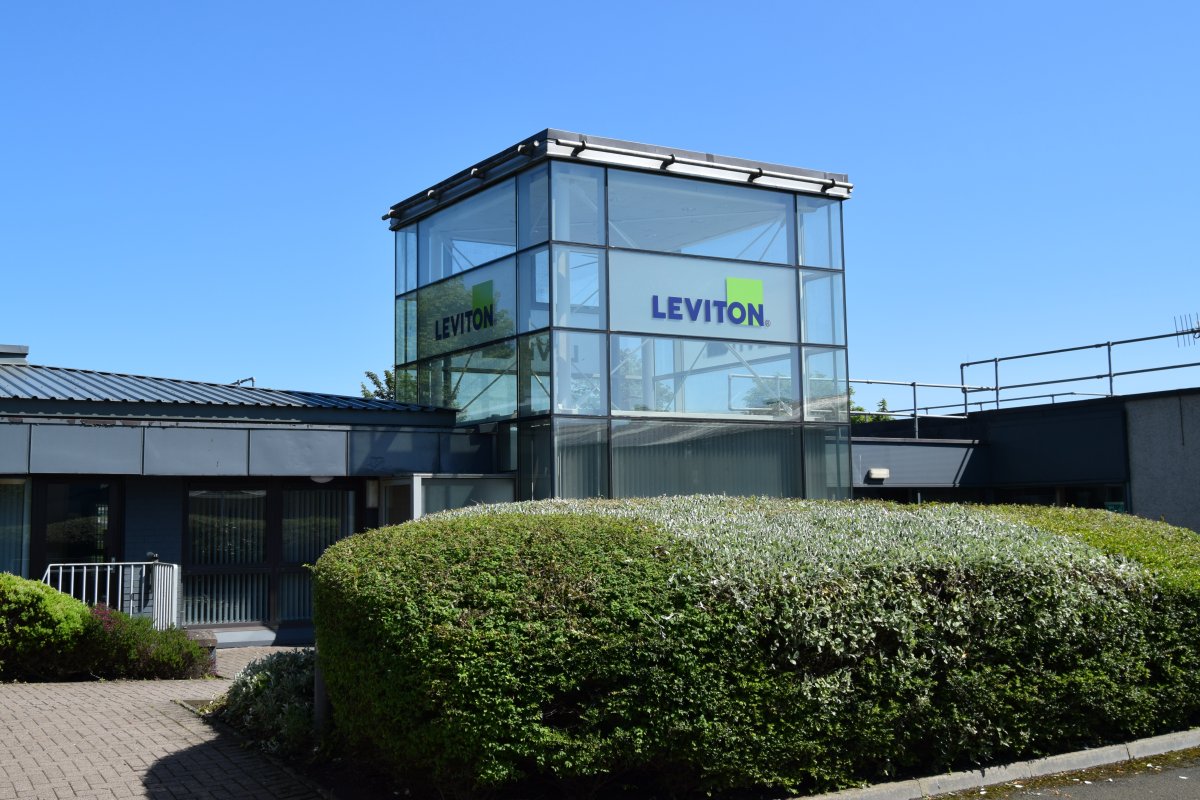
Leviton, a manufacturer of cabling, fibre, and connectivity products for data centres and enterprise networks, has announced a $100 million (£75 million) global capital investment in its Network Solutions business, aimed at expanding manufacturing capacity for fibre-optic and copper networking systems. The five-year investment follows an $80 million (£60 million) capital programme completed in 2025. Leviton says the new investment is in response to demand for networking products for AI infrastructure and smart buildings. Daryoush Larizadeh, President and CEO of Leviton, comments, “For 120 years, Leviton has remained relevant by looking beyond today’s demands and investing in what comes next. “This $100 million commitment to our Network Solutions business underscores our determination to lead through innovation, manufacturing excellence, and customer partnership.” The investment covers Leviton's Network Solutions manufacturing facilities for fibre-optic and copper systems. It includes increased capacity for Category 6A cabling and connectors, as well as expanded fibre-optic cabling and connectivity manufacturing for enterprise and data centre networks. Expanding fibre and copper capacity Ross Goldman, COO of Leviton Network Solutions, notes, “While many organisations remain cautious amid volatile raw material and energy costs, Leviton believes this is the right time to invest. “The expansion of AI, smart buildings, and high-performance networks is happening at an unprecedented pace. With this five-year investment, we’re ensuring our customers have access to the capacity, quality, and global scale they need, when they need it most.” The investment follows Leviton's previous capital programme, which expanded global production capacity, doubled the size of its Fuquay-Varina (North Carolina) facility, and increased its copper and fibre manufacturing capabilities. Ross concludes, “Capital investments like these are not just about adding capacity; they are about building long-term capability and service. Our customers are planning infrastructure for decades of AI-driven growth. We’re matching that vision with the foresight to invest in world-class manufacturing, even in challenging market conditions.” For more from Leviton, click here.

Datacenter United signs multi-megawatt capacity agreement
Datacenter United, an independent Belgian data centre operator, has signed a binding agreement to provide multi-megawatt data centre capacity for AI workloads at DC Machelen in Belgium. The environment will use liquid cooling to support the power densities and heat loads associated with high-density AI systems. The customer's identity and commercial terms of the agreement will remain confidential. AI systems concentrate increasing amounts of computing power within a limited footprint, raising both the power required per rack and the amount of heat that must be removed. Power supply, cooling, connectivity, redundancy, and operations must, therefore, be engineered as an integrated environment. Liquid cooling removes heat closer to its source and can enable high-density configurations that are increasingly difficult to support with air cooling alone. The system at DC Machelen will be engineered around the customer's confirmed architecture and operational requirements. The agreement reflects demand for specialised AI infrastructure in Belgium, with the project moving from planning to deployment. Liquid cooling for high-density AI Friso Haringsma, CEO of Datacenter United, comments, “Demand for specialised AI infrastructure in Belgium is moving from ambition to actual deployment. "This binding agreement translates a specific customer requirement into a concrete, multi-megawatt project in Machelen. It demonstrates that a Belgian operator can support high-density AI workloads at this scale.” The liquid-cooling design is intended to support higher computing densities whilst improving cooling and energy efficiency. Datacenter United says the project also demonstrates the importance of access to power, connectivity, suitable locations, and predictable permitting for AI infrastructure development in Belgium. DC Machelen is designed for organisations with high power and capacity requirements. The site combines power, space, carrier-neutral connectivity, and the flexibility required for large-scale, high-density infrastructure. Technical implementation will proceed according to the agreed system configuration and deployment plan. Further information on the commissioning schedule is set to be provided at a later stage. For more from Datacenter United, click here.

DataVita invites Greens, APRS to Chapelhall data centre
DataVita, a UK data centre and cloud services provider, has published open letters inviting Ross Greer MSP, Co-leader of the Scottish Greens, and Kat Jones, Director of Action to Protect Rural Scotland (APRS), to visit its data centre campus at Chapelhall in North Lanarkshire, Scotland. The invitation to Ross also extends to his co-leader, Gillian Mackay MSP, with both letters welcoming colleagues, including planning and technical advisers. DataVita says visits can take place at a time convenient to the recipients. The Scottish Greens are expected to use an opposition debate on data centres to renew calls for a moratorium on large-scale data centre applications across Scotland. The proposed visits would provide an opportunity to see DataVita's existing operations, discuss construction under way at Chapelhall, and ask questions about its published proposals for a fourth data centre, DV4. DataVita, which is headquartered in Lanarkshire, has operated data centres in Scotland for more than 10 years. It built, owns, and operates its DV1 facility in Chapelhall, is constructing DV3 alongside it, and operates a second facility in Glasgow. The company says its facilities use renewable energy and closed-loop cooling, with plans for new facilities to contribute to Scotland's electricity grid. DataVita recently secured around £300 million in funding from a syndicate of lenders, including the UK Government's National Wealth Fund, to expand DV1 and build DV3. The company says this will support the development of Scotland's first AI data centres within a designated AI Growth Zone. UK Government figures estimate that, if fully adopted, AI could be worth up to £47 billion a year to the UK economy over the next decade. DataVita says the wider data centre campus could also support more than 3,400 new jobs and more than £8 billion in private investment in North Lanarkshire. More immediately, the expansion of DV1 and development of DV3 are expected to create around 600 construction jobs, as well as around 100 permanent high-skilled roles once completed. Data centre plans and public discussion The Lanarkshire AI Growth Zone features a Community Investment Fund that will provide up to £543 million in direct funding to North Lanarkshire over 15 years. This includes skills and training programmes in AI, coding, and other areas of technology for local people, alongside support for local food banks and charities, delivered in partnership with the community. Danny Quinn, Managing Director of DataVita, comments, “Nearly all of us use data centres every single day whether we realise it or not - from being able to use online banking and working from home, to scientists delivering groundbreaking medical research. They are the critical infrastructure that makes many of the things we do in modern life possible, and that is only going to accelerate as technology becomes even more entwined with daily life. “For more than a decade, we’ve been supporting Scotland’s public services, businesses, and even households to take advantage of the many benefits from online services. And, although AI is very much a hot topic at the moment, there is no doubt it is here to stay, and the question for Scotland is how can we best use it to support jobs, skills, the public services we all rely on, and the way we live more generally. “DataVita fully supports an open, public debate about the right kind of controls to have in place for AI and, where necessary, government action to protect our economy, society, and environment. But, the importance of the decisions we make about AI for Scotland's future economy cannot be overstated. We need to move beyond a debate in which one side has to be entirely right and the other entirely wrong. “Where opinions differ, open and honest dialogue is the best way forward. A visit gives us the opportunity to show how our facilities operate and have a detailed conversation about our plans. We can explain the choices behind their design, hear the questions people have, and discuss them directly. “Data centres differ in what they do and how they are designed and operated. We would welcome the chance to explain how those differences apply to our facilities and proposals, and we are making these invitations public because the developments are of public interest. “People should be able to see that we are willing to explain our work, listen to different views, and have a constructive discussion. We hope the invitations will be accepted.” The letters are published in full on the DataVita website. For more from DataVita, click here.

techUK calls for 10-year digital infrastructure strategy
Trade association techUK has called on the UK Government to publish a 10-year 'Digital Infrastructure Strategy' by 2027, warning that economic growth, productivity, and national resilience depend on stronger digital infrastructure. The organisation’s latest report argues that connectivity, compute, and data infrastructure are now as fundamental to the economy as transport, energy, and housing. It says the UK’s digital technologies already contribute an estimated £286 billion in annual Gross Value Added (GVA), equivalent to around 13% of national output. The UK is home to Europe’s largest data centre market, alongside research capabilities in quantum, photonic, and neuromorphic computing, whilst full-fibre broadband and 5G Standalone deployment continue to expand. However, techUK warns that high industrial electricity prices, lengthy grid connection times, planning constraints, and comparatively weak network performance are limiting investment and threatening the UK’s competitive position. Five objectives for 2035 The report sets out five objectives for 2035: universal full-fibre and 5G Standalone coverage, with commercial 6G deployment underway; a globally competitive position in next-generation compute; electricity prices below the IEA median; governance and planning frameworks that can keep pace with technological change; and widespread digital adoption across the UK. To support these objectives, techUK recommends a coordinated programme of government and industry action. This includes establishing a cross-government digital infrastructure strategy, appointing a Minister of State with responsibility for its delivery, and creating a dedicated digital infrastructure unit within the Regulatory Innovation Office. The organisation also calls for an interim update to the UK Compute Roadmap by 2027, covering neuromorphic, photonic, and quantum computing, alongside measures to develop commercial supply chains. On energy, techUK recommends a roadmap to bring non-domestic electricity prices below the IEA median by 2035. Its proposals include moving electricity levies to general taxation by 2029 and accelerating grid connection reforms. Sophie Greaves, Associate Director for Digital Infrastructure at techUK, argues that the UK needs to treat digital infrastructure as a national economic priority. She says, “Digital infrastructure is no longer simply an enabler of economic activity; it is the foundation on which future economic growth, innovation, and national resilience will be built. The countries that invest now in connectivity, compute, and data infrastructure will be best placed to capture the economic opportunities of the next decade. “By following the roadmap we have set out for a resilient digital infrastructure by 2035, the UK can secure its position as a leader in compute, bringing significant benefits to the economy.” techUK warns that failing to address these infrastructure challenges could result in slower growth, weaker productivity, reduced investment, and greater dependence on infrastructure and technologies developed elsewhere. For more from techUK, click here.

AVK launches capital business for on-site data centre power
AVK, a provider of power systems and electrical infrastructure for data centres, has launched AVK Capital, a funding entity that will finance and own on-site power infrastructure for data centres, with customers accessing the capacity through long-term power purchase agreements (PPAs). The business houses investment secured by AVK from Partners Group in August 2026. The model is intended to give data centre developers access to on-site power without carrying the infrastructure costs on their own balance sheets. Under the model, AVK selects and engineers the power infrastructure for each site, whilst AVK Capital funds and owns the assets. The customer then pays for the power as an operating cost rather than making the upfront capital investment. The infrastructure can incorporate microgrids, AVK PowerPods, fuel cells, renewable energy, and standby generation. AVK will remain responsible for the delivery, commissioning, operation, and maintenance throughout the asset’s operating life. Funding aims to accelerate power delivery AVK says the model addresses two barriers facing data centre development: constrained grid capacity and the capital cost of providing on-site generation. Ben Pritchard, Chief Executive Officer at AVK, explains, “Access to power is the single biggest constraint on data centre development in Europe, and the cost of solving it is the second. AVK Capital takes both off the table. “We already design, build, operate, and maintain on-site power at commercial scale, and being able to fund and own it as well means a developer can contract for power in the same way they contract for any other service.” AVK Capital will sit alongside AVK’s existing business, which will continue to deliver standby, prime, and modular power infrastructure for customers that choose to fund projects themselves. Bob Downing, VP of Sales, Energy Solutions at AVK, suggests that bringing financing and engineering together can reduce the number of handovers during a project. He notes, “We can sit down with a developer, agree what the site needs, agree how it is paid for, and then go and build it, without a chain of handovers in between.” AVK Capital is set to be introduced to the market this month. For more from AVK, click here.

CargoSense acquires Adapt-IP for data centre logistics
CargoSense, a supply chain exception management provider, has acquired wireless technology developer Adapt-IP, bringing its patented wireless connectivity and real-time asset tracking capabilities into CargoSense’s supply chain platform for data centre operations. The acquisition is intended to strengthen CargoSense’s ability to monitor equipment and materials as they move through warehouses, staging yards, and data centre sites, where delays can affect construction and fit-out schedules. Adapt-IP’s technology provides location tracking across multiple facilities, long-range wireless connectivity, and environmental monitoring. CargoSense says the combined platform will allow operators to identify supply chain exceptions and coordinate responses before they affect projects. Wireless tracking adds physical data Adapt-IP’s engineering team, led by Michael McNamara, will take responsibility for CargoSense’s hardware strategy, including deployment, systems integration, and customer requirements. Rich Kilmer, CEO of CargoSense, says, “This acquisition represents a strategic investment for CargoSense. Our customers face increasing complexity in managing their supply chains at hyperscale. Paired with real-time data from the physical environment, our service automatically detects and resolves problems before they become delays. “Combining Adapt-IP's expertise in silicon and device capabilities with our deep understanding of our customers' supply chain challenges enables us to meet those challenges head on.” Michael McNamara, CEO of Adapt-IP, also suggests that the acquisition will accelerate the company’s technology roadmap and provide a route to wider deployment across data centre and manufacturing operations.

T5 Services creates EverOn data centre business
T5 Services has announced changes to its construction and operations businesses, with T5 Construction becoming EverOn Data Center Services (EverOn DCS), while T5 Operations is set to join Salute. Effective from 1 September, EverOn DCS will operate as an independent data centre construction company focused on mission-critical digital infrastructure. At the same time, T5 Operations has entered into a definitive agreement to join Salute, bringing the two organisations' operations businesses together. EverOn DCS has grown from $87 million (£64 million) in revenue in 2021 to $1.7 billion (£1.2 billion) in 2025, with 83% of its 2025 revenue coming from third-party construction projects. The business was originally established within T5 Data Centers and now works with hyperscale, developer, enterprise, and AI customers across North America. According to T5 Services, establishing EverOn DCS as an independent company will allow it to focus on its third-party construction activities as demand for data centre capacity increases. The company has completed more than 260 construction projects, delivering more than 12 million square feet (1.1 million square metres) of data centre space across the United States. Its activities include ground-up campus construction, data hall fit-outs, retrofits and upgrades, design-build delivery, LLE equipment procurement, commissioning oversight, QA/QC, owner advisement, and preconstruction services. EverOn also has experience with direct liquid cooling, high-density AI infrastructure, and construction in live, energised mission-critical environments. T5 Operations to join Salute Salute has announced an agreement to acquire T5 Operations, which will bring the operations teams together and aims to give customers access to a broader range of technical resources and geographic coverage, according to the companies. EverOn and Salute will continue to work together as strategic partners, with the companies stating that collaboration between construction and operations will support operational readiness and long-term facility performance. Pete Marin, CEO and Chairman of T5 Data Centers, comments, "This is a strategic evolution that strengthens both businesses. Our construction business has grown significantly beyond its original mandate, earning the trust of third-party developers and hyperscalers, and establishing EverOn gives [the] organisation the independence and focus to continue scaling. "At the same time, bringing our T5 Operations team together with Salute creates an even stronger platform dedicated to helping customers maximise uptime and operational excellence. We’re incredibly proud of what both teams have built and excited about what comes next.”


Translate »