Huawei sets out its vision for intelligent data infrastructure
Author: Joe Peck
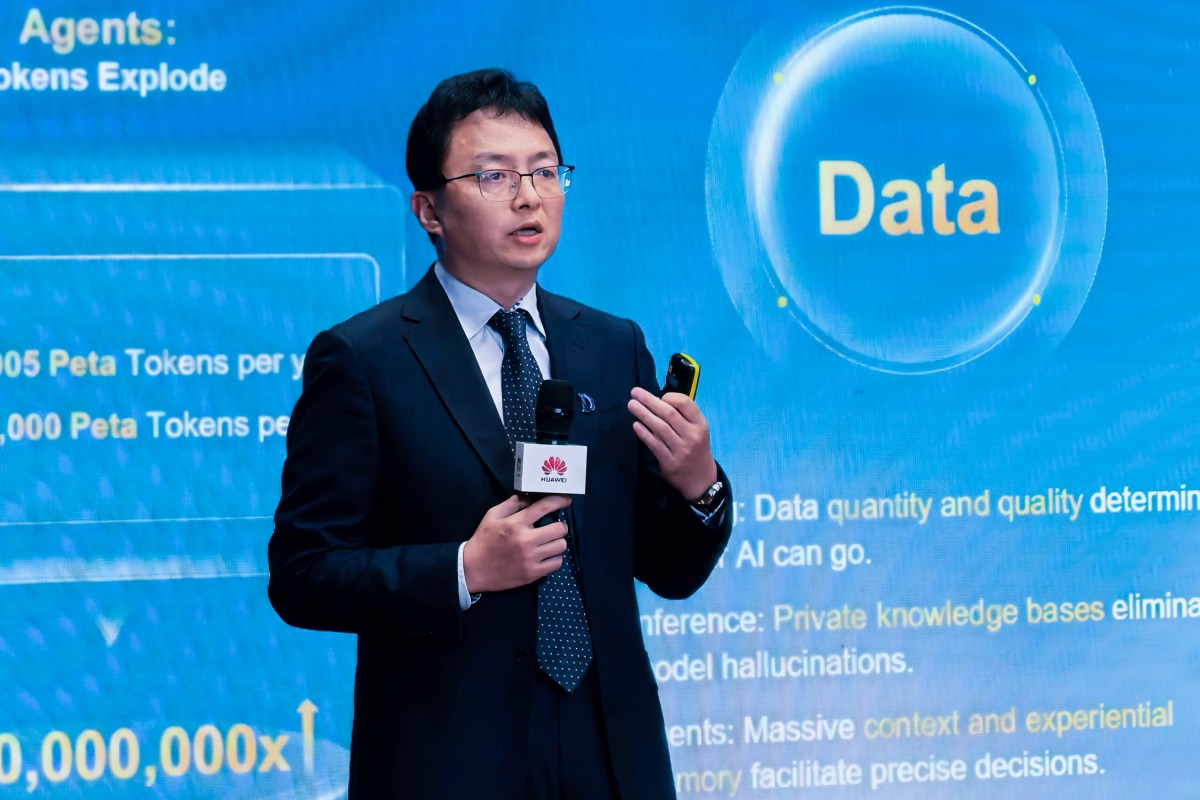
Speaking at Huawei Connect 2026 in Florence, Huawei‘s Data Storage leadership made the case that the AI race has entered a new phase, one where data quality and architecture – not raw compute – will determine which enterprises succeed.
Florence, Italy, played host to Huawei Connect 2026 on 16 October, with the company’s Data Storage Summit drawing together enterprise leaders, technology partners, and industry experts to examine how data infrastructure must evolve to serve the demands of the AI era. The central argument, articulated most clearly by Yuan Yuan, President of Huawei’s Data Storage Product Line, was deceptively simple: computing power and model development have had their moment, and AI has now entered a stage where data is the decisive factor.
“The next chapter of AI is data,” Yuan says. His case rests on a structural argument: deploying AI successfully at enterprise scale is no longer primarily a question of accessing sufficient compute or choosing the right foundation model. The bottleneck has shifted to data – its quality, its accessibility, and the infrastructure built to manage it. Enterprises that fail to address this will find their AI investments underperforming, regardless of how much they spend on GPUs.
A platform built for AI inference
The headline product announcement at Florence was Huawei’s 3+1 AI Data Platform Solution – the company’s claim to be the first in the industry to integrate a knowledge base, key-value (KV) cache store, memory bank, and Unified Cache Manager into a single platform. The solution has already been deployed across more than 20 service scenarios, and the customer cases presented at the summit illustrate the practical impact.
A leading hospital used the platform to address a persistent problem with large-model AI in clinical settings: limited understanding of specialist medical terminology and a tendency towards hallucinations. By integrating multimodal medical data and applying knowledge parsing, vectorisation, and knowledge graph construction, the hospital developed a clinical-grade agent for diagnosis and treatment, lifting the adoption rate of AI-assisted diagnosis reports from 50% to 90%.
In a different context, a major internet company was struggling with the storage demands of multi-turn, long-sequence inference tasks for AI coding workflows. Huawei’s platform improved inference throughput by a factor of 2.2 – measured in tokens per second – by replacing repeated computation with associative search, using multi-level cache scheduling and prefix cache techniques. Meanwhile, a large bank applied the platform to its customer service operations, automatically extracting historical conversation data and enabling memory recall in seconds, resulting in a 16% increase in customer satisfaction.
Infrastructure that keeps pace with AI
Lucio Ceruti, CTO of Huawei Data Storage Italy, outlined the product-level upgrades underpinning the broader platform story. Performance improvements centre on FlashLink intelligent algorithms, built on a data and control plane separation architecture, which deliver a 50% performance uplift. On resilience, an integrated ransomware protection system with network-storage collaboration achieves 99.99% ransomware identification accuracy, supported by intelligent health inspection and automatic diagnosis capabilities. Energy efficiency gains come from hardware-based offloading of deduplication and compression, combined with dynamic CPU frequency reduction, reducing overall power consumption without compromising throughput.
Yuan also highlighted an upgraded AI Data Lake Solution, built on higher-density green hardware, with global data visibility, multi-dimensional vector retrieval, and the ability to deliver data in seconds – designed to act as a one-stop supply of high-quality data for AI training and inference pipelines.
European deployments in practice
Two European customer cases grounded the summit’s broader narrative in concrete infrastructure terms. Daniele Cesarini, Head of AI/HPC Architecture at Cineca – Italy’s national supercomputing centre – described how the organisation adopted Huawei OceanStor Pacific scale-out storage to build an exabyte-scale scientific research data lake with tiered storage for hot, warm, and cold data. The deployment supports the Square Kilometre Array project, among other large-scale scientific programmes, and has significantly reduced both system complexity and total cost of ownership.
Marco Frontini, Chief Information and Digital Officer of Cerba HealthCare Italia, described a different challenge: consolidating a legacy IT architecture spread across 50 labs and five central nodes into a single full-stack platform. The company, which operates 400 medical centres, serves more than 1.2 million patients, and conducts over 50 million examinations each year, achieved a 23% reduction in five-year TCO while adding ransomware protection and zero data loss capabilities.
Building for what comes next
Adley Zhang, Director of Huawei’s European Data Centre Marketing and Solution Sales Department, contextualised the product and customer announcements within Huawei’s broader European trajectory. The company has been expanding its presence across finance, healthcare, education and research, and retail, and Zhang emphasised Huawei’s commitment to an open and innovative ecosystem as the foundation for continued growth in the region.
For data centre and infrastructure professionals, Huawei believes its Florence summit’s message is worth taking seriously. The shift Yuan describes – from compute-centric to data-centric AI infrastructure – has real architectural implications. It demands storage systems capable of supporting high-throughput inference, low-latency retrieval, long-term memory, and seamless data governance at scale. Huawei’s argument is that these requirements call for a purpose-built platform, not a collection of upgraded legacy components. The customer deployments on show in Florence suggest that argument is beginning to find traction across European enterprises.
For more from Huawei, click here.
This article is sponsored by Huawei