What is a data centre?
Author: Joe Peck
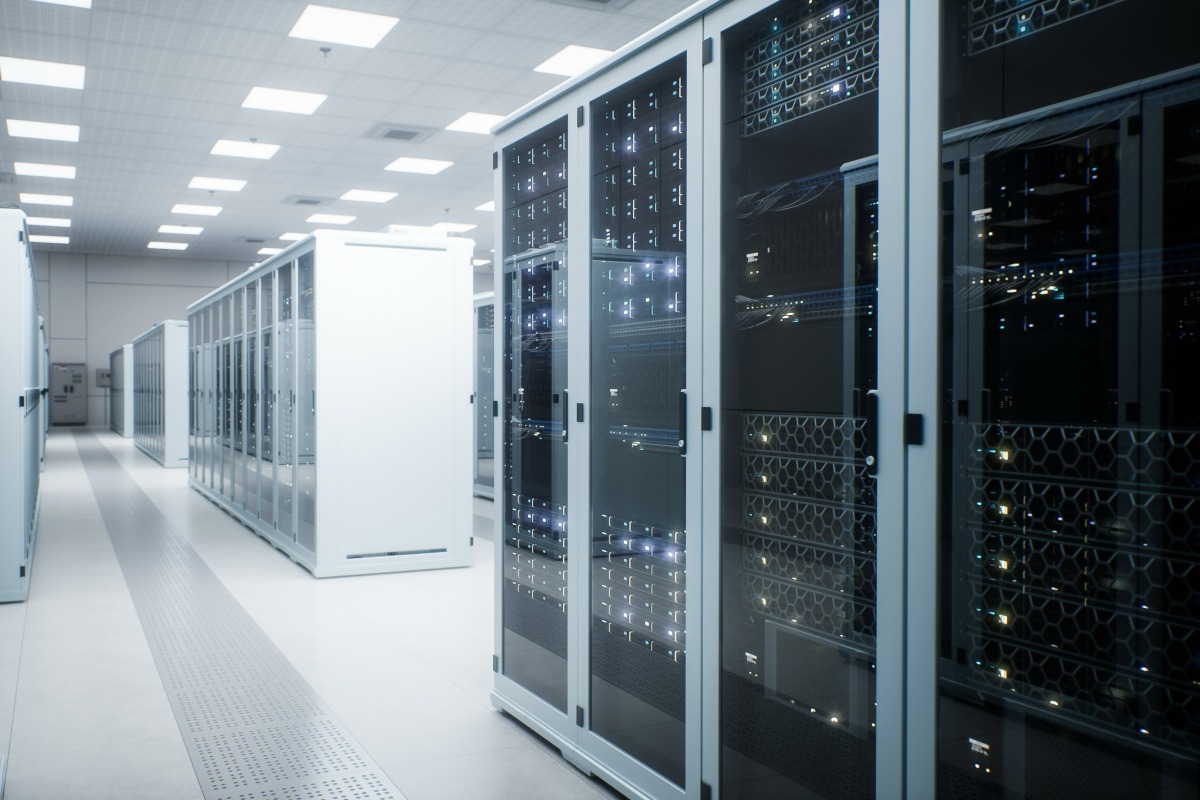
A data centre is a secure, purpose-built facility that houses large numbers of computers (known as servers), along with the networking, power, and cooling equipment needed to keep them running around the clock. In short, it is where the internet, the cloud, and artificial intelligence (AI) physically live.
Every time you stream a film, tap a bank card to pay, check a map, or ask an AI chatbot a question, a data centre somewhere does the work. Most of us never see (or notice) them, yet they have become some of the most talked-about, expensive, and contested buildings on the planet.
Key takeaways
• A data centre is essentially a very large, very secure room (or campus) full of connected computers that store, process, and move data.
• ‘The cloud’ is not a place; it is a service delivered from data centres.
• Data centres vary enormously, from a cupboard-sized edge site to a multi-building hyperscale campus drawing the power of a small city.
• The AI boom is driving record investment and, with it, new questions about power, water, land, and resilience.
• Data centres are now treated as critical national infrastructure (CNI) by many governments, including the UK’s.
How does a data centre work?
At its simplest, a data centre does three things: it stores information, processes it, and moves it to wherever it is needed.
When you open an app or load a website, your device sends a request across the internet, usually over fibre-optic cables, to a data centre. Servers there process the request, retrieve or calculate what you need, and send the answer back. All of this typically takes a fraction of a second.
To make that possible around the clock, a data centre also needs three things that the computers cannot provide for themselves:
1. Power — delivered reliably and with multiple layers of backup
2. Cooling — because computers turn almost every watt of electricity they use into heat
3. Connectivity — meaning fast, resilient network links to the outside world
Wrap all of that in tight, comprehensive physical and cyber security (due to their sensitive importance to the modern digital world) and you have a data centre.
Types of data centre
Not all data centres are alike. The main categories are:
• Enterprise data centres: built and run by a single organisation for its own use, such as a bank, retailer, or government department.
• Colocation (‘colo’) data centres: where operators lease space, power, cooling, and connectivity to multiple customers who install their own equipment. Retail colocation serves smaller customers; wholesale colocation leases whole halls or buildings to big ones.
• Hyperscale data centres: enormous facilities operated by, or built for, the largest cloud and technology companies. They are designed to scale rapidly and often form campuses of several buildings, with the biggest now planned at gigawatt scales.
• Cloud data centres: the facilities that deliver public cloud services (rented computing, storage, and software over the internet). Most are hyperscale.
• Edge data centres: smaller sites placed close to users or devices in order to cut delay (latency) for services such as streaming, gaming, and industrial systems.
• AI data centres (sometimes termed ‘AI factories’): facilities designed specifically for AI workloads, with extremely dense racks of specialist chips and advanced cooling. Some are run by AI-focused cloud providers, often called ‘neoclouds’.
• Modular and containerised data centres: prefabricated units built off site and delivered ready to install, useful for speed or remote locations.
These categories overlap. A single facility can be, for example, a hyperscale, cloud, and AI data centre all at once.
What are data centres used for?
Data centres underpin almost every digital service. Common uses include:
• Cloud computing and hosting: renting out computing power, storage, and software so organisations (and users) do not have to run their own.
• The internet itself: hosting websites, email, apps, social media, and online shopping.
• Streaming and content delivery: storing and delivering films, music, games, and live broadcasts to millions of devices.
• Networking and traffic exchange: acting as hubs where networks interconnect and internet traffic is passed between them.
• Banking and payments: processing transactions and detecting fraud in seconds.
• Healthcare: patient records, imaging, and medical research.
• Government, policing, and emergency services: secure databases and coordination systems.
• High-performance computing (HPC): supercomputing for weather forecasting, climate modelling, engineering, and simulation.
• Research and science: universities and laboratories use data centres to analyse huge datasets, from genomics to particle physics to space missions.
• AI training and inference: training teaches a large language model (LLM) by processing enormous datasets; it’s extremely compute-heavy. Inference is what happens when a trained model answers your question and, as AI use grows, it’s becoming a major source of demand as well.
• Quantum computing: quantum computers are mostly experimental and are often housed in specialist facilities, but they are increasingly linked with conventional data centres, which handle the surrounding ‘classical computing’.
What is inside a data centre?
Inside, a data centre divides into two broad worlds. The IT equipment does the computing. The supporting infrastructure keeps it powered, cool, connected, and safe.
The computing kit
• Servers: the computers themselves, stacked in racks. A single facility may hold tens of thousands of these.
• CPUs (central processing units): general-purpose processors that run operating systems and most everyday software.
• GPUs (graphics processing units): originally built for graphics, now the workhorses of AI because they can perform huge numbers of calculations in parallel. They are powerful, expensive, and power-hungry, with the latest generation of AI chips being able to draw around a kilowatt each.
• Other accelerators: custom AI chips, such as tensor processing units (TPUs), designed for specific workloads.
• Storage: solid-state drives (SSDs) and hard disk drives (HDDs) that hold the data.
• Networking equipment: switches and routers that link servers to each other and to the outside world. In AI clusters, ultra-fast networking between chips is as important as the chips themselves.
• Racks: the standardised metal frames that hold servers, storage, and networking kit. A traditional rack draws roughly five to 10 kilowatts, whereas AI racks can exceed 100 kilowatts, which is why AI is forcing a redesign of data centres.
• Cabling: structured fibre-optic and copper cabling links everything inside the building, whilst fibre routes (including subsea cables) link data centres to each other and to the wider internet.
Power
• Grid connections and substations: high-voltage power arrives from the grid, often via a dedicated on-site substation, and is stepped down by transformers.
• Switchgear: equipment that controls, protects, and isolates electrical circuits.
• Uninterruptible power supplies (UPS): large battery systems that keep servers running through a power cut for the seconds or minutes it takes for generators to start.
• Backup generators: typically diesel – or increasingly cleaner alternatives such as hydrotreated vegetable oil (HVO) – which take over during a longer outage. They are mostly only run for testing and emergencies.
• Power distribution units (PDUs) and busbars: PDUs distribute electricity to racks, whilst busbars are rigid metal conductors that carry large currents along the room, often overhead, replacing bulky cabling.
• Redundancy: power is usually duplicated so that no single failure takes the facility down. You will see this described as N+1 (one spare) or 2N (a fully mirrored system).
Cooling
Every watt of power used by the computers ends up as heat, so cooling is vital. The main approaches are:
• Air cooling: cool air is pushed through the racks. Layouts often use ‘hot aisles’ and ‘cold aisles’ to keep hot and cold air separate.
• Chillers and evaporative (adiabatic) cooling: systems that remove heat from the building. Evaporative methods can be energy efficient but use water.
• Liquid cooling: water or specialist fluid is brought directly to the hot components (direct-to-chip), or the servers are submerged in fluid (immersion). It is increasingly essential for dense AI racks.
• Heat reuse: some sites now capture waste heat for use in district heating networks, offices, or other buildings.
Layout
• White space: the areas where the IT equipment lives, such as data halls full of racks.
• Grey space: the back-of-house areas that support the white space, such as plant rooms, generators, switchgear, UPS rooms, chillers, and storage.
Safety, security, and monitoring
• Physical security: perimeter fencing, access controls, CCTV, and on-site security teams.
• Fire detection and suppression: specialist systems designed to protect equipment, often using gas or water mist rather than conventional sprinklers.
• Monitoring systems: building management and data centre infrastructure management (DCIM) software track temperature, power, and equipment health in real time.
Why do data centres use so much power and water?
The computers run continuously, and the cooling and backup systems around them also need power. AI has pushed this up sharply, since AI chips are more power-hungry and are packed more densely. As such, because data centres need reliable, round-the-clock supply, getting a grid connection has become one of the biggest obstacles to building them. On-site power generation (including the deployment of ‘microgrids’) is one approach increasingly being explored to combat this.
Water use, meanwhile, varies enormously by design. Some facilities use ‘closed-loop’ systems that recirculate the same water, whilst others use evaporative cooling that consumes water as it evaporates. There is also an indirect footprint, because generating electricity can itself use water. Operators measure and report this with metrics like ‘water usage effectiveness’ (WUE), but it remains a sensitive local issue.
The industry has made long-running efforts to cut energy waste, buy renewable power, and reuse heat. Nevertheless, whether efficiency gains can keep pace with soaring AI demand is an ongoing debate, alongside discussions around the resultant environmental impacts.
The bottom line
A data centre is simply a building full of computers, but it is the building on which almost everything digital now depends. This, as a side effect, also makes them high-profile targets for malicious actors and nation states, during both peacetime and wartime.
As AI, cloud computing, and the digital economy expand, these facilities – which were once barely regarded outside of specialist circles – will only continue to become a more present part of daily discussions and life. Ultimately, understanding how data centres work, what they need, and what they cost, alongside their impacts and implications, has never mattered more.
Want to go deeper? Explore our coverage of hyperscale facilities, AI infrastructure, data centre cooling, data centre power, edge computing, and more.
Related Posts