Armada, Johnson Controls plan 500MW AI infrastructure rollout
Author: Joe Peck
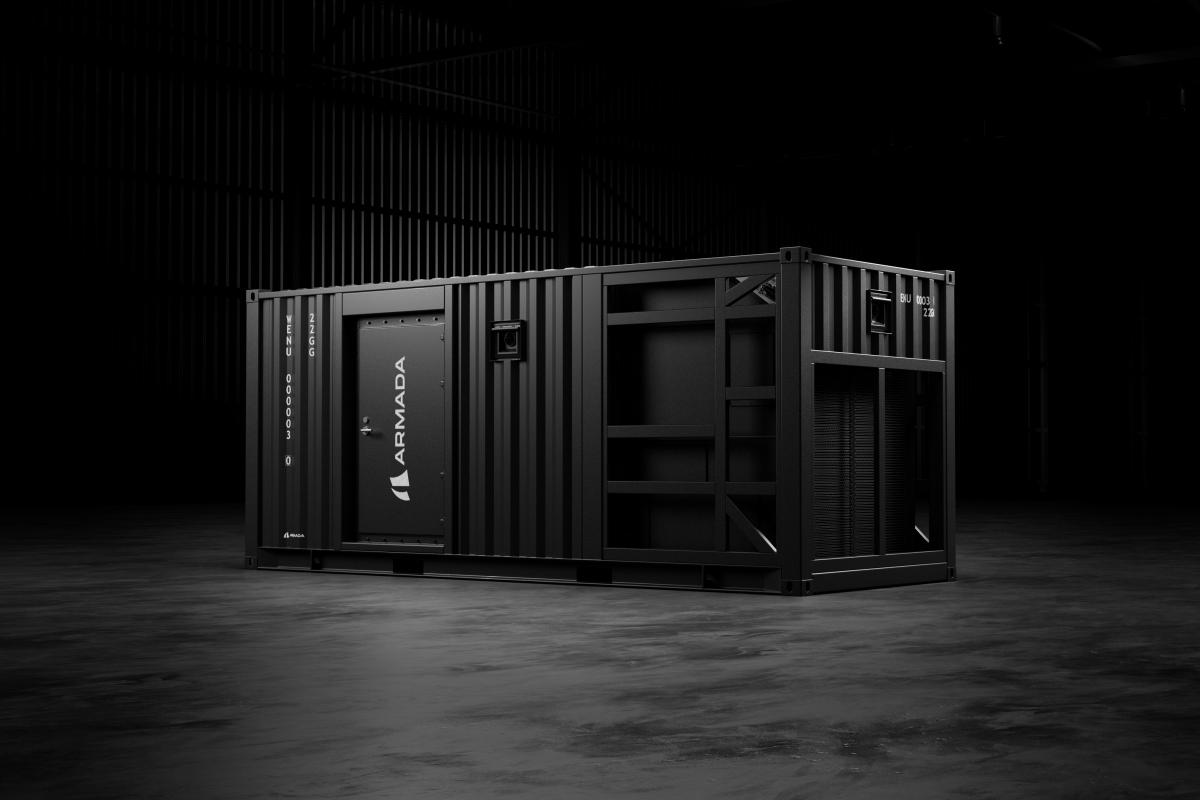
Armada, a US provider of modular edge data centres and connectivity for remote sites, plans to work with Johnson Controls, a global provider of smart building technologies, to build 500MW of distributed sovereign super intelligence (SI) infrastructure in 2027, using factory-integrated systems based on NVIDIA’s DSX POD reference design and Vera Rubin platform.
Announced at NVIDIA GTC, the collaboration will combine engineering, manufacturing, and deployment to deliver modular infrastructure with cabling, wiring, piping, and functional validation completed before shipment.
Factory-built infrastructure aims to accelerate deployment
The NVIDIA DSX POD reference design moves repeatable construction work from data centre sites into factories. Compute, networking, rack-level power, plumbing for liquid cooling, and supporting infrastructure are integrated and validated before delivery.
On site, the containers are connected to prepared power, water, cooling, and networking infrastructure, with capacity expanded by adding standardised units.
Armada will use NVIDIA DSX Air to simulate AI factories and validate its Bridge GPU management software before shipment. Once deployed, NVIDIA DSX MaxLPS will help manage power and workloads to maximise computing throughput within each site’s available power capacity.
Dan Wright, co-founder and CEO of Armada, says, “The SI race isn’t going to be won by whoever pours concrete the fastest. Companies and nations can have the chips, the land, the power, and the ambition and still be told to wait years for a building.
“The NVIDIA DSX POD reference design lets us cut that wait out of the equation. We build the SI factory in one of our Galleon Forge factories, ship it, connect it, and our customers are generating tokens in months on infrastructure they own and control.”
Distributed capacity for sovereign AI
Armada says conventional 50MW facilities can take years to become IT-ready and require around 600,000 on-site labour hours. It also cites a projected construction workforce shortfall of 288,000 workers by 2027 as a challenge to expanding capacity.
The company plans to deploy modular SI facilities close to energy sources, including stranded, renewable, and off-peak power. Its proposed architecture is designed to operate without cloud dependencies, allowing customers to retain control of their models, data, and infrastructure.
Charlie Boyle, Vice President of DGX Systems at NVIDIA, notes, “The demand for compute is outpacing the speed at which the world can build the facilities to house it.
“By utilising the NVIDIA DSX POD reference design, Armada can deliver factory-built, Vera Rubin-based containers to customers. Together with Johnson Controls, Armada is positioned to bring Vera Rubin-based factories to customers who need capacity now, wherever their energy and data are.”
Manufacturing partnership
Armada brings experience deploying modular data centre infrastructure in remote and challenging environments, including Alaska, a US Navy littoral combat ship, and desert locations in the Middle East.
The company says its manufacturing and deployment capabilities will support the planned rollout, with Johnson Controls contributing thermal management technology, engineering, and global manufacturing capacity.
Joakim Weidemanis, CEO of Johnson Controls, comments, “NVIDIA is rapidly advancing the age of intelligence and reshaping the infrastructure required to support it.
“Our collaboration with Armada combines their expertise in deploying compute at the edge with Johnson Controls’ advanced thermal management technology, engineering capabilities, and global manufacturing scale. This combination delivers high-performance infrastructure engineered to quickly bring capacity online where and when it’s needed.”
Under the collaboration, NVIDIA will design, test, and validate the DSX POD reference design for the Vera Rubin platform, whilst Armada will engineer, manufacture, integrate, customise, service, and deliver the modular data centres.