Russelectric details its transfer switches for data centres
Author: Joe Peck
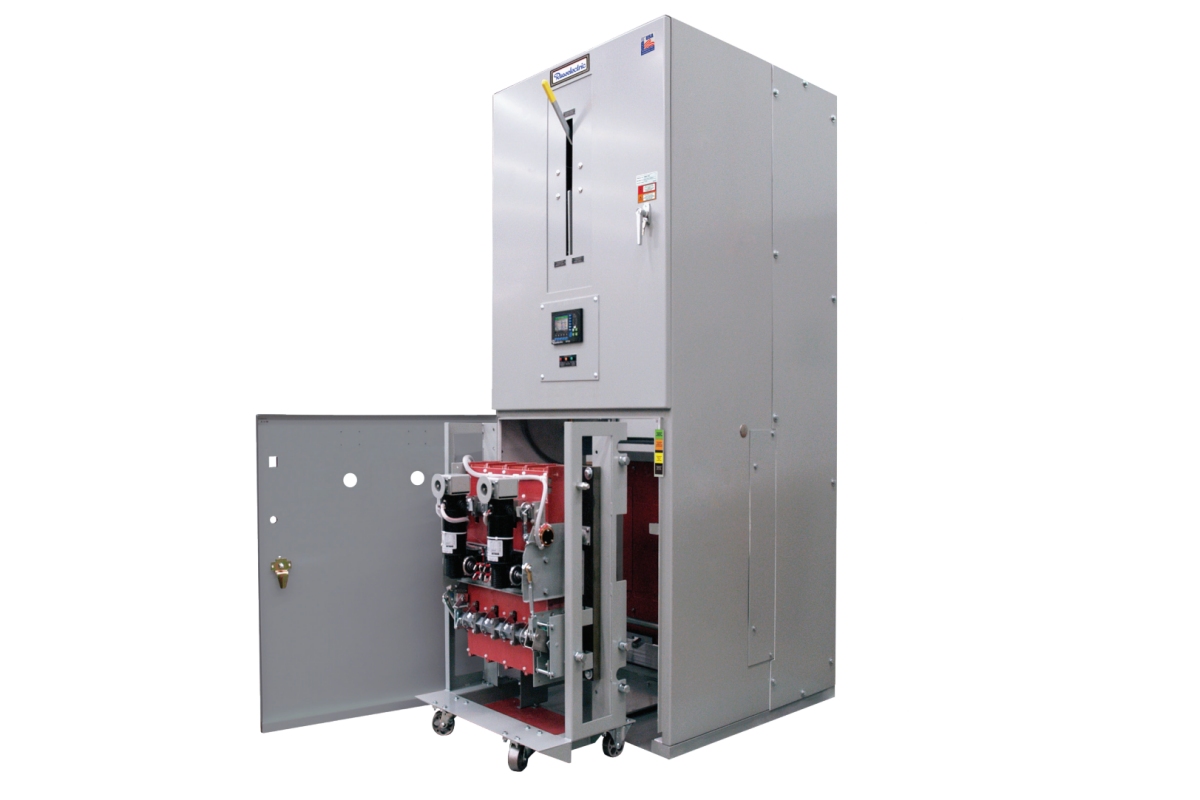
US power control manufacturer Russelectric, a Siemens business, has outlined the features of its automatic transfer switches for data centres and other critical facilities.
The transfer switches are available in 480VAC configurations with three-cycle and 30-cycle UL-tested closing and withstand ratings under UL 1008.
The 30-cycle rating can support selective coordination with overcurrent protection devices, including systems with extended trip delays. This can be used to meet National Electrical Code (NEC) requirements for emergency and legally required standby systems.
The switches use preloaded springs and an over-centre mechanism driven by an electric operator to open and close the power contacts. During an open-transition transfer, the contact mechanism remains locked until the over-centre position is reached.
The preloaded springs then open the closed contacts and close the open contacts rapidly, with a momentary break between the two operations. The quick-break function provides rapid arc interruption at maximum voltage and current, reducing contact erosion.
The design is intended to withstand the mechanical and thermal demands associated with fault durations of up to 30 cycles.
Transfer switch configurations
Control components and wiring can be replaced without removing the transfer switch from its enclosure. The front-connected wiring uses flame-retardant, 600V SIS-rated switchboard wiring, with connections identified using sleeve-type markers that are visible from the front of the cabinet.
Open-transition versions are available for basic transfer applications and loads with high inductive characteristics. They use a quick-break, quick-make transfer mechanism, positive mechanical interlocking, and electrical operators.
The switches are available in three- and four-pole configurations, with front-accessible wiring. The 30-cycle withstand rating allows the switches to accommodate a range of short-time overcurrent protection settings, which can simplify coordination studies in high-density electrical systems.
Closed-transition versions provide closed-transition retransfer to the preferred power source for testing without interrupting power. If the preferred source is lost, the switches provide high-speed quick-break, quick-make open-transition transfer.
These versions are available in two-, three-, and four-pole configurations, with front-accessible wiring. The 30-cycle rating is designed to maintain the transfer switch’s operating capability following exposure to fault conditions.
The transfer switches can coordinate with a range of circuit breakers, including devices with extended trip delays. This provides flexibility when electrical systems are modified or expanded and can help reduce the potential for disruption to servers, cooling systems, and other critical IT infrastructure.
For more from Russelectric, click here.