9 December 2025
Siemens, nVent develop reference design for AI DCs
 
9 December 2025
tde expands tML breakout module for 800GbE ethernet
 
9 December 2025
Energy Estate unveils Tasmanian subsea cables and hubs
 
8 December 2025
De-risking data centre construction
 
8 December 2025
Europe races to build its own AI backbone
 

Latest News


Datacentre Innovation Series 2025 announced
In an age where digital transformation is pivotal for every industry, TraiCon Events says it is proud to announce the Datacentre Innovation Series 2025, taking place on 10 December 2025 at the Park Hotel in Hyderabad, India. This premier event will focus on the future of data centres, exploring new technologies, sustainability practices, and cutting-edge innovations that are reshaping the industry. Transforming India’s data centre landscape India’s data centre industry is on the brink of a major revolution, driven by cloud adoption, data sovereignty, AI, and the growing need for digital infrastructure. With a rapidly expanding digital economy and increased reliance on cloud computing, India is investing heavily in modernising and expanding its data centre ecosystem. The focus is on scalability, resilience, sustainability, and ensuring that data protection and privacy are at the forefront. The Datacentre Innovation Series 2025 will delve into the most pressing topics such as edge computing, data centre automation, 5G infrastructure, green data centers, AI-driven operations, and cybersecurity. Who should attend? This high-level strategic forum will bring together more than 250 senior-level professionals, government officials, industry experts, technology innovators, and decision-makers to discuss the future of India’s data infrastructure and the rapidly evolving landscape of digital transformation. Attendees will include: • Data centre operators & providers• Cloud service providers (CSPs)• Telecom operators• Government & regulatory officials• Technology innovators & solution providers• Data security & privacy experts• Sustainability leaders• Data infrastructure investors• Designers & engineers of data centres• Academia & research institutions• Telecom & IT analysts Why this series and why now? India’s data centre industry is witnessing unprecedented growth, with an increasing focus on sustainability, cloud-first strategies, and the future of edge computing. As the nation drives towards digital India initiatives and addresses data sovereignty concerns, it’s essential to stay ahead of the curve with the latest technologies and best practices. With the rise of 5G, AI, and IoT, the demand for robust, scalable, and secure data centres is higher than ever before. The Datacentre Innovation Series 2025 will equip professionals with the knowledge and strategies required to tackle the evolving challenges and ensure that India’s data centre ecosystem is ready for the demands of the future.

GNM-IX launches new PoP in Bucharest
GNM-IX, a Dutch internet exchange and backbone operator, has announced the launch of a new point of presence (PoP) in Bucharest, Romania, located in NXDATA-1, one of the country’s major carrier-neutral data centres and a digital gateway to Southeast Europe. This marks GNM’s first presence in Romania, expanding the company’s distributed interconnection platform into another region of Europe. The new Bucharest site provides access to GNM’s core connectivity services - internet exchange (GNM-IX), VLAN-based interconnections, and global IP Transit - enabling Romanian operators and content networks to exchange traffic locally and optimise international routes through GNM’s multi-terabit platform. For existing GNM members, the new PoP should strengthen connectivity across Southeast Europe, creating additional redundancy and more efficient routing options towards the Balkans, Central Europe, and beyond. Alex Surkoff, Business Development Director at GNM, comments, “Our goal is to make high-performance connectivity available wherever networks grow. “Expanding to Bucharest enhances our distributed architecture and gives both local and international operators new ways to interconnect - staying local in traffic exchange while remaining part of the global internet fabric.” GNM-IX now has more than 10 Tbps of aggregated traffic and 650+ connected networks. For more from GNM, click here.

Stellanor acquires eight DCs from Redcentric
Data centre operator Stellanor Datacenters, backed by a fund managed by global investment manager DWS, has announced the acquisition of eight strategic data centre sites from Redcentric, currently serving approximately 450 clients. The move marks a milestone in Stellanor’s broader strategy to be a major platform of regional data centres serving national and international enterprises as well as service providers with a need for wholesale and AI inference data centre capacity. Stellanor says it is creating a new generation of regional data centres, designed for proximity, performance, sustainability, and accessibility. As digital services become increasingly critical to business operations, the demand for secure, scalable, and locally hosted infrastructure is accelerating. Enterprise adoption of generative AI and real-time analytics will significantly accelerate this trend, particularly at the edge. Stellanor believes its growing network of urban and near-urban facilities are well positioned to meet the requirements of enterprise and AI-driven workloads of customers across the country. Steve Scott, CEO at Stellanor, argues, “We’re building infrastructure for the future, where data is generated, processed, and protected at the edge. Our goal is to set a new benchmark for high-performance, community-conscious data centres in Northern Europe. "Our focus is always on our customers, who will receive the highest standard of service. We look forward to growing our business alongside them and serving their future colocation needs.” Strategic UK expansion The newly acquired sites are strategically located in London, Reading, Cambridge, Woking, Gatwick, Byfleet, and West Yorkshire. The sites are seen as attractive given their high-density colocation capabilities, security standards, and sustainable operations powered by 100% renewable energy. Aparna Narain, Partner at DWS, comments, “The acquisition of RDC by Stellanor represents a transformative step in expanding our UK footprint to ten, high-quality, strategically located assets with 36MW of secured grid capacity and a blue-chip customer base. “We see significant long-term value in building resilient, scalable, and sustainable infrastructure that supports the UK’s digital economy.” With this acquisition, Stellanor will operate ten data centres across the UK, with plans for continued expansion across the UK and Nordics, focusing on service quality.

Aligned, Calibrant to deploy on-site battery storage
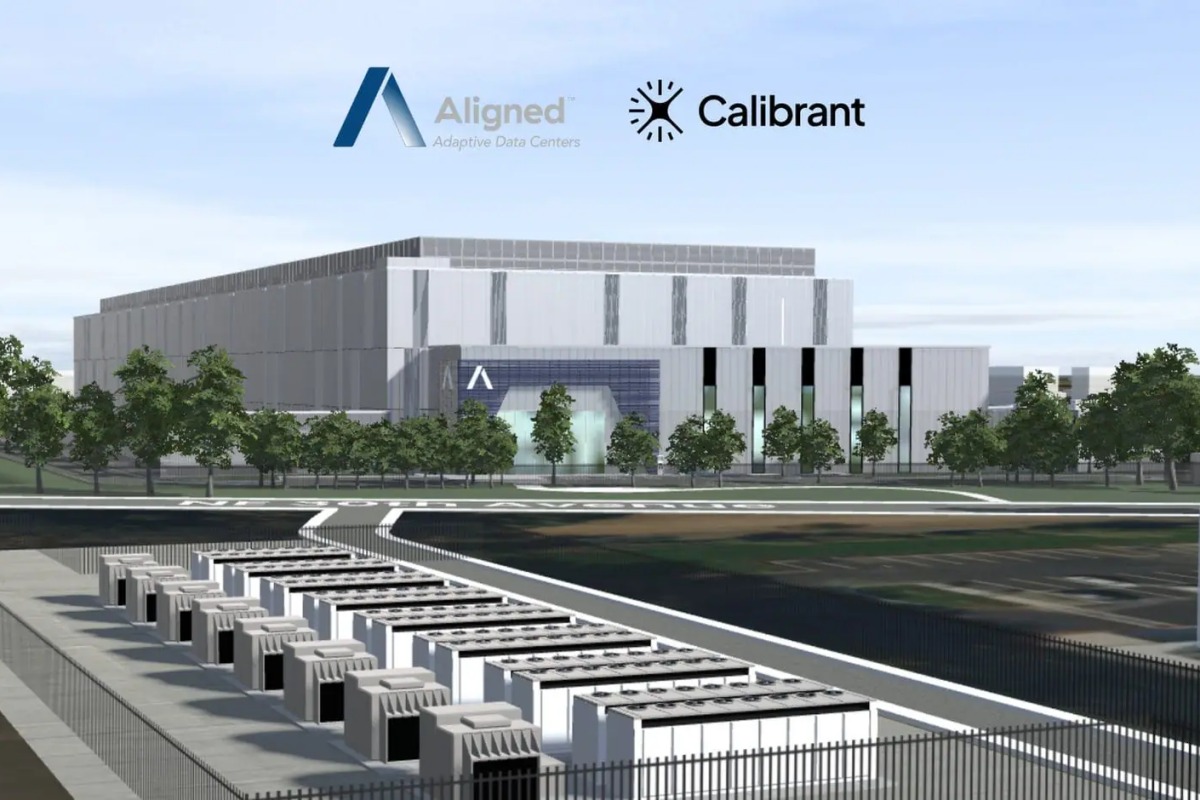
Aligned Data Centers (Aligned), a technology infrastructure company, and Calibrant Energy (Calibrant), a US provider of on-site energy systems, have announced a new energy solution to address an urgent constraint to the data centre industry: access to grid power. The announcement comes as the rapid growth of AI and advanced computing fuels unprecedented power demand, accelerating the need to increase load service and ensure reliable access to grid power. Under the agreement, Calibrant will deliver a 31MW / 62MWh battery energy storage system (BESS) at Aligned’s data centre campus in the Pacific Northwest. The on-site system, planned to be operational in 2026, will enable the facility to come online and scale operations years earlier than would be possible with traditional utility upgrades. Calibrant and Aligned have been partnering with a regional utility in the Pacific Northwest since the start of negotiations to explore flexibility as a means to increase and accelerate interconnection. Phil Martin, CEO at Calibrant, says, “This project flips the script on how data centres access power. “Rather than the false choice between waiting years for system upgrades or having to go off grid entirely, we're working with leading data centre providers like Aligned to use distributed energy solutions to facilitate and accelerate grid interconnection. “This innovative model allows large power users to take control of their energy future while being stewards of their community - ensuring growth objectives are met in a manner that supports grid reliability, has minimal environmental impact, and doesn't burden others with the costs." A US first This will be the first time in the US that a battery system is purpose-built to accelerate interconnection and bring a large-scale data centre online. Developed using Calibrant’s 'Path to Power' solution - a replicable, scalable approach that leverages on-site energy to overcome siting and capacity bottlenecks - the system functions as a grid-responsive asset, designed to discharge during peak demand, bolster grid reliability, and ensure uninterrupted service. Calibrant and Aligned say they prioritised safety and the use of domestically manufactured components for this project, sourcing from suppliers that maintain US-based manufacturing and supply chains. The battery system meets international safety standards by incorporating multiple layers of protection, including safer battery chemistry, built-in fire mitigation measures, and remote 24/7 monitoring. Key equipment, including transformers, switchgear, and batteries, were all manufactured and/or assembled in the United States. Andrew Schaap, CEO at Aligned, comments, “This strategic project redefines how we grow in power-constrained markets. "With this BESS, we’re converting our load from a potential grid liability into a dynamic grid asset, providing the regional utility with the tools needed to accelerate our ramp, and we’re doing it responsibly, without impacting ratepayers. “We're proud to partner with Calibrant on a new market-defining initiative, directly addressing the industry's critical constraint of access to grid power. Their experience in serving large power users and critical facilities was instrumental in our ability to move quickly and efficiently.” Calibrant and Aligned confirmed they are considering similar projects in other markets, signalling a repeatable approach for data centre operators facing interconnection challenges. For more from Aligned, click here.

nLighten reports first ICFEn scores for UK, Germany, Spain
nLighten, a European data centre operator, has announced the first Integrated Carbon-Free Energy (ICFEn) scores for its data centres in the United Kingdom, Germany, and Spain, something the company considers a significant step in how environmental performance is measured within the sector. Developed in collaboration with the Fondazione Eni Enrico Mattei (FEEM), nLighten says the ICFEn framework introduces a more comprehensive approach to sustainability reporting by assessing hourly carbon-free energy matching, heat recovery, and contributions to grid stability. Unlike traditional metrics that rely on annual averages or focus solely on energy consumption, the company notes that ICFEn provides real-time insights into how facilities contribute to decarbonisation through energy reuse and system integration. A new framework for transparent environmental reporting The ICFEn model builds upon the 24/7 Carbon-Free Energy concept by including three key elements: hourly renewable electricity matching, heat recovery, and grid stabilisation. This combined methodology aligns with the EU Energy Efficiency Directive, as well as sustainability standards such as the Greenhouse Gas (GHG) Protocol and the Science Based Targets initiative. Chad McCarthy, Chief Technology Officer at nLighten, comments, “Traditional sustainability metrics have focused on the data centre’s electrical energy profile, but ICFEn integrates the data centre into a community energy system, accounting for both consumption and contribution. "By including heat recovery and real-time renewable energy matching, we’re offering customers and stakeholders unprecedented transparency about our environmental impact, hour by hour, not just as year-end averages.” nLighten’s facilities in the UK, Germany, and Spain achieved good ICFEn scores through renewable power purchase agreements and heat recovery initiatives. Its UK data centres recorded an ICFEn score of 94.61%, higher than the regional carbon-free energy grid average of 56.47%. The company achieves hourly renewable energy matching by integrating renewable assets into its portfolio and aligning their production with operational demand in real time. This aims to ensure that data centres are powered by clean energy when it is actively being consumed. Francesco Marasco, Vice President of Energy Operations and Sustainability at nLighten, adds, “We’re not just measuring renewable energy consumption, but quantifying environmental improvement through sustainable projects, for which we share the calculation method transparently. "The ICFEn methodology allows us to demonstrate measurable, system-wide benefits that lower community emissions. We encourage other operators to adopt this framework, as raising awareness of data centres’ environmental contributions benefits the wider sector.” Encouraging wider adoption nLighten has made the ICFEn methodology publicly available under a Creative Commons licence to encourage industry-wide adoption. The framework’s release coincides with updates to the GHG Protocol, which are expected to introduce hourly-based renewable energy reporting requirements. The company plans to extend ICFEn reporting to all European sites and introduce third-party verification of hourly energy and heat recovery data as part of its next phase of implementation. For more from nLighten, click here.

Data Centre Congress Global returns in 2026
Data Centre Expo Global is set to return to Olympia London on 4–5 February 2026, bringing together global leaders and innovators from across the digital infrastructure ecosystem to explore the future of green data, intelligent investment, and resilient physical infrastructure. Driving sustainable growth through innovation and investment Under this year’s themes of green investment, digital innovation, and physical infrastructure, the programme will spotlight how operators are redefining the foundations of data centres. Expect deep explorations of decarbonisation strategies, circular and modular design, grid integration, advanced cooling, power systems innovation, and sustainable site planning. Sessions will also examine how digital innovation is reshaping infrastructure, from AI-driven operations, automation, and control systems to next-generation materials, software-defined infrastructure, and data centre architectures that flex with demand and resilience requirements. Hyperscale, edge, and ensuring infrastructure resilience On the day two track, speakers will explore how hyperscale and edge infrastructures must evolve to serve a distributed, latency-sensitive, resilient future. Topics include data sovereignty, resilient connectivity, distributed compute, AI orchestration, fault tolerance, and hybrid edge-cloud architectures. The focus will remain squarely on designing systems that sustain performance under evolving stressors and threats. Hear from leading voices in digital infrastructure Attendees will gain first-hand insight from distinguished industry leaders, including: ● Elena Rehman, EMEA Head for Data Center Land Development, Microsoft● Kenneth Dalton, Operations Director, Global Switch● Vladimir Prodanovic, Principal Product Manager, NVIDIA● Susanna Kass, Data Center Advisor (UNSDG-EP)● Wilfried Dudink, Senior Director, Strategy & Development, Digital Realty● Joe Hurman, Principal Consultant, STL Partners● Steve Hone, CEO and co-founder, DCA (Data Centre Alliance)● Venessa Moffat, Advisory Board Member, DCA These experts will share case studies, forecasts, technical deep dives, and actionable guidance to help decision-makers across data centre and infrastructure industries. A hub for cross-domain collaboration Co-located with Cyber Security & Cloud Expo, AI & Big Data Expo, IoT Tech Expo, Digital Transformation Week, Cloud Transformation Conference, Edge Computing Expo and the Intelligent Automation Conference, the Expo will offer delegates exposure to the full spectrum of digital infrastructure trends and challenges. This integrated environment aims to foster "serendipitous connections and cross-industry innovation." Nearly 8,000 attendees, 150 exhibitors, and over 200 speakers are expected to convene in London to chart the course of next-generation infrastructure. To be a part of it, you can review the full agenda, explore the speaker list, or register for a free or 'Gold' pass by visiting the event's website.

Elevate sparks dialogue at DCA Transformation 2025
Elevate – Future Faster, the data centre brand from Excel Networking, was represented by Rebecca Nye at the DCA Data Centre Transformation 2025 event held at IET Birmingham this week. Rebecca joined a distinguished panel to discuss the evolving demands of the data centre sector and the bold questions shaping its future. The panel, hosted by Mark Acton (DCA), featured industry leaders including Jovita Januskeviciute (JLL), Anastasia Wills (NGED), and Dr Sharon Richardson (Hoare Lea). Together, they explored: • The immediate and long-term future of data centres • The impact of AI on power requirements and infrastructure planning • How far ahead we can realistically predict the digital landscape • The role of nuclear power and the need for greater education around the importance of the data centre industry Rebecca highlighted Elevate’s strengths in supporting clients through stock availability, reduced lead times, and just-in-time delivery - all critical factors in helping customers meet project timelines and scale with confidence. Rebecca comments, “Elevate is here to accelerate transformation, challenge convention, and support our customers in navigating the complexities of tomorrow’s data centre environment. “We’re seeing a shift in expectations. It’s not just about capacity anymore; it’s about agility, speed, and foresight. “Elevate is committed to helping our partners stay ahead of the curve. We’re not just imagining the future; we’re building it." Elevate – Future Faster continues to lead the charge in delivering high-density fibre solutions, containment solutions, ducting, and intelligent power distribution, alongside strategic partnerships with global innovators such as nVent, Sunbird, Senko, Schleifenbauer, and more. For more information about Elevate and its mission to bring the future faster, reach out to Rebecca directly on Linkedin, visit Elevate's website, or follow Elevate on LinkedIn. For more from Elevate, click here.

AWS outage sparks call for resilient DC strategies
This Monday’s Amazon Web Services (AWS) outage demonstrates the importance of investing in resilient data centre strategies, according to maintenance specialists Arfon Engineering. The worldwide outage saw millions unable to access popular apps and websites - including Alexa, Snapchat, and Reddit - after a Domain Name System (DNS) error took down the major AWS data centre site in Virginia. With hundreds of platforms down for over eight hours, it was the largest internet disruption since a CrowdStrike update caused a global IT meltdown last year. The financial impact of the crash is expected to reach into the hundreds of billions, while the potential reputational damage could be even more severe in the long run. A preventable disaster Although not caused by a lack of maintenance or physical malfunction of equipment and building services, the consequences of the downtime do reflect an opportunity for operators to adopt predictive maintenance strategies. Alice Oakes, Service and Support Manager at Arfon, comments, “The chaos brought by Monday’s outage shows the sheer damage that can be caused by something as simple servers going down. "While it might’ve been unavoidable, this is certainly not the case for downtime caused by equipment failures and reactive maintenance. “This is where predictive maintenance can make a real difference; it's more resilient, cost-effective, and environmentally responsible than typical reactive or preventative approaches, presenting operators with the chance to stay ahead of potential issues.” Predictive maintenance strategies incorporate condition-based monitoring (CBM), which uses real-time data to assess equipment health and forecast potential failures well in advance. This enables informed and proactive maintenance decisions before the point of downtime, eliminating unnecessary interventions and extending asset life in the process. CBM also reduces the frequency of unnecessary replacements, contributing to lower carbon emissions and reduced energy consumption in a sector under scrutiny for its environmental impact. Alice continues, “This incident is a timely reminder that resilience should be built into every layer of data centre infrastructure, especially the physical equipment powering them. "With billions set to be invested in UK data centres over the coming years, operators have a golden opportunity to future-proof their facilities. “Predictive maintenance should be cornerstone of both new-build and retrofit facilities to adapt to ensure continuity in a sector where downtime simply isn’t an option.”

Kao Data unveils blueprint to accelerate UK AI ambitions
Kao Data, a specialist developer and operator of data centres engineered for AI and advanced computing, has released a strategic report charting a clear path to accelerate the UK's AI ambitions in support of the UK Government's AI Opportunities Action Plan. The report, AI Taking, Not Making, delivers practical recommendations to bridge the gap between government and industry - helping organisations to capitalise on the recent £31 billion in commitments from leading US technology firms including Microsoft, Google, NVIDIA, OpenAI, and CoreWeave, and highlighting key pitfalls which could prevent them from materialising. Drawing on Kao Data's expertise in delivering hyperscale-inspired AI infrastructure, the report identifies three strategic pillars which must be addressed for the UK to secure the much-anticipated economic boost from the Government’s Plan for Change. Key areas include energy pricing and grid modernisation, proposed amendments to the UK’s AI copyright laws, and coordinated investment strategies across the country’s energy and data centre infrastructure systems. "Matt Clifford's AI Opportunities Action Plan has galvanised the industry around a bold vision for Britain's digital future, and the recent investment pledges from global technology leaders signals tremendous confidence in our potential," says Spencer Lamb, MD & CCO of Kao Data. "What's needed now is focused collaboration between industry and government to transform these commitments into world-class infrastructure. Our new report offers a practical roadmap to make this happen - drawing on our experience developing data centres, engineered for AI and advanced computing, and operating those which already power some of the world's most demanding workloads." The new Kao Data report outlines concrete opportunities for partnership across a series of strategic pillars, including integrating data centres into Energy Intensive Industry (EII) frameworks, implementing zonal power pricing near renewable energy generation and accelerating grid modernisation to unlock the projected 10GW AI opportunity by 2030. Additionally, the report proposes new measures to evolve UK AI copyright law with a pragmatic approach that protects creative industries whilst ensuring Britain remains a competitive location for the large-scale AI training deployments essential for attracting frontier AI workloads. Further, the paper shares key considerations to optimise the government's AI Growth Zones (AIGZs), defining benefit structures that create stronger alignment between public infrastructure programmes and the private sector to ensure rapid deployment of sovereign UK AI capacity. "Britain possesses extraordinary advantages, world-leading research institutions, exceptional engineering talent, and now substantial investment to back the country’s AI ambitions," Spencer continues. "By working in partnership with government, we believe we can transform these strengths into the physical infrastructure that will power the next generation of industrial-scale AI innovations and deliver solutions that position the UK at the forefront of the global AI race." To download the full report, click here. For more from Kao Data, click here.

Start Campus, Nscale to deploy NVIDIA Blackwell in the EU
Start Campus, a designer, builder, and operator of sustainable data centres, in partnership with hyperscaler Nscale, has announced one of the European Union’s first deployments of the NVIDIA GB300 NVL72 platform at its SIN01 data centre in Sines, Portugal. The project supports Microsoft’s AI infrastructure strategy and marks a milestone in the development of advanced, sovereign AI capacity within the EU. Nscale, a European-headquartered AI infrastructure company operating globally, selected Start Campus’s site for its strategic location, readiness, and scalability. The first phase of the deployment is scheduled to go live in early 2026 at the SINES Data Campus. High-density power to support next-generation AI The NVIDIA GB300 NVL72 platform is designed for high-performance AI inference and training workloads, supporting larger and more complex model development. Start Campus says the installation will accommodate rack densities exceeding 130 kW, with power and cooling systems engineered to meet the requirements of ultra-dense AI computing. Portugal’s government has welcomed the investment as a key step in strengthening the country’s position in the European digital economy. Castro Almeida, Minister of Economy and Territorial Cohesion, comments, “This investment in Sines confirms international confidence in Portugal as a destination for innovation and technology. It strengthens our position in the global digital economy and supports high-value job creation.” Miguel Pinto Luz, Minister of Infrastructure and Housing, adds, “Start Campus illustrates how digital and infrastructure strategies can align to deliver long-term sustainability. "Sines demonstrates the convergence of the digital transition with Portugal’s geographic advantages - particularly its port, which plays a strategic role in connecting new submarine cables and enabling low-carbon investment.” Recent research by Copenhagen Economics projects that data centre investment could contribute up to €26 billion (£22.6 billion) to Portugal’s GDP by 2030, creating tens of thousands of jobs. Portugal’s location supports strong connectivity through high-capacity subsea cables such as Equiano, 2Africa, and EllaLink, providing low-latency global links. Data from national grid operator Redes Energéticas Nacionais (REN) shows that renewable energy supplied 71% of Portugal’s electricity consumption in 2024, rising to 81% in early 2025. The country’s energy costs also remain below EU and Euro Area averages. The next steps Robert Dunn, CEO of Start Campus, says, “With SIN01 now at full capacity and expanding to meet demand, we have demonstrated that the SINES Data Campus is ready for ultra-dense, next-generation AI workloads. "Partnering with Nscale and NVIDIA on this deployment highlights Portugal’s role as a leader in sustainable AI infrastructure.” The company is also progressing work on its next facility, the 180 MW SIN02 data centre, which will form part of the same campus. Josh Payne, CEO and founder of Nscale, notes, “AI requires an environment that combines scale, resilience, and sustainability. This deployment demonstrates our ability to deliver advanced infrastructure in the European Union while meeting the technical demands of modern workloads. "Partnering with Start Campus allows us to lay the groundwork for the next generation of AI.” Nscale is expanding its European footprint, including building the UK’s largest AI supercomputer with Microsoft at its Loughton campus and partnering with Aker ASA on Stargate Norway - a joint venture linked to multi-billion-euro agreements with Microsoft. For more from Start Campus, click here.


Translate »